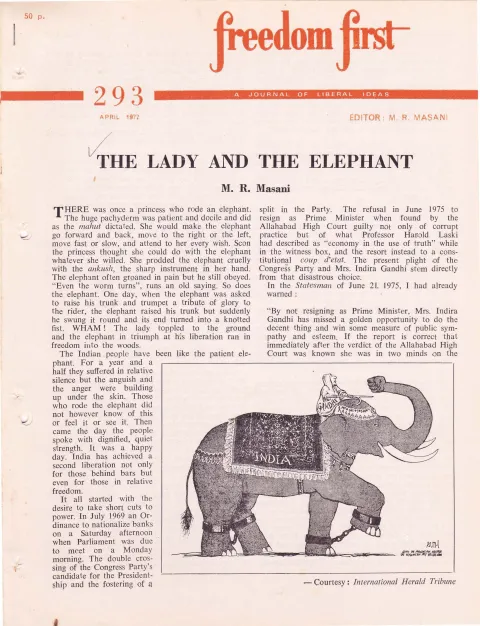
periodical issue
Freedom First
A Journal of Liberal Ideas
By H. M. Patel
Published for the Democratic Research Service by J. R. Patel, Associate Editor, Freedom First at 127, M. Gandhi Rd., Bombay (Phone: 273914) and printed by him at States' People Press, Ghoga Street, Fort, Bombay-400 001. · Bombay · 1978
16 pages
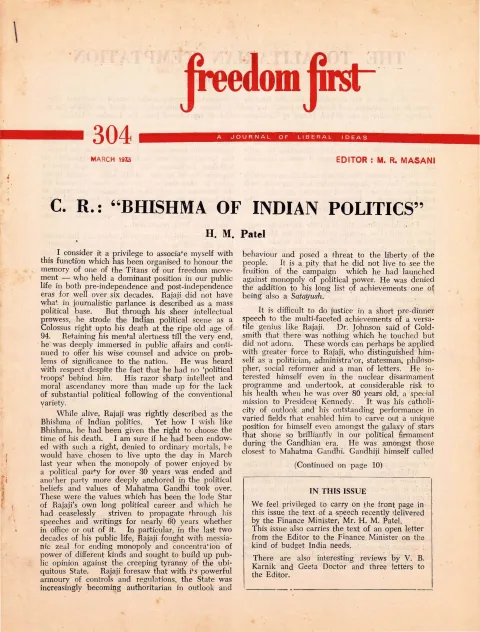
Freedom First
Summary
This is issue 304 (March 1978) of Freedom First, the Bombay monthly journal of liberal ideas edited by M. R. Masani. The front page carries H. M. Patel’s pre-dinner tribute to C. Rajagopalachari (“Rajaji”), delivered at a Rajaji Foundation subscription dinner in Bombay on 22 January 1978, eulogising Rajaji as the “Bhishma of Indian Politics” for his decades-long crusade against monopoly of political and economic power and the “permit-licence-quota Raj”. The issue’s editorial centrepiece is Masani’s own open letter to Finance Minister H. M. Patel ahead of the 1978-79 Union Budget, arguing for drastic cuts in direct and indirect taxation, decontrol, and a German-style (Ludwig Erhard) economic liberalisation. Other contributions include a reprinted British Labour MP’s essay on the “totalitarian temptation” in democracies (Raymond Fletcher), a reprinted address by former British Liberal leader Jo Grimond against bureaucratic strangulation of small business, and a foreign-affairs piece on Egypt’s Africa anxieties by Victor Perry. A substantial wire-service “World News” digest covers Ivory Coast development policy, a Greek virginity-damages court case, Bukovsky’s criticism of Western human-rights policy, exposure of Spanish Communist leader Santiago Carrillo’s Stalinist past, Coca-Cola’s Egypt archaeology sponsorship, Soviet repression of a dissident coal miner, and India’s tacit alignment with the USSR on Diego Garcia. The issue closes with reader letters (on judicial impartiality, industrial terrorism, and a satirical guide for opportunist election candidates), two book reviews (on the Khmer Rouge atrocities and on Cold War intelligence history), and a compilation of quotations (“With Many Voices”).
Key points
-
H. M. Patel’s tribute at the Rajaji Foundation dinner eulogises C. Rajagopalachari as the “Bhishma of Indian Politics”, crediting his weekly Swarajya columns for popularising the case against economic controls and the “permit-licence-quota Raj”.
-
Minoo Masani’s open letter “Set the People Free”, addressed to Finance Minister H. M. Patel ahead of the 1978-79 Budget, urges sharp cuts in direct and indirect taxation and unproductive civil expenditure, citing Wanchoo Committee findings on tax evasion and holding up Ludwig Erhard’s postwar German decontrol as the model.
-
Raymond Fletcher’s reprinted Times essay warns that the “totalitarian temptation” is a standing risk in any democracy regardless of party, citing both Nixon and Indira Gandhi as leaders who succumbed to it.
-
Jo Grimond’s reprinted address to the Association of Independent Business argues unchecked bureaucratic growth and monopoly protection are killing small business in Britain, and that competition rather than central direction keeps business efficient.
-
Victor Perry’s piece traces Sadat’s 1977 peace initiative partly to Egyptian anxiety over Soviet-backed radical expansion in Africa, including Egyptian moves against Libya and support for Zaire’s Mobutu against the Shaba invasion.
-
A World News digest reports Vladimir Bukovsky’s criticism of the West for softening on human rights, an exposé of Spanish Communist leader Santiago Carrillo’s Stalinist past, and Soviet miner Vladimir Klebanov’s psychiatric committal for organising a workers’ protest group.
-
V. B. Karnik reviews Peace With Horror by John Barron and Anthony Paul on the Khmer Rouge’s mass evacuations and killings after 1975, estimated at roughly a million Cambodian deaths, while Geeta Doctor reviews Constantine Fitzgibbon’s Secret Intelligence in the 20th Century.
-
Reader letters criticise Chief Justice M. H. Beg’s public remarks as breaching judicial restraint and condemn ongoing industrial terrorism, while a satirical letter by Sheila Sumant mocks opportunist ticket-seeking politicians.
Essays
C. R.: “Bhishma of Indian Politics”
By H. M. Patel
H. M. Patel’s tribute to C. Rajagopalachari, delivered as a pre-dinner speech at a Rajaji Foundation function in Bombay on 22 January 1978, casts Rajaji as the “Bhishma of Indian Politics” — a colossus without a mass political base who nonetheless dominated Indian public life for over six decades through sheer intellect and moral authority. Patel surveys Rajaji’s roles as politician, administrator, statesman, philosopher, social reformer and man of letters, noting his closeness to Gandhi, his Gandhian-era social work (temple entry for Harijans, khadi promotion, anti-untouchability), his willingness to accept political unpopularity (including over his 1942 partition formula), his tenure as Chief Minister of Madras (1937-39) where he balanced firm policy-making with respect for civil servants, and his post-independence crusade against the “permit-licence-quota Raj” and the “omniscient and omnipotent State.” The speech credits Rajaji’s weekly Swarajya columns with popularising the case against economic controls and licensing, while acknowledging not everyone agreed with the full thrust of his argument. It closes by praising Rajaji as a writer (his Tamil prose and his Tamil renderings of the Ramayana and Mahabharata) and by describing the aims of the Rajaji Foundation in keeping his ideas alive.
- Rajaji is eulogised as the ‘Bhishma of Indian Politics’, a towering figure who held no mass political base but exercised outsized influence through intellect and moral standing until his death at 94.
- He was among the pre-independence Gandhians who brought an ethical approach to politics, working on temple entry, anti-untouchability, khadi, and village industries in Madras through the 1930s despite social ostracism.
- As Chief Minister of Madras (1937-39) he distinguished sharply between policy-making (the politician’s role) and administration (the civil servant’s role), earning the trust of civil servants while retaining full political responsibility.
- In his last two decades he fought ‘with messianic zeal’ against monopoly and concentration of power, terming the regime of economic controls the ‘permit-licence-quota Raj’, and mounted this campaign chiefly through weekly articles in Swarajya.
- He believed controls and licences, even when not intended to build socialism, in practice bred corruption and entrenched a political-economic oligarchy, favouring instead decentralisation of power and a genuine federal system.
- The speech frames Rajaji as blending Upanishadic wisdom with British liberalism, prioritising the individual’s dignity, freedom and self-realisation against the encroaching State.
- Rajaji is also credited as a major Tamil writer, including Tamil versions of the Ramayana and Mahabharata rendered into English, alongside numerous essays and short stories.
- The speech closes urging the Rajaji Foundation to promote systematic study of his ideas so as to help build an India in which people are ‘free, fearless and self-reliant’.
The Totalitarian Temptation
By Raymond Fletcher
An abridged reprint from the London Times of a piece by Raymond Fletcher, a Labour Member of the British House of Commons, warning that the ‘totalitarian temptation’ persists in every democracy regardless of the party in power. Writing in the run-up to an expected British general election, Fletcher argues Callaghan’s Labour government survives less on conviction than on tactical positioning, that Mrs Thatcher’s Conservatives have not yet succeeded in converting a conservative mood into active anger, and that fears of Britain’s trade unions as a revolutionary threat are overblown — union leaders are conventional bargainers, not usurpers. He concludes that the totalitarian threat is not a matter of ‘a list of notorious names’ but a standing temptation available to any government of any political colour, citing both Nixon and Indira Gandhi as leaders who succumbed to it.
- Fletcher reprises his own seven-year-old Encounter analysis that a general election is a ‘rejection’ rather than a genuine choice between programmes.
- He argues Callaghan’s political survival owes to occupying the ‘central position’ Napoleon described as tactically crucial, not to public enthusiasm.
- He is skeptical that Mrs Thatcher’s Conservatives can convert a generally conservative public mood into an active desire to vote out Labour before the likely autumn election.
- He dismisses the idea that British trade union leaders are a revolutionary threat, describing them instead as conventional collective bargainers.
- The totalitarian temptation, Fletcher concludes, ‘is always there, whatever the colour of the government in power’ and ‘exists in all democracies’ — citing Nixon and Mrs [Indira] Gandhi as examples of leaders who yielded to it.
Set the People Free: An Open Letter to the Finance Minister
By Minoo Masani
Minoo Masani’s open letter to Finance Minister H. M. Patel ahead of the 1978-79 Union Budget urges a drastic ‘U Turn’ in fiscal policy: sharp cuts in both direct and indirect tax rates, echoing the plea Nani Palkhivala had repeatedly made in his own annual Budget commentaries. Masani contends that India has stagnated relative to Asian peers (Japan, South Korea, Malaysia, Singapore, Hong Kong, Taiwan) and that punitive taxation has driven both evasion (citing the Wanchoo Committee’s 1972 findings and an estimated Rs 2,800 crore of unreported 1968-69 income) and a collapse in investment and entrepreneurship. He argues for a Laffer-type logic — that lower rates can raise actual revenue, as shown under President Kennedy — paired with drastic cuts in unproductive civil expenditure and an end to the ‘permit-quota-licence-raj’ (a phrase he attributes to Rajaji). He invokes Ludwig Erhard’s postwar German decontrol as the model, argues political democracy needs to be supplemented by ‘economic democracy’ via free markets, and closes by urging Patel to use his position within the Janata coalition government to force through the change.
- Masani calls on Finance Minister H. M. Patel to enact a ‘U Turn’ in tax policy, picking up an appeal Nani Palkhivala had made repeatedly to Patel’s predecessors.
- He argues India has stagnated economically relative to other Asian economies (Japan, South Korea, Malaysia, Singapore, Hong Kong, Taiwan) despite similar starting points, with per capita income actually falling in the last two years.
- High direct tax rates are said to be both oppressive and ‘counter-productive’ — inducing evasion; he cites the Wanchoo Committee’s 1972 report and an estimate that Rs 2,800 crores of 1968-69 income went untaxed.
- He notes excise duties expanded from 15 items in 1951 to 133, now over half of total tax revenue, and argues indirect tax reduction (not increase) is the way to redress the balance, since much of any resulting profit increase returns to government via corporate tax.
- He calls for a corresponding drastic cut in unproductive civil expenditure, criticising a ‘bloated class of under-paid and under-employed clerks and functionaries.’
- He cites Ludwig Erhard’s overnight decontrol of the West German economy (‘the German miracle’) as the model for what India’s Janata Government should do.
- He frames the needed change as extending economic democracy — ‘the ballot of the market place’ exercised daily — to complement political democracy exercised only every five years.
Among Sadat’s Worries
By Victor Perry
Victor Perry’s piece examines an underreported motive behind Sadat’s 1977 peace initiative with Israel: mounting Egyptian anxiety over Soviet-backed radical expansion in Africa. The article traces two years of Egyptian concern as Angola, then Somalia/Ethiopia and Libya-backed threats to Sudan, drew Soviet and Cuban influence closer to the Nile’s headwaters and to the Bab el Mandeb strait, prompting Egypt to court Somalia away from Moscow, mount a border campaign against Libya, and dispatch an air force team to help Zaire’s Mobutu regime repel the Shaba invasion.
- Sadat’s peace initiative with Israel is presented as partly motivated by a desire to free Egyptian military and strategic resources to counter growing Soviet-backed radicalism in Africa.
- Egypt spent arms and aid to woo Somalia away from Moscow and mounted a border campaign against Libya to warn Qadhafi off African adventurism.
- Egypt sent an air force team to help Mobutu’s Zaire fend off the Shaba invasion, seen by Cairo as a threat to the Nile’s sources on Zaire’s border.
- Egypt’s parliament stated in December that infiltration of pro-Soviet forces into Africa threatens security and places a heavy commitment on Egypt.
- Egyptian support for African moderates (Kenya, Zaire) is conditioned, per the article, on those countries’ acceptance of Islamization programs proposed by Qadhafi and the Saudis.
Why Small Business?
By Jo Grimond
A report on a speech by former British Liberal Party leader Jo Grimond to the Association of Independent Business, warning that unchecked growth of bureaucracy in Britain will kill independent business. Grimond attacks a ‘bureaucratic attitude’ that favours monopoly, dislikes competition, and demands centralisation, arguing it has driven postwar Britain’s inflation and unemployment. He sets out three propositions: that competition, not central direction, keeps business efficient; that big business should not be allowed to create monopolies or block new entrants (as nationalised industries do); and that curbing inflation and building a lively economy requires encouraging new and small business. He criticises over-manning as a direct cause of inefficiency and government subsidies as often directing resources to the wrong recipients.
- Grimond argues the postwar ‘bureaucratic attitude’ — demanding subordination to organisations/unions and centralisation — has beggared Britain, driving inflation and unemployment.
- He puts forward three propositions: competition keeps business efficient; big business/monopoly and blocked market entry (as under nationalised industries) should not be allowed; small business should be encouraged to curb inflation and build a lively economy.
- He likens using over-manning to cure unemployment to the Poor Law practice of paying men to dig holes and fill them again.
- Government subsidies, he argues, tend to go to the wrong recipients and redirect resources from more useful investment while requiring bureaucrats to administer them.
World News (Ivory Coast Model; Virginity Valued at £4,660; Bukovsky Critical of West; Carrillo Exposed; Coca-Cola Helps Egypt; Protesting Miner Declared Insane; India Stands With Russia?)
A multi-item ‘World News’ digest of wire and syndicated reports (pages 7-9) covering: Ivory Coast President Houphouet-Boigny’s Yamoussoukro development model and his vision of an ‘urbanized, not urban’ peasantry (Times, Jan 17); a Greek court’s controversial 350,000-drachma damages award for loss of virginity under the Civil Code, criticised by feminists as anachronistic (Times, Jan 21); Vladimir Bukovsky’s criticism of Western nations, including the US, for softening on human rights after an initial Carter push (International Herald Tribune, Dec 21); an exposé of Spanish Communist leader Santiago Carrillo’s Stalinist past based on Jorge Semprun’s memoir, alleging Carrillo was complicit in the 1963 execution of Julian Grimau (International Herald Tribune, Jan 19); Coca-Cola’s agreement to underwrite a Brooklyn Museum archaeological expedition to Theban tombs in Egypt despite an Arab boycott of the company (International Herald Tribune, Nov 21); the arrest and psychiatric committal of Soviet coal-miner-turned-labour-activist Vladimir Klebanov and 37 other worker-signatories protesting corruption and hazardous conditions (International Herald Tribune, Dec 22); and a report that India has quietly signalled support for the Soviet position against US base construction on Diego Garcia ahead of President Carter’s New Delhi visit (Guardian, Dec 29).
- Houphouet-Boigny’s Yamoussoukro project is presented as a model combining private property with village-level collectivism (‘the principle of solidarity and private property’), explicitly distinguished from Marxism.
- A Greek court awarded £4,660 in ‘virginity damages’ to the family of a seduced 16-year-old under a Civil Code provision, prompting protest from Greek jurists and women’s groups as a ‘humiliating anachronism’.
- Vladimir Bukovsky criticised the US and other Western nations for letting human-rights pressure on the USSR lapse after an initial post-Carter push, reportedly due to pressure from France and other groups.
- A best-selling memoir by novelist Jorge Semprun accuses Spanish Communist Party leader Santiago Carrillo of Stalinist ruthlessness, including complicity in the 1963 execution of party rival Julian Grimau.
- Vladimir Klebanov, a Soviet miner who organised a workers’ protest group over corruption and hazardous conditions, was seized and committed to a psychiatric hospital; the piece notes such worker-led dissent is unusual compared to intellectual/scientist-led rights activism.
- Diplomatic sources in New Delhi indicated India’s ‘basic view’ is now aligned with the USSR against continued US construction on Diego Garcia, complicating the ‘genuine non-alignment’ India sought to project ahead of Carter’s visit.
Letters (Political Comments by Judges; Terror at Home; Tips for Aspiring Candidates)
By K. S. Venkateswaran; Col. C. L. Proudfoot (Retd.); [unsigned]
The ‘Letters’ section (pages 12-13) prints three reader contributions. Col. C. L. Proudfoot (Retd.) responds to a prior item on judicial impartiality, warning that industrial terrorism and the state’s failure to protect citizens mock human dignity and erode the economy, and cautions those in power that the electorate is watching and will vote them out. K. S. Venkateswaran writes on ‘Political Comments by Judges,’ criticising Chief Justice M. H. Beg for a public statement seen as breaching judicial restraint, and invokes past observations by former Chief Justice A. N. Ray and the 1958 Law Commission on why judges must not descend into public political controversy. Sheila Sumant contributes a satirical letter, ‘Tips for Aspiring Candidates,’ mock-advising failed ticket-seekers to found their own party, court press attention through lofty statements and slum visits, and negotiate for tickets from whichever party will pay — naming S. K. Patil and Hanumanthaiah as having ‘failed miserably’ at this game.
- K. S. Venkateswaran criticises Chief Justice M. H. Beg’s public remarks on the habeas corpus case as violating the convention of judicial aloofness from political controversy, citing precedent from former Chief Justice A. N. Ray and the 1958 Law Commission.
- Col. C. L. Proudfoot (Retd.) condemns ongoing industrial terrorism and warns that the state’s failure to safeguard citizens erodes both the economy and public trust, cautioning politicians that voters are watching.
- Sheila Sumant’s satirical letter mocks opportunist Indian politicians, offering a mock ‘guide’ to securing a party ticket through manufactured populism and media manipulation, naming S. K. Patil and Hanumanthaiah as having failed at exactly this game.
Reviews: The Horror in Cambodia (Peace With Horror by John Barron and Anthony Paul)
By V. B. Karnik
The ‘Reviews’ section (pages 13-15) carries two book notices. V. B. Karnik reviews ‘Peace With Horror’ by John Barron and Anthony Paul (Hodder and Stoughton), a detailed, refugee-testimony-based account of the Khmer Rouge’s mass evacuations, executions, and disease/starvation deaths following the April 1975 Cambodian communist takeover, estimating roughly a million Cambodian deaths and describing the Angka Loeu’s goal of engineering a ‘disoriented, malleable mass’ from which to build a new society. Geeta Doctor reviews Constantine Fitzgibbon’s ‘Secret Intelligence in the 20th Century’ (Hart Davies MacGibbon), praising its account of Cold War-era espionage, code-breaking (including the Bletchley Park breaking of Enigma, concealed for 35 years until F. W. Winterbotham’s ‘The Ultra Secret’), and the psychological dimension of intelligence work, while pushing back gently on the book’s tendency to divide the world neatly into ‘good guys’ (the West) and ‘bad guys’ (the Russians), which she calls part of a ‘global political paranoia.’
- Karnik’s review of ‘Peace With Horror’ describes the Khmer Rouge’s post-1975 forced evacuation of Cambodian cities, causing mass death by execution, disease, and starvation of an estimated one million people.
- The book is based on refugee testimony collected in Thailand, Paris and Washington and cross-checked by the authors, described by Karnik as skilled, experienced newsgatherers.
- The Communist goal, per an American diplomat quoted in the book, was ‘total social evolution’, destroying the past to construct a ‘disoriented, malleable mass’ from which to build a new Cambodian society under the Angka Loeu (‘Organisation on High’).
- Doctor’s review of Fitzgibbon’s ‘Secret Intelligence in the 20th Century’ highlights its account of the Bletchley Park Enigma code-breaking effort, concealed for 35 years, and the book’s argument that peacetime intelligence work is in some ways more secretive than wartime.
- The review praises Fitzgibbon’s account of the psychological dimension of intelligence and propaganda (e.g. reframing of the Vietnam War, Korea, Hungary, Czechoslovakia as parts of one ongoing ‘intelligence war’), but criticises his rigid division of the world into ‘good guys’ and ‘bad guys’ as a form of ‘global political paranoia’.
Reviews: Very Secret Intelligence (Secret Intelligence in the 20th Century by Constantine Fitzgibbon)
By Geeta Doctor
The closing page (‘With Many Voices’) is a compilation of short quotations drawn from the international and Indian press of December 1977-January 1978, on themes of liberty, hypocrisy, and political posturing, framed by an epigraph from Tennyson. Quoted figures and sources include Harold R. Isaacs on liberated peoples creating new tyrannies, Gavin Young on Mrs Gandhi splitting the Congress, Eric Hoffer on self-forgetting as what man craves most, Lord Hailsham on the ‘hysteria of the race relations industry’, Anwar Sadat comparing himself to a rocket in orbit above dwarf critics, a Liberal MP on turkeys not voting for Christmas, a Rhodesian on Africans being ‘capitalists without capital’, David Steel on seeking new relevance rather than new principles, and William F. Buckley Jr. on Moscow’s marking of Human Rights Day with fresh repression. The page also carries the Freedom First subscription form and the issue’s printer/publisher colophon.
- The page compiles short quotations from world and Indian newspapers (December 1977-January 1978) under the recurring Freedom First feature title ‘With Many Voices’.
- Quotes touch on political hypocrisy and repression: Harold R. Isaacs on ‘liberated’ people creating new tyrannies; Anwar Sadat likening himself to ‘a rocket in orbit’ above his critics; William F. Buckley Jr. on Moscow’s suppression of Human Rights Day dissidents.
- British politics features prominently: Gavin Young on Mrs Gandhi’s example for Congress splits feeding a Janata split; Lord Hailsham on the ‘hysteria of the race relations industry’; David Steel on seeking ‘new relevance’ rather than ‘new principles’ for the Liberal Party.
- The page closes with the Freedom First subscription form (annual subscription Rs. 5.00, care of Democratic Research Service, Bombay) and the issue’s registration/printer colophon.
Generated by the v1.5 extraction pipeline. Awaiting editorial review.
Metadata and summary are AI-extracted from the source PDF and reviewed for editorial accuracy. The original work is available via the Read PDF tab above (where present); paragraph-level citation inside the PDF is deferred to a future engagement.