periodical issue
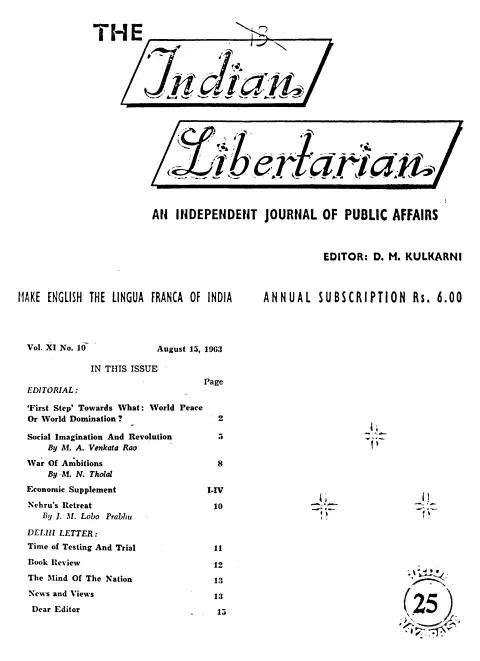
The Indian Libertarian
An Independent Journal of Public Affairs
By MA Venkata Rao, M. N. Tholal
Edited by D. M. Kulkarni, B.A., LL.B., for the Libertarian Publishers Private Ltd., Printed by G. N. Lawande, at States' People Press, Janmabhoomi Bhavan, Ghoga Street, Fort, Bombay-1, and published by him at the office of The Libertarian Publishers (Private) Ltd., First floor, Arya Bhuvan, Sandhurst Road West, Bombay 4. · Bombay · 1963
16 pages
The Indian Libertarian
Summary
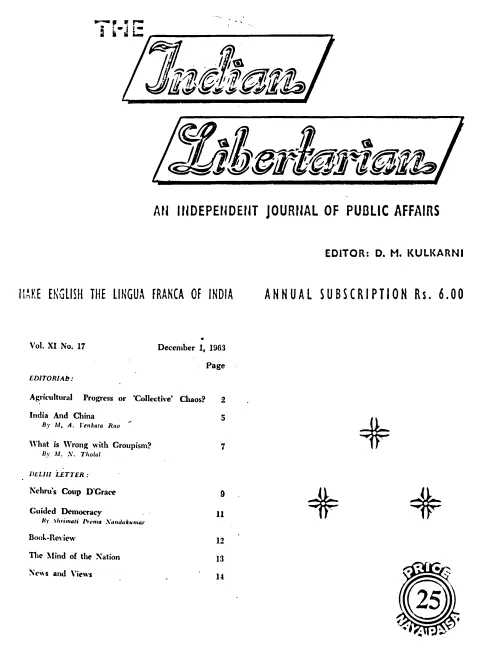
This 1 December 1963 issue of The Indian Libertarian (Vol. XI, No. 17), edited by D. M. Kulkarni for Libertarian Publishers in Bombay, gathers a Bombay-liberal protest against the cooperative-farming turn taken at the Congress’s Nasik session, an alarmed reading of Maoist China’s territorial ambitions in South and South-East Asia, and a polemic on the legitimacy of ideological ‘groupism’ inside the ruling Congress. A Delhi Letter reports on the post-Kamaraj-Plan jostling within the AICC; further columns review Wilhelm Roepke’s defence of the social-market economy, applaud Aligarh University’s switch to English-medium instruction, and round up news on Cold War realignment, India’s foreign-debt burden and Sino-Indian frontier policy.
Key points
-
Editor D. M. Kulkarni’s editorial “Agricultural Progress or ‘Collective’ Chaos?” attacks the Congress’s Nasik-session endorsement of cooperative joint farming as a fresh push toward Soviet-style collectivism, pointing to famines under Stalin, Khrushchev and Mao as warnings.
-
A companion editorial, “Well Done, Aligarh University!”, welcomes the university’s decision to adopt English as its medium of instruction and to broaden governance beyond a closed community.
-
M. A. Venkata Rao’s “India And China” reads Communist China as a permanently unsatisfied nation seeking the wealth of South and South-East Asia, from India and Burma to Indonesia, Korea and Formosa.
-
Venkata Rao interprets the widening Sino-Soviet quarrel as Peking positioning itself as a rival pole of world communism rather than moderating its revolutionary intent.
-
M. N. Tholal’s “What is Wrong with Groupism?” defends factional disagreement inside the ruling Congress as healthy, citing the Gokhale-Tilak division and the 1907 Surat split as productive historical precedent.
-
The “Delhi Letter”, titled “Nehru’s Coup D’ Grace”, reports the AICC’s circulation of a democratic-socialism paper and reads the Kamaraj Plan as an instrument for reshuffling Congress patronage as Indira Gandhi rises to Joint Secretary.
-
Shrimati Prema Nandakumar’s “Guided Democracy” tracks the euphemistic political vocabulary adopted by Sukarno’s Indonesia, Ayub Khan’s Pakistan, Nasser’s Egypt and Ne Win’s Burma to dress up personal rule.
-
Nandakumar warns that any Congress adoption of similar euphemistic phrasing in India would dissolve parliamentary accountability into the discretion of a single charismatic leader.
-
The issue closes with a book review of “Economics of the Free Society”, credited to J. Chamberlain, rounding out its blend of political commentary and economic argument.
Essays
Agricultural Progress or ‘Collective’ Chaos?
Signed by editor D. M. Kulkarni, this editorial attacks the Congress AICC’s renewed embrace of cooperative joint farming following its Nasik session, treating it as a fresh attempt by Nehru and the Planning Commission to push Indian agriculture toward Soviet-style collectivism. It argues that the Land Consolidation, Group Farming and Congress Cooperatives programme will neither raise yields nor protect the peasant, and points to the recurring famines of Stalin’s and Khrushchev’s USSR and Mao’s China as evidence of where ‘collective chaos’ leads. A short companion editorial, ‘Well Done, Aligarh University!’, welcomes the University’s decision to make English its medium of instruction and to open up its governance beyond a closed Muslim community.
- Reads the Congress’s Nasik resolution on cooperative joint farming as a doctrinal capitulation to socialist planners rather than a response to agricultural facts.
- Casts Nehru and Patil’s land-policy turn as continuous with the Stalinist and Khrushchevite collectivisations that produced Soviet famine.
- Contrasts forced cooperatives with peasant proprietorship, which it presents as the only basis for sustained productivity gains.
- Welcomes Aligarh Muslim University’s move to teach in English and to broaden its governance as a liberal reform of a sectarian institution.
India And China
By MA Venkata Rao
M. A. Venkata Rao reads Communist China as a permanently ‘unsatisfied nation’ whose strategic goal is the physical possession of the wealth of South and South-East Asia, from India and Burma through Indonesia and the Philippines to Korea and Formosa, with Japan reduced to a subordinate role inside a Chinese co-prosperity sphere. He uses the widening Sino-Soviet quarrel to argue that Peking is now positioning itself as the rival pole of world communism rather than as Moscow’s junior partner, and warns Indian opinion not to mistake tactical lulls on the frontier for a change of intent.
- Frames China as an ‘unsatisfied nation’ whose ambitions cover the whole of South and South-East Asia.
- Lists India, Malaya, Burma, Thailand, Indonesia, Vietnam, the Philippines, Korea and Formosa as the territorial objects of Chinese expansion.
- Reads the Sino-Soviet split as China bidding for primacy in the communist bloc, not as a softening of its revolutionary line.
- Cautions India against treating frontier quiet as evidence that the Chinese threat has passed.
What is Wrong with Groupism?
By M. N. Tholal
M. N. Tholal mounts a defence of organised factionalism inside Indian political life, arguing that ‘groupism’ is not a pathology but the normal expression of democratic disagreement. He reaches back to the pre-Independence Congress to show that the Liberal-Extremist split between Gokhale and Tilak, and the later differences between Gandhi and his rivals, produced a stronger movement than the artificial unity demanded by post-Independence Congress leaders. The piece treats the campaign against groupism as a thin disguise for personal control of the ruling party.
- Argues that ideological groups inside a ruling party are healthy rather than disloyal.
- Cites the Gokhale-Tilak division and the Surat split of 1907 as a productive episode in Congress history.
- Reads contemporary attacks on ‘groupism’ as cover for centralising authority around individual leaders.
Nehru’s Coup D’ Grace
By From Our Correspondent
The ‘Delhi Letter’ reports on the AICC session at which a ‘democratic socialism’ paper was circulated to affiliated bodies and on the political fallout of the Kamaraj Plan inside Congress. The correspondent traces how state-level leaders, the Working Committee and the central party machinery are using both documents to reshuffle patronage, with Indira Gandhi rising as a Joint Secretary while older ministers manoeuvre for position; the column reads the move as Nehru’s attempt to entrench a chosen line of succession.
- Reports the circulation of an AICC paper on democratic socialism to affiliated bodies.
- Treats the Kamaraj Plan as the chief instrument for reorganising Congress patronage in late 1963.
- Flags Indira Gandhi’s rising organisational role and reads Nehru’s moves as succession management.
Guided Democracy
By Shrimati Prema Nandakumar
Shrimati Prema Nandakumar takes aim at the new political vocabulary—‘Guided Democracy’, ‘National Front’, ‘Basic Democracy’—that authoritarian rulers across Asia and Africa have adopted to dress up personal regimes in democratic costume. She tracks the pattern through Sukarno’s Indonesia, Ayub Khan’s Pakistan, Nasser’s Egypt and Ne Win’s Burma, and warns that Congress flirtation with similar phrasing in India would dissolve parliamentary accountability into a single charismatic leader’s discretion.
- Reads ‘Guided Democracy’ and its cognates as euphemisms invented by post-colonial strongmen for personal rule.
- Surveys Sukarno’s Indonesia, Ayub Khan’s Pakistan, Nasser’s Egypt and Ne Win’s Burma as worked examples.
- Warns that Indian acceptance of the same vocabulary would erode parliamentary accountability.
Book Review: Economics of the Free Society by Wilhelm Roepke
By Reviewed by J. Chamberlain
J. Chamberlain reviews Wilhelm Roepke’s Economics of the Free Society, presenting it as a compact statement of the post-war German liberal case for a competitive market order anchored in firm monetary discipline and a rule-of-law state. The notice underlines Roepke’s links to the Ludwig Erhard reforms behind the West German recovery and recommends the book to Indian readers as a corrective to planning enthusiasm.
- Frames Roepke’s book as the canonical short statement of the ‘social market’ position.
- Connects the argument to Ludwig Erhard’s currency reform and the Wirtschaftswunder.
- Reads the book as a corrective for Indian planning enthusiasm.
The Mind of the Nation
Under the standing rubric ‘The Mind of the Nation’, the issue carries a column titled ‘The Third Alternative’ arguing that India’s task is to build a polity that is neither communist nor a passive imitation of Western capitalism, but is grounded in liberty under law and in voluntary economic cooperation. The piece reads the Cold War’s bipolar framing as a false choice and asks Indian liberals to claim the third position for themselves.
- Names a ‘third alternative’ between Soviet collectivism and undifferentiated Western capitalism.
- Locates that position in liberty under law and voluntary economic cooperation.
- Rejects the Cold War’s bipolar framing as the only available political menu.
News and Views
The ‘News and Views’ digest gathers short items on U.S. space-programme rationale, Mao-aligned organising in Pakistan-occupied Kashmir, a reported troop revolt inside Red China, Chester Bowles on the duty to defend freedom, Aligarh Muslim University’s adoption of English-medium teaching, S. K. Patil’s speech against dictatorial socialism, the Reserve Bank’s new data-collection on bank shares, India’s foreign-debt burden, and token strikes in the Soviet bloc.
- Reports U.S. statements that free-world security underwrites the American space programme.
- Notes Chester Bowles’s call for active defence of freedom against communist pressure.
- Picks up S. K. Patil’s argument that ‘dictatorial’ socialism is incompatible with Indian conditions.
- Flags Aligarh Muslim University’s decision to teach in English and discusses unrest inside the communist bloc.
Generated by the v1.5 extraction pipeline. Awaiting editorial review.
Metadata and summary are AI-extracted from the source PDF and reviewed for editorial accuracy. The original work is available via the Read PDF tab above (where present); paragraph-level citation inside the PDF is deferred to a future engagement.