non liberal
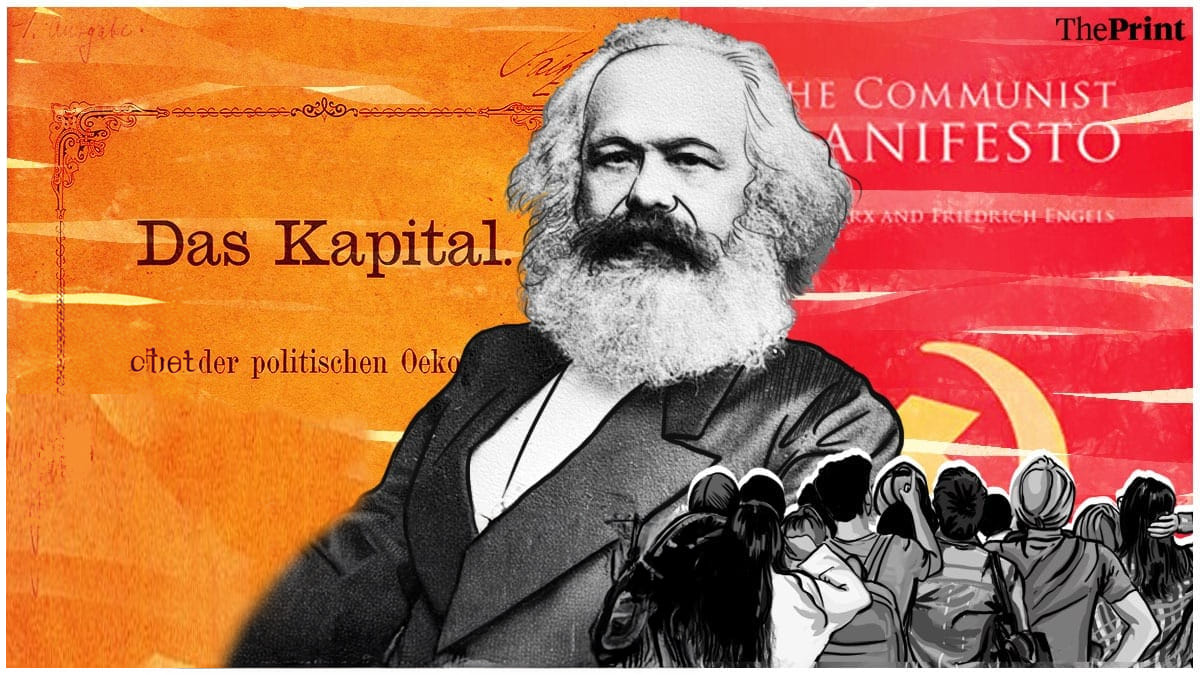
Karl Marx
1818–1883
Also known as: Marx, मार्क्स, कार्ल मार्क्स
How Karl Marx is discussed in this archive
Referenced in 23 other works , including National Priorities for 1970 , IL Explainer - Ep 4 | Socialism Reconsidered by Minoo Masani , and समस्याएँ भारत की .
In IL Explainer - Ep 4 | Socialism Reconsidered by Minoo Masani : Marx is invoked through repeated references to 'Marxist socialism' as the ideological framework whose assumptions Masani is critiquing.
In MUTUAL FUNDS AND OFFSHORE FUNDS IN INDIA : Marx anchors Dave's autobiographical conversion narrative — named as part of the 1950s intellectual diet (Marx, Soviet planning, Mahalanobis model) that he was raised on before turning toward free enterprise.
In समस्याएँ भारत की : Marx appears twice — first as the inheritor of the Marxist analytic tradition Joshi indicts for treating agriculture as subordinate to industry, then as a thinker Joshi defends in his own right against Indian left-wing critics who use Marxist authority to attack Shetkari Sanghatana.
In Industrial Relations : Naval Tata invokes Marx via V.
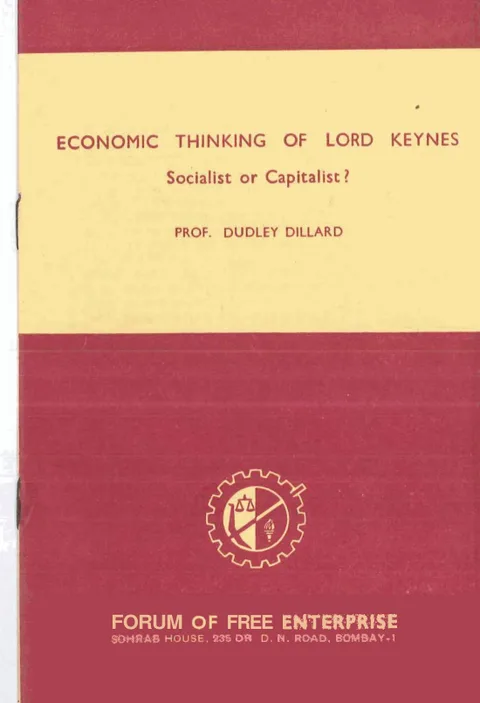
In ECONOMIC THINKING OF LORD KEYNES : Marx is invoked both as part of the classical-economist tradition Dillard uses to contextualise Keynes, and as the target of Keynes's open hostility — Keynes dismissed Capital as 'an obsolete textbook'.
Mentioned in (200)
Primary works (186)
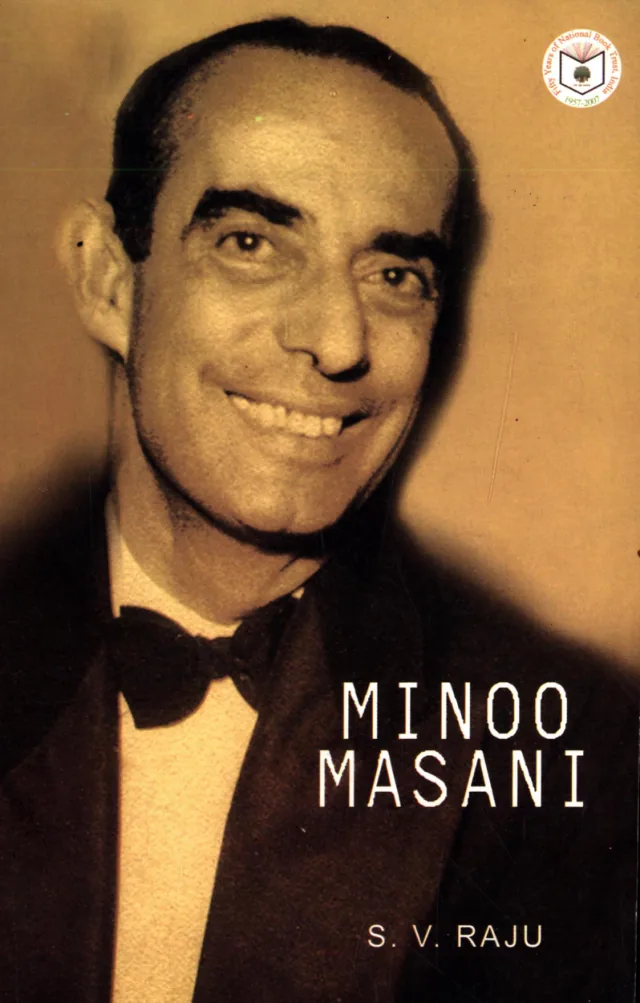
- IL Explainer - Ep 4 | Socialism Reconsidered by Minoo Masani · 2022
- "there were at least four assumptions of Marxist socialism that required reconsideration" · Marxism is the framework whose tenets the essay reconsiders.
- "Now Masani spoke of this assumption in the context of Russia where where despite Marxist socialism, we weren't able to arrive at a classless society." · Marxist socialism named as the doctrine that failed to deliver a classless society in Russia.
Show all 186
- MUTUAL FUNDS AND OFFSHORE FUNDS IN INDIA · 1991
- "Dave was raised on Marx, Soviet planning and the Mahalanobis model, and saw free enterprise as the cause of India's problems rather than the cure" · Marx named as one of the formative influences Dave later repudiated
- समस्याएँ भारत की · 1988
- "the Marxist and mainstream development-economics traditions alike treat agriculture as subordinate to industry, thereby legitimising the continued suppression of farm prices" · Essay 2 indicts the Marxist tradition for the same agrarian extractivism Joshi attacks in mainstream economics
- "Marx himself — who is invoked by the organisation's left-wing detractors — has yet to receive recognition from the Indian establishment for his analysis of exploitation" · Essay 6 turns the tables on Joshi's left-wing critics by claiming Marx's exploitation analysis as more sympathetic to the Shetkari cause than to its detractors
- Industrial Relations · 1979
- "Dr. V. M. Dandekar's critique of the bankmen's strike invoking Karl Marx and social justice" · used to defuse the union charge of anti-labour bias by mobilising socialist authority against strike tactics
- ECONOMIC THINKING OF LORD KEYNES · 1968
- "Dillard situates Keynes alongside Adam Smith, Ricardo, John Stuart Mill, Karl Marx and Alfred Marshall as a classical-rank figure" · Marx placed in the classical tradition from which Keynes emerged
- "Dillard records Keynes' open hostility to Marxism — calling Capital 'an obsolete textbook'" · Keynes's rejection of Marxism as a key strand in Dillard's argument that Keynes was not a socialist
- Congress Misrule and the Swatantra Alternative · 1966
- "Karl Marx is cited—ironically—for the observation that those who own property are free, a point Masani turns against the Congress logic of abolition." · Marx is weaponised against socialist abolition of property via his own dictum on property and freedom
- NATIONALISATION AT THE CROSSROADS · 1962
- "Desai opens by historicising Marx: when Das Capital was written, labour had no right to organise or vote, parliamentary democracy was a fiction, and the welfare state did not yet exist" · Desai frames Marx as a 19th-century thinker whose premises have been overtaken by 20th-century institutional change
- "Historicises Marx by arguing that adult franchise, trade unionism, welfare-state legislation and labour parties winning power at the ballot box have dissolved the 19th-century premise that nationalisation is the only escape from capitalist exploitation." · key-point restatement of the opening Marx-historicisation move
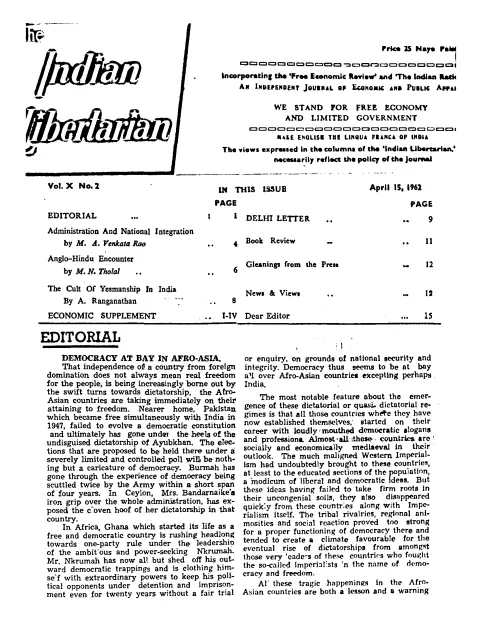
- The Indian Libertarian · 1960
- "S. K. G. Rajan dismisses Marx as an economist but credits him as a social thinker whose writings exposed the misuse of power by capitalists" · Rationalist Supplement aside; splits Marx's economic from his social writings
- ENLIST CO-OPERATION OF PRIVATE ENTERPRISE · 1959
- "The capitalism Karl Marx attacked, on his reading, no longer exists in the older democracies; socialism has receded to the background." · Rama Rau uses Marx's historical critique to defuse contemporary socialist arguments
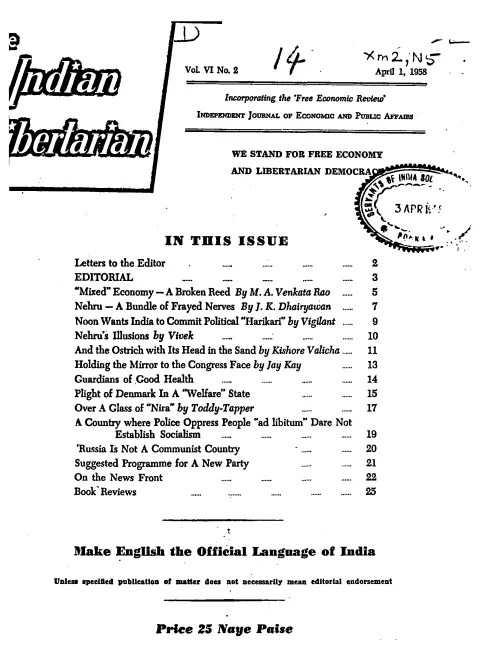
- The Indian Libertarian · 1958
- "invoking Karl Marx as the intellectual father of progressive income taxation and calling it the 'Father of all Taxes'" · Denmark sidebar genealogically traces graduated income tax back to Marx as ideological pedigree-puncturing
- "Progressive income tax is attributed to Marx's Communist Manifesto and criticised as a tool of class warfare rather than equity." · key-points distillation of the anti-Marx sidebar
- LIMITS OF NATIONALISATION · n.d.
- "Marx's thesis of socialising the means of production was a response to nineteenth-century conditions" · sets up the historical-relativist argument Matthai uses to deflate nationalisation's doctrinal warrant
- "He rereads Marx historically — socialisation of the means of production made sense against nineteenth-century despotism and propertied-class capture, but loses its grip in democratically governed states with adult franchise and a sovereign parliament." · key-points restatement; Marx is treated as a thinker whose remedy is bounded by his own century's politics

Opinion pieces (1)
- Encoding Privacy in a Digital World
- "She has been surviving on Amartya Sen, Fukoyama and Karl Marx not only for the sheer joy of critiquing, analyzing and learning their works but to see how economics and developmental policies could work in tandem." · author bio at the end of the essay; Marx listed among the author's formative thinkers

Excerpts (11)
- A Dialogue Between Socrates And Lenin
- "As my master Marx taught, there is but one evil: the exploitation of man by man." · In Seervai's fictional dialogue, Lenin credits Marx's doctrine as the basis for Communist justice theory — used to expose the fallacy of Leninist coercion
- Dangerous Counter Philosophy - Piloo Mody
- "Harold Laski on the other hand, under the lure of Marx and the Soviet revolution, is of the opinion that change is inherently contrary to the nature of a liberal democracy" · Marx's influence on Laski is cited to identify the source of the anti-liberal democratic pessimism Mody is arguing against
- De-Stalinisation Versus Communism
- "Marx's advocacy of violent class struggle translated into the Bolshevik revolution to the dictatorship of the single party in the name of the proletariat." · Marx's theory is traced as the origin point of a causal chain leading inevitably to Stalinist dictatorship
- Democracy Means Bread And Freedom
- "Harold Laski on the other hand, under the lure of Marx and the Soviet revolution, is of the opinion that change is inherently contrary to the nature of liberal democracy" · Marx's influence on Laski's structural pessimism about democracy is identified as the source of the counter-argument Mody must refute
- The Mission of Libertarianism
- "whom Karl Marx called the bourgeoisie) side streams of what may be roughly called “socialist thought” sprung up seeking " · first introduction of Marx as the source of collectivist ideology
- "most successful of these trends was that represented by Karl Marx, partly because he founded the International Working Men’s Movem" · identifies Marx as the dominant socialist thinker whose influence the author contests
- Marx and Theory of Value
- "Marx’s critique of capitalism is based on the idea that there is no harmony of interests as believed by classical economists." · positions Marx as the foundational socialist thinker whose theory is under examination
- "Marx's theory of surplus-value is not the result of unbiased research." · opening claim framing the article's thesis about Marx's method
- National Priorities for 1970
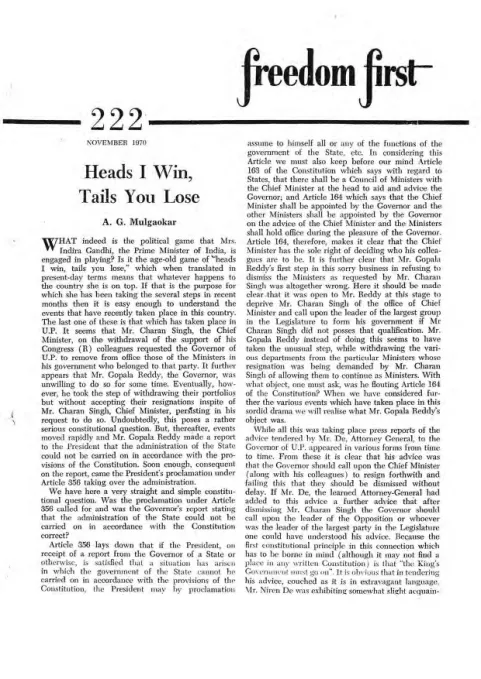
- "It is only through control over one's physical environment that, to some extent, one is able to operate as a free man, as Karl Marx said." · Masani concedes a Marxist premise to invert the conclusion
- "Instead of saying that everyone must therefore have property so that everyone may be free, he came to the conclusion that everyone must be deprived of property!" · Masani's signature inversion of Marx's logic, the property-as-liberty argument
- Socialism or State Capitalism
- "the nature of which has undergone a great change since Karl Marx expounded his theory." · Marx named as the originator of the socialist theory whose practical development the essay analyses
- "Stalin wanted to make dictatorship absolute and totalitarian and, therefore, made State Capitalism the exclusive form of economic development in the USSR" · essay traces how Stalin's state capitalism diverged from Marx's original theory




Show all 11
- THE MISSION OF LIBERTARIANISM
- "While outlining the rise of Karl Marx's labour theory of value, the author revisits theories of labour rooted in individualism." · Marx identified as the intellectual foil against which the essay's libertarian vision is developed
- "The individualist philosophy of John Stuart Mill and his followers which guided liberal democracy is today eclipsed by the communist collectivism of Karl Marx" · Marx's collectivism presented as the dominant force that libertarianism must displace
- The Wisdom of the Rulers
- "today communism has built itself on the theories of Karl Marx" · comparison of communist dogma to Catholic theology, both demanding unquestioning loyalty from their adherents
- "This is the historical and economic determinism of Karl Marx" · summary of Marxist dialectical materialism as the communists' governing philosophy
- To Prosperity through Freedom
- "Karl Marx (the perverse student of Hegel) also had some dim notion of Freedom as the culmination of his communist society" · assessment of Marxist theory of freedom as a dim echo of Hegelian idealism, contrasted with Swatantra's free-market freedom