
periodical issue
Freedom First
The Changing Face of Indian Politics
By Mangesh Kulkarni, Minoo Masani, Sharad Joshi, S. V. Raju
Indian Committee for Cultural Freedom, 3rd floor, Army & Navy Building, 148, Mahatma Gandhi Road, Bombay 400001 · Bombay · 1995
52 pages
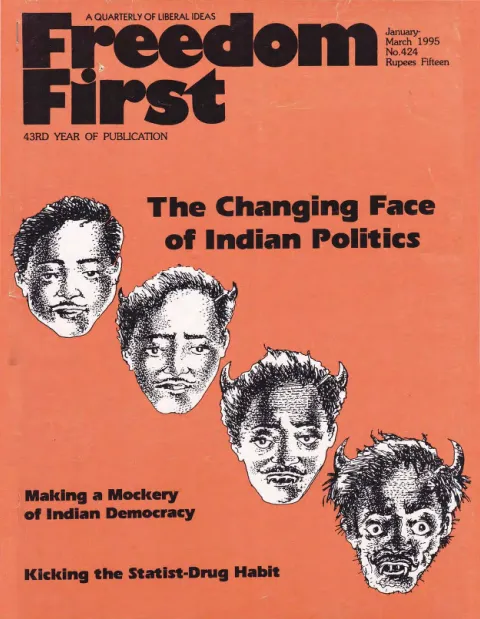
Freedom First
Summary
Freedom First No. 424 (January-March 1995) is a quarterly issue marking the journal’s 43rd year of publication and its return to being published directly by the Indian Committee for Cultural Freedom (ICCF) after the Democratic Research Service, its publisher of 40 years, was required to vacate its Bombay premises. The editorial explains this institutional history and reaffirms the magazine’s founding commitment to an open society, free-market economics, and opposition to both statist economic policy and religious fundamentalism. The issue’s central theme, previewed on the cover as ‘The Changing Face of Indian Politics’, is explored across several essays: S. V. Kogekar traces the decline of the Congress-dominated post-Independence political order into personality-driven, casteist, populist politics; P. R. Dubhashi argues that the pursuit of power in politics need not preclude decency and proposes a code of conduct for parties; Mangesh Kulkarni examines what limits can realistically be placed on politics in a mass democracy, warning against both technocratic and free-market panaceas; and an extract from Minoo Masani’s 1969 Rajaji Birthday Lecture, reprinted for its continuing relevance, diagnoses the decay of Indian public life. The issue closes (within the rendered pages) with Sharad Joshi’s polemical essay likening the transition from a statist to a market economy to drug de-addiction, arguing that half-measures and equivocation will fail.
Key points
-
The editorial marks the journal’s 43rd year and its return to being published directly by the Indian Committee for Cultural Freedom after the Democratic Research Service was required to vacate its Bombay premises, reaffirming Freedom First’s commitment to an open society and free-market economics.
-
S. V. Kogekar’s title essay, “The Changing Face of Indian Politics”, traces the decline of the disciplined post-Independence Congress System into personality-driven, casteist, populist politics under Indira and Rajiv Gandhi, and surveys regional parties, the BJP and the Janata Dal as each lacking a coherent ideology.
-
P. R. Dubhashi’s “The Purpose of Politics” argues the pursuit of power is not inherently wrong if it serves national progress, and calls for a constitutional code of conduct to separate party from government, citing T. N. Seshan’s enforcement of the electoral code as a partial precedent.
-
Mangesh Kulkarni’s “Limits to Politics” surveys custom, theocracy, technocracy and the free market as historical devices for bounding politics, and concludes India lacks the prerequisites for the market alone to do so, proposing instead a welfare-oriented “social market economy” embedded in civil society.
-
A republished extract from Minoo Masani’s 1969 Rajaji Birthday Lecture, “Too Much Politics, Too Little Citizenship”, diagnoses the decay of Indian public life through politicians’ reluctance to accept opposition, the party becoming an end in itself, the cult of personality, and an illiterate electorate.
-
Sharad Joshi’s “Kicking the Statist-Drug Habit” likens the transition from a statist to a market economy to hard-drug de-addiction, insisting it must be total and uncompromising and warning that bureaucrats and crony-capitalists nostalgic for the license-permit-quota raj will sabotage half-hearted reform.
Essays
The Changing Face of Indian Politics
By S. V. Kogekar
S. V. Kogekar surveys the trajectory of Indian politics from the idealistic, self-sacrificing nationalist movement of the pre-Independence period through the Congress Party’s post-1947 dominance (the ‘Congress System’) to its disintegration under Indira Gandhi and Rajiv Gandhi. He argues that both leaders centralised authority, subverted internal party democracy, and replaced ideology with the naked pursuit of power, a shift that produced populism, dynastic succession, criminalisation of politics, and reliance on caste- and community-based vote banks. He then surveys the opposition landscape of the mid-1990s — regional parties built around film-star personalities (Telugu Desam, AIADMK), the Communist Party in West Bengal, the Janata Dal’s collapse after the Mandal agitation, the BJP’s implication in the Babri Masjid demolition and its alliance with the Shiv Sena, and the caste-based Bahujan Samaj Party — concluding that no major party has built itself on a coherent ideology and organisational discipline.
- Pre-Independence politics was marked by self-sacrifice and nationalist conviction rather than personal gain.
- After 1947 the Congress enjoyed a near-monopoly of power for about twenty years under a disciplined, consensus-seeking party structure (the ‘Congress System’).
- Indira Gandhi and Rajiv Gandhi centralised authority, nominated rather than elected functionaries, and personalised power, destabilising the party pyramid.
- Ideology gave way to the pursuit of power itself, producing populist programmes (free electricity, cheap foodgrains) that strain state resources without solving problems.
- Politics is increasingly organised around caste and communal ‘vote banks’, reversing the pre-Independence emphasis on abolishing caste distinctions.
- Criminal elements have entered politics as money and muscle power become an accepted part of electoral strategy.
- Regional parties (Telugu Desam, AIADMK, BSP), the BJP, and the Janata Dal are each surveyed and found to rest on personality, caste, or short-term populism rather than a durable ideology or organisation.
The Purpose of Politics
By P. R. Dubhashi
P. R. Dubhashi, writing as Vice-Chancellor of Goa University, addresses the widespread disenchantment with Indian politics, attributing it to the criminalisation of politics and the loss of ideological commitment among parties since Independence. He argues that the pursuit of power is not inherently wrong provided it serves the progress of the nation, but that Indian parties have reduced ideology to an external facade (citing Indira Gandhi’s ‘Garibi Hatao’, V. P. Singh’s Mandal card, and L. K. Advani’s Mandir Rathyatra as examples of issue-based rather than ideological politics). He calls for a formal code of conduct — maintaining the distinction between party and government, avoiding populist causes that incite disorder, and ensuring merit-based appointments — to be enshrined in the Constitution, crediting Chief Election Commissioner T. N. Seshan’s enforcement of the electoral code of conduct as a partial precedent.
- Disenchantment with politics stems from politicians’ behaviour, not from a change in what politics fundamentally is.
- The pursuit of power in politics is not itself objectionable, provided it serves national progress rather than purely factional interest.
- Ideological coherence among Indian parties has weakened progressively since Independence, especially after the Soviet collapse discredited socialist patterns.
- Parties adopted vote-catching slogans (Garibi Hatao, the Mandal card, Mandir Rathyatra) as substitutes for genuine ideological commitment.
- A constitutional code of conduct is needed to keep party and government separate, curb populism, and restore public faith in politics.
- T. N. Seshan’s enforcement of the electoral code of conduct is cited as a positive but incomplete precedent.
Limits to Politics
By Mangesh Kulkarni
Mangesh Kulkarni, a lecturer in Political Science at SNDT Women’s University, asks whether limits can be placed on politics, taking his title from the Club of Rome’s ‘Limits to Growth’ report. He defines politics broadly as the mediation of conflicting interests through norms, laws, and institutions, and argues that the notion of ridding society of politics entirely is naive: total unanimity or total conflict are the only conditions under which politics becomes redundant, and neither exists in practice (he cites the Rwandan genocide as an example of raw conflict overwhelming political mediation). He surveys historical and contemporary devices for limiting politics — custom in traditional societies, the utopian abolition of politics in Plato and Marx, theocracy (with Iran as a cautionary example and Poland’s Church-led anti-communism as a positive one), technocracy (exemplified by Rajiv Gandhi’s reliance on Sam Pitroda and by Finance Minister Manmohan Singh), and the free market — concluding that India lacks the prerequisites (land reform, literacy, work culture) for a market economy to benefit all, and that a ‘social market economy’ geared to welfare rather than profit, embedded in a vibrant civil society, is the only sound way to bound politics.
- The essay’s title alludes to the Club of Rome’s 1972 ‘Limits to Growth’ report, drawing an analogy between limiting economic growth and limiting politics.
- Politics is defined as the process by which conflicting interests are mediated through norms, laws, and institutions, not merely government activity.
- The desire to eliminate politics entirely is naive; only total consensus or total conflict removes the need for politics, and the Rwandan tragedy shows what happens when conflict outstrips political mediation.
- Plato’s philosopher-guardians and Marx’s vision of communist society are cited as utopian schemes that replace politics with benevolent rule or benign anarchy.
- Theocracy is examined as a limiting device, contrasting Iran’s Islamic regime negatively with the Polish Catholic Church’s role against communism.
- Technocracy, exemplified by Sam Pitroda’s ‘technology missions’ under Rajiv Gandhi and by Finance Minister Manmohan Singh, is criticised because technocrats are not selfless and most political problems resist purely technical solution.
- India lacks prerequisites — land reform, universal literacy, appropriate work culture — for the free market alone to limit politics beneficially; a ‘social market economy’ geared to welfare within a strong civil society is proposed instead.
Too Much Politics, Too Little Citizenship
By M. R. Pai
This is a republished extract from Minoo Masani’s Fourth Rajaji Birthday Lecture, delivered in Bangalore in January 1969 under the auspices of the Gokhale Institute of Public Opinion, and reprinted here (edited to remove some dated references) because the editors judged it as relevant in 1995 as when delivered 25 years earlier. Speaking as a Swatantra Party parliamentarian, Masani laments the declining effectiveness and rising indiscipline of Parliament compared to the pre-Independence Legislative Assembly, and surveys the disintegration of the Congress Party and the short-lived non-Congress ‘United Front’ governments of the period. He identifies four causes of the decay of public life: the reluctance of India’s politicians to accept being in opposition (unlike healthy democracies where a substantial share of politicians are prepared to be out of office); the transformation of the party from a means into an end in itself; the cult of personality over principle; and an illiterate electorate that is difficult to communicate with through normal democratic channels. The extract (marked ‘to be continued’) ends as Masani begins to discuss the strengths and weaknesses of the Indian national character, including ‘lack of courage’ — specifically the absence of a non-conformist conscience — as manifested in indiscipline, unpunctuality, and the failure of institutions such as universities and the judiciary to resist political interference.
- This is a 1969 lecture by Minoo Masani, reprinted in 1995 with light editing because the editors consider its diagnosis of Indian political decay still relevant.
- Masani argues Parliament in 1969 was less effective than the pre-Independence Legislative Assembly and that all parties, including his own Swatantra Party, had lost credibility with the electorate.
- He identifies the reluctance to be in opposition as the first cause of political decay, contrasting India’s near-universal desire for office with healthier democracies where a substantial share of politicians accept opposition.
- A second cause is that the party, meant to be a means to policy ends, has become an end in itself, with office sought for its own sake.
- A third cause is the cult of personality — preoccupation with which individuals hold power rather than with policies or principles.
- A fourth cause is an illiterate electorate that is hard to reach through manifestos, print, or independent broadcast media, all of which were under government control at the time.
- The lecture segues into a discussion of the Indian national character, praising traits like patience and love of family while criticising a lack of the ‘non-conformist conscience’ Gandhi embodied in his willingness to say ‘no’.
- The excerpt ends mid-argument with an explicit editorial note that it is being published in two instalments and the continuation is signalled with ‘(to be continued)’.
Kicking the Statist-Drug Habit
By Sharad Joshi
Sharad Joshi, founder of the Shetkari Sanghatana farmers’ movement and President of the Swatantra Bharat party, argues that the transition from a ‘statist’ to a market-oriented economic system must be total and uncompromising, likening it to hard-drug de-addiction. He dismisses gentler analogies — weaning a baby, unbinding a Chinese woman’s feet, cutting a dog’s tail — as inadequate because the socialist state is not an organic or naturally nurturing relationship but an artificial addiction with no organic basis, comparing the socialist state to the demoness Pootana offering poisoned milk to the infant Krishna. He insists de-addiction requires strict discipline, firm resolve, and total denial of access to the ‘drug’ of state intervention, warning that half-hearted reformers — bureaucrats, crony-capitalists, or governments themselves nostalgic for the old license-permit-quota raj — will doom liberalisation to failure, and that societies long habituated to statism (whether under ‘iron, bamboo or khadi curtains’) suffer particular psychological difficulty adjusting to a free economy.
- Joshi frames economic liberalisation as identical in structure to drug de-addiction: it requires total, unequivocal commitment with no half-measures.
- He rejects gentler comparisons (weaning a baby, Chinese foot-binding reversal, docking a dog’s tail) as failing to capture that the socialist state is an artificial addiction, not an organic relationship.
- The socialist state is likened to the demoness Pootana, who offered poisoned milk to the infant Krishna in Hindu epic, an image of deceptive nurture that is actually lethal.
- De-addiction demands strict discipline, firm resolve, and total denial of access to state intervention, not gradual or soft-hearted treatment.
- Bureaucrats and crony-capitalists who benefited under the old license-permit-quota raj are identified as likely saboteurs of genuine reform.
- Nations under long socialist (‘iron, bamboo or khadi curtain’) regimes face particular psychological difficulty adapting to open markets and international norms.
- The essay closes with the epigrammatic claim that de-statisation is de-addiction because the state itself is the drug.
Generated by the v1.5 extraction pipeline. Awaiting editorial review.
Metadata and summary are AI-extracted from the source PDF and reviewed for editorial accuracy. The original work is available via the Read PDF tab above (where present); paragraph-level citation inside the PDF is deferred to a future engagement.
People in this work
Related across the archive
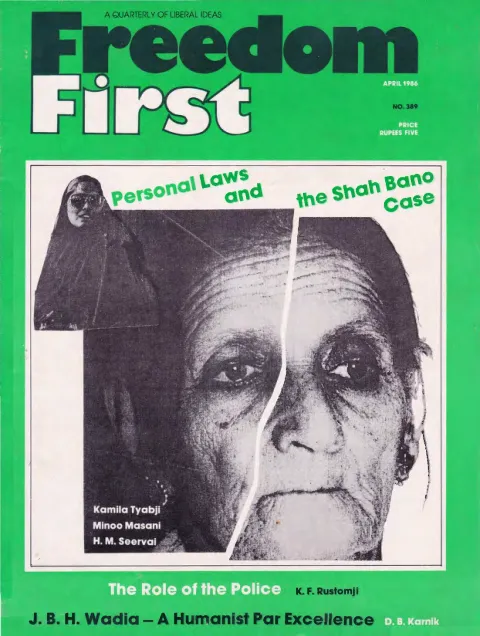 Primary workFreedom First
- Primary work1st Indian Liberals Annual Lecture | The Case for Individual Liberty in India by Ms. Sagarika Ghose
- Primary work2nd Indian Liberals Annual Lecture | The Scope for Political Liberalism in India by Dr. JP Narayan
 ExcerptMinoo Masani on Citizenship
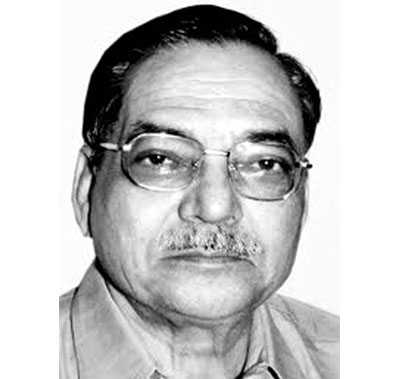 ExcerptSharad Joshi on Liberalism in India