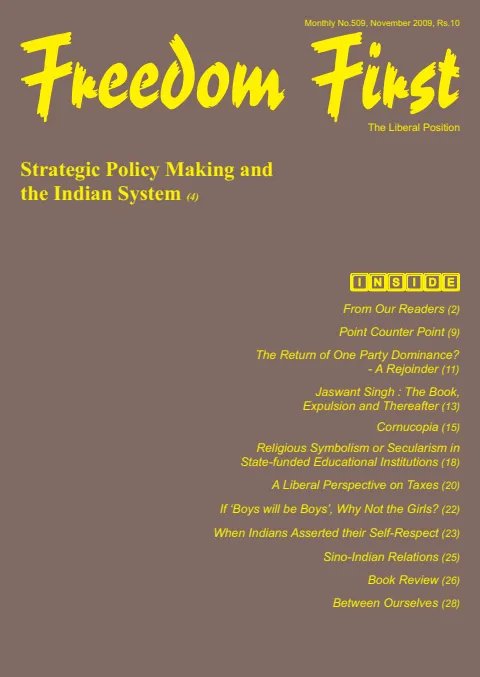
periodical issue
Freedom First
A Liberal Monthly – 56th Year of Publication
By S. V. Raju
Publishers: Indian Committee for Cultural Freedom (ICCF), 3rd Floor, Army & Navy Building, 148, Mahatma Gandhi Road, Mumbai 400 001. Published by J. R. Patel for the Indian Committee for Cultural Freedom (ICCF) and printed by him at Union Press, 13 Homji Street, Fort, Mumbai 400 001. · Mumbai · 2009
44 pages
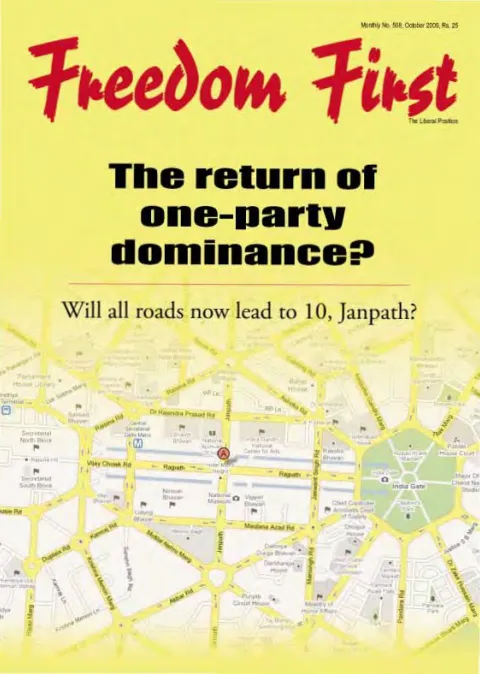
Freedom First
Summary
The rendered pages show the October 2009 issue of Freedom First, a liberal monthly whose cover feature asks whether India is moving back toward one-party dominance. The issue opens with a tribute to A. K. Venkat Subramanian, remembered for public service, electoral reform work, and citizen activism, then turns to an editorial warning that renewed Congress-family dominance, BJP disarray, and the absence of a functioning liberal party could weaken democratic competition.
Key points
-
The cover feature by H. R. Bapu Satyanarayana uses Jaswant Singh’s expulsion from the BJP over his Jinnah book to diagnose broader BJP disarray, arguing the real danger is the erosion of a credible opposition able to check entrenched Congress-family dominance.
-
K. Vedamurthy revisits C. Rajagopalachari’s wartime attempts to negotiate with Jinnah and the Muslim League, arguing Rajaji’s willingness to discuss Pakistan ‘in principle’ was strategic realism rather than surrender, drawing on Hiren Mukherjee, Rajmohan Gandhi, and Sri Aurobindo.
-
Keshav Rau argues the Gujarat ban on Jaswant Singh’s Jinnah book exposes the danger of letting state governments ban books over partisan displeasure, proposing that book-ban powers be transferred to an independent authority appealable to the Supreme Court.
-
Ashok Karnik’s “Point Counter Point” complicates partisan certainty on the reassessment of Jinnah, the RSS’s ability to fix the BJP’s problems, and the enduring lesson of the Kandahar hijacking as a failure of advance crisis planning.
-
P. R. Dubhashi argues Indian higher education has drifted from Nehru’s humanistic ideal toward marketisation and credential competition, supporting expansion while warning that political patronage and fragmented regulation undermine both access and quality.
-
Sanjeev Sabhlok attacks foreign aid from a liberal standpoint, arguing it fuels corruption and dependency rather than removing poverty, and calls for it to be replaced by free trade, scholarships, and support for domestic liberal reformers.
-
Reader letters and the “Many Voices” page cover Shashi Tharoor’s ‘cattle class’ remark, Mumbai voter apathy linked to the loss of local democratic control over civic decisions, and public panic about swine flu.
Essays
Many Voices
The “Many Voices” page collects short quotations from public figures and press reports on punishment, Sino-Indian relations, Jinnah’s political afterlife, book and movie bans, Swiss bank accounts, the RSS, Amitabh Bachchan’s political experience, Shashi Tharoor’s “cattle class” remark, Westminster-style elections, A. Q. Khan, and moral policing in educational institutions. The page functions as a snapshot of current political anxieties and public controversies.
- Quotes criticise impunity, censorship, political opportunism, and public hypocrisy.
- Several items circle around the BJP, Jinnah, the RSS, and party discipline.
- The Tharoor “cattle class” exchange is presented as both a controversy and a clarification.
- The page also flags campus dress codes as a form of social conservatism.
From Our Readers
The rendered “From Our Readers” pages include letters and reader-contributed notes on secular criticism of Hindu practices, Shashi Tharoor’s Twitter controversy, the tone of Firoze Hirjikaka’s column, Mumbai voter apathy, and public panic about swine flu. The Mumbai letter argues that voter apathy is partly a response to decision-making moving from elected municipal bodies to state-level authorities and agencies, leaving citizens alienated from urban governance.
- Readers debate religious criticism, gendered language, and the line between humour and public offence.
- A letter on Mumbai voter apathy links low turnout to loss of local democratic control over roads and transport.
- A swine-flu note argues that media hysteria and mask panic exceed the actual risk.
- The page treats public participation and informed citizenship as practical liberal concerns.
The Return of One-Party Dominance: The Great Danger
By H. R. Bapu Satyanarayana
H. R. Bapu Satyanarayana uses Jaswant Singh’s expulsion from the BJP after his book on Jinnah as a way to diagnose BJP disarray and the weakness of opposition politics. The essay argues that the danger is not the personal fate of Advani, Rajnath Singh, or Jaswant Singh, but the effect of BJP implosion on India’s ability to check Congress dominance.
- Jaswant Singh’s expulsion is presented as a symptom of ego, factionalism, and intolerance inside the BJP.
- The essay argues that Congress has entrenched dynastic politics through the Gandhi family’s symbolic capture of institutions and schemes.
- Rahul Gandhi is treated ambivalently: sincere in some criticisms, yet structurally advantaged by lineage.
- The author wants a chastened and reformed BJP chiefly because democracy needs a credible opposition.
Rajaji, Jinnah and Pakistan
By K. Vedamurthy
K. Vedamurthy revisits C. Rajagopalachari’s attempts to negotiate with Jinnah and the Muslim League during the Second World War. The essay argues that Rajaji’s willingness to discuss Pakistan “in principle” was not surrender but strategic realism, rooted in his sense that wartime conditions and Muslim political sentiment required a negotiated settlement before Partition hardened into catastrophe.
- The essay links the Jaswant Singh controversy to older disputes over Jinnah’s responsibility and Rajaji’s wartime position.
- Rajaji is portrayed as foresighted, unpopular, and willing to lose friendships for a settlement he believed necessary.
- Vedamurthy cites Hiren Mukherjee, Rajmohan Gandhi, C. R. Narasimhan, Sri Aurobindo, and V. Shankar to reconstruct the debate.
- The closing irony is that Muslims remained the largest minority in secular India even after Partition.
Banning Books: Time to Impose Curbs
By Keshav Rau
Keshav Rau argues that the Gujarat ban on Jaswant Singh’s Jinnah book exposes the danger of letting state governments ban books because a political party’s beliefs are offended. He distinguishes arguable grounds for restriction, such as security or law-and-order risk, from partisan displeasure, and proposes that book-ban powers be withdrawn from state governments and placed with an independent authority whose decisions can be appealed to the Supreme Court.
- The article treats the book ban as a free-expression issue beyond BJP internal discipline.
- Rau contrasts bans on Lady Chatterley’s Lover, The Satanic Verses, and James Laine’s Shivaji book with the Jaswant Singh ban.
- The Gujarat ban is criticised as lacking “application of mind” and as confusing party belief with state authority.
- The attached Banned Books Week note broadens the argument into access to ideas and intellectual freedom.
Point Counter Point
By Ashok Karnik
Ashok Karnik’s “Point Counter Point” sets opposing arguments side by side on three controversies: Jinnah’s reassessment, RSS influence over the BJP, and the Kandahar hijacking. The column’s method is to complicate partisan certainty: it questions selective praise of Jinnah, says the RSS cannot simply fix the BJP’s political problems, and argues that the enduring lesson of Kandahar is the need for advance crisis planning rather than retrospective blame.
- The Jinnah section warns against judging political figures by isolated episodes rather than the whole record.
- The RSS-BJP section distinguishes advice from organisational control and says the BJP must recover on its own or sink.
- The Kandahar section describes the hijacking decision as an all-party failure under public pressure.
- The page below the column reprints the Joshua Bell metro-station anecdote about perception and missed beauty.
Issues of Higher Education in India
By P. R. Dubhashi
P. R. Dubhashi argues that higher education in India has been pulled away from liberal and humanistic ideals toward marketisation, credential competition, and narrow employment signalling. He supports expansion of institutions and recognises the need for private and foreign participation, but warns that political patronage, high fees, weak quality, poor governance, and fragmented regulation undermine both access and standards.
- The essay contrasts Nehru’s humanistic ideal of the university with market-driven education as a commodity.
- Dubhashi worries that students chase remunerative courses while basic sciences, literature, philosophy, and history decline.
- He supports institutional expansion but warns that coaching culture and credential competition erode learning.
- Private institutions are criticised for political concessions, high fees, poor standards, and donation-based access.
- The essay calls for less politicised university governance and a single regulatory authority for higher education.
Come On, Liberals: Let’s Change India! Banishing the Concept of Foreign Aid
By Sanjeev Sabhlok
Sanjeev Sabhlok’s essay attacks foreign aid from a liberal standpoint, arguing that a free society depends on exchange, self-respect, and voluntary cooperation rather than dependency. He contends that foreign aid fails to remove poverty, fuels corruption and authoritarianism, protects international bureaucracies, and should be replaced by free trade, liberal education, policy partnerships, scholarships, and support for domestic liberal reformers.
- Sabhlok argues that aid violates dignity when imposed without consent and humiliates recipients while flattering donors.
- He rejects the idea that poverty is caused by a shortage of aid, instead blaming anti-market and socialist policies.
- Aid is described as fungible money that can support dictators, guns, corruption, and international bureaucracies.
- The essay recommends teaching freedom through local reformers, scholarships, policy partnerships, and open trade.
- A boxed Swatantra Party manifesto excerpt opposes huge foreign debts while supporting foreign capital in private enterprise.
Generated by the v1.5 extraction pipeline. Awaiting editorial review.
Metadata and summary are AI-extracted from the source PDF and reviewed for editorial accuracy. The original work is available via the Read PDF tab above (where present); paragraph-level citation inside the PDF is deferred to a future engagement.