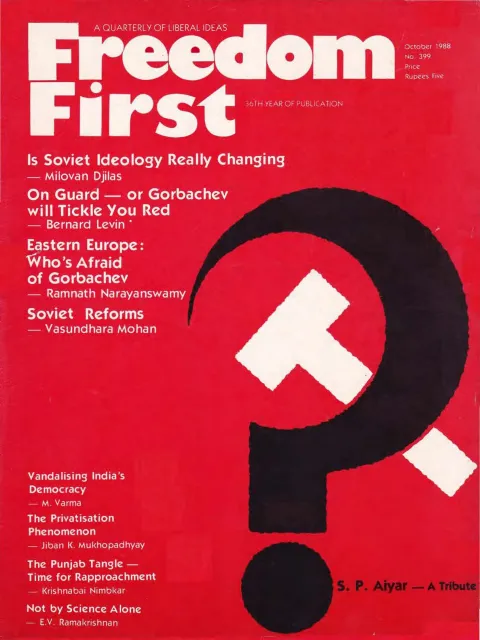
periodical issue
Freedom First
A Quarterly of Liberal Ideas
Published by J.R. Patel for the Democratic Research Service and printed by him at Parsiana Publications Pvt. Ltd., 300 Perin Nariman Street, Bombay 400 001 · Bombay · 1992
56 pages
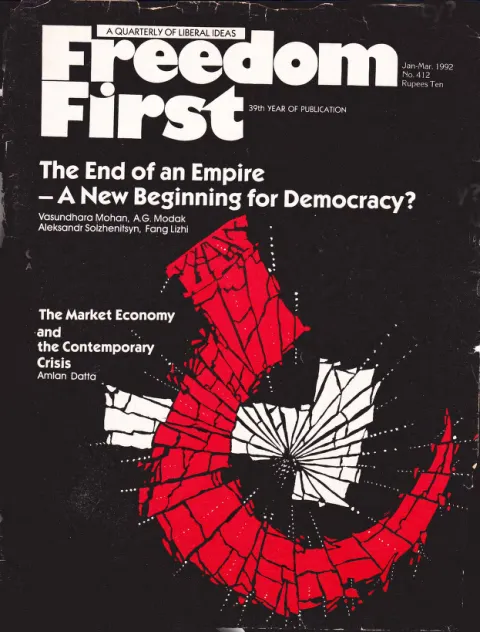
Freedom First
Summary
Freedom First No. 412 (January–March 1992), the Bombay-published quarterly of the Democratic Research Service, is dedicated to Mikhail Gorbachev in the aftermath of the Soviet Union’s dissolution. The issue’s cover package, ‘The End of an Empire — A New Beginning for Democracy?’, gathers four pieces on the August 1991 Moscow coup and its aftermath: Vasundhara Mohan’s ‘The Coup in the USSR’ traces Gorbachev’s reform record and the conservative backlash that produced the putsch; A.G. Modak’s ‘Why the Coup Failed?’ argues the plotters invoked a Union that had already lost its ideological and national legitimacy; Aleksandr Solzhenitsyn’s ‘Can Democracy Grow in Russia?’ (adapted from his pre-coup pamphlet Rebuilding Russia) cautions that durable Russian democracy must be built bottom-up from local self-government rather than proclaimed wholesale from above; and Fang Lizhi’s ‘The Unfinished Revolution — China’s Time Will Come’ extends the argument to China, insisting that modernization is impossible without democratization and that Tiananmen was only ‘the tip of the iceberg.’ Shorter regular features in the rendered pages include the editorial ‘Between Ourselves,’ a page of quoted press clippings (‘With Many Voices’), a column on forced blood donation by Tibetan prisoners in Chinese custody (‘Of Cabbages and Kings’), a historical sidebar on Lenin’s 1917 coup, a boxed poem on Gorbachev by Louella Lobo Prabhu, a short obituary-styled essay ‘Soviet Communism (1917–1991)’ by Robert Conquest, and a boxed excerpt from Leszek Kolakowski on the limits of denationalization. The table of contents shows the issue continuing past what was rendered here into ‘The Masani Viewpoint,’ Amlan Datta’s Rajaji Birthday Lecture on ‘The Market Economy and the Contemporary Crisis,’ a Burma piece by Aung San Suu Kyi, an agriculture symposium, a debate section, and a book review — none of which were seen in these pages.
Key points
-
Vasundhara Mohan’s “The Coup in the USSR” traces Gorbachev’s reform record from 1985, credits the repeal of Article 6 as “the last straw” provoking hardliners, and recounts the failed August 1991 coup and Yeltsin’s rise.
-
A.G. Modak’s “Why the Coup Failed?” identifies four causes of Soviet communism’s collapse — dogmatism, statism, exposure to “the truth about the West,” and the exhaustion of militant materialist philosophy.
-
Aleksandr Solzhenitsyn’s “Can Democracy Grow in Russia?” cautions that durable Russian democracy must be built bottom-up from local self-government, citing Karl Popper’s view that democracy is chosen to avoid tyranny rather than for its virtues.
-
Fang Lizhi’s “The Unfinished Revolution — China’s Time Will Come” insists modernisation is impossible without democratisation, citing at least 876 Chinese labour camps and calling Tiananmen only “the tip of the iceberg.”
-
A boxed commentary by Leszek Kolakowski cautions that denationalisation need not mean total privatisation and that market forces alone cannot resolve every social conflict.
-
The issue is dedicated to Mikhail Gorbachev and carries a column on forced blood donation by Tibetan prisoners in Chinese custody and a short obituary-styled essay, “Soviet Communism (1917–1991),” by Robert Conquest.
Essays
The Coup in the USSR
By Vasundhara Mohan
Vasundhara Mohan surveys Gorbachev’s rise and reform agenda from 1985 and the mounting conservative resentment inside the CPSU that culminated in the August 1991 coup. She credits Gorbachev’s ‘consensus building’ style — arms control, troop withdrawals from Afghanistan and Eastern Europe, glasnost’s press liberalisation, and the repeal of Article 6 of the USSR Constitution ending the Party’s constitutional monopoly — while showing how each concession alienated hardliners in the Party apparatus, the KGB and the armed forces. The essay closes (across the rendered pages) with the coup itself: the plotters’ poor planning, Yeltsin’s public defiance, and Gorbachev’s return to office, though weakened relative to Yeltsin.
- Gorbachev became CPSU General Secretary in March 1985 as the youngest leader since Stalin, pursuing glasnost and perestroika.
- His foreign policy (INF Treaty, withdrawal from Afghanistan/Czechoslovakia/Hungary) was initially dismissed by both Western leaders and Soviet citizens as propaganda.
- Domestic reforms — replacing septuagenarian leaders, releasing political prisoners, loosening press control and emigration law — provoked conservative fear.
- The repeal of Article 6 (ending the CPSU’s special constitutional privileges) is described as ‘the last straw’ forcing Party conservatives to act.
- The August 1991 coup, led by Gennady Yenayev, failed due to poor coordination and Yeltsin’s success in rallying public resistance.
- Gorbachev was restored to the presidency but emerged diminished relative to Yeltsin’s new popularity.
Why the Coup Failed?
By A.G. Modak
A.G. Modak, Reader in the Centre for Soviet Studies at Bombay University, dissects why the August 1991 coup collapsed and offers a four-cause analysis of Soviet communism’s broader decline: dogmatism (tracing intellectual repression from Lenin through Stalin), statism (the USSR’s over-reliance on centralized state power to catch up with capitalism), ‘the truth about the West’ (the puncturing of decades of Soviet propaganda contrasting capitalist exploitation with socialist justice), and ‘militant materialism’ (the exhaustion of Marxist-Leninist philosophy itself, including a swipe at communist intellectual Roger Garaudy). He concludes the coup failed because the plotters, modeling themselves on Brezhnev’s ouster of Khrushchev, misjudged both Gorbachev’s remaining public standing and the Russian people’s unwillingness to return to Stalinism.
- Yenayev’s conspirators modeled their coup on Leonid Brezhnev’s 1964 ouster of Khrushchev but misjudged public mood.
- Modak identifies four causes for the USSR’s collapse: dogmatism, statism, exposure to the economic truth about Western capitalism, and the exhaustion of militant materialist philosophy.
- Lenin, not just Stalin, is now held responsible for Soviet dogmatism and the persecution of ‘reformist’ intellectuals.
- Soviet propaganda had contrasted a supposedly exploitative capitalist state with a just socialist one, but by 1991 citizens recognized this dichotomy as false.
- The coup’s failure is presented as also unintentionally dismantling ‘the whole legacy of the October revolution of 1917.‘
Can Democracy Grow in Russia?
By Aleksandr Solzhenitsyn
Aleksandr Solzhenitsyn, in an excerpt adapted from his pamphlet Rebuilding Russia (written before the coup and published by Farrar, Straus & Giroux), argues that genuine Russian democracy cannot be proclaimed ‘thunderously from above’ but must grow from the bottom up — starting with local self-government in small towns, settlements and districts where voters can know their candidates directly. He warns against the excesses of universal-suffrage electoral theater, invokes Karl Popper’s view that democracy is chosen not for its virtues but to avoid tyranny, and cites Vasily Maklakov’s 1917-era warning that democracy requires a disciplined populace Russia lacked then and lacks even more now. The rendered excerpt ends with a Freedom First-sourced boxed rebuttal/commentary from Leszek Kolakowski on the pitfalls of denationalization and market reform.
- Solzhenitsyn insists 1917’s chaos must not be repeated by rushing into ‘a marvelous constitution’ or trusting ‘breathless orators.’
- He argues real democracy must be built from the bottom up: villages, settlements (poselki), and districts (uyezd, rayon), not proclaimed as a finished system from the center.
- Cites Karl Popper: democracy is chosen not because it ‘abounds in virtues’ but to avoid tyranny.
- Cites Vasily Maklakov, a Constitutional Democrat leader, on democracy requiring political discipline that Russia lacked in 1917 and lacks even more today.
- Critiques mass electoral campaigns for degrading political thought and rewarding demagogues over statesmen.
- A boxed commentary by Leszek Kolakowski (not part of Solzhenitsyn’s own text) argues denationalization need not mean total privatization and that market forces alone cannot resolve every social conflict.
The Unfinished Revolution - China’s Time Will Come
By Fang Lizhi
Fang Lizhi, the Chinese astrophysicist and pro-democracy dissident who took refuge in the American Embassy in Beijing after Tiananmen, argues in this reprint from The Journal of Democracy (Summer 1991) that China cannot achieve genuine modernization without democratization. He rejects the claim that economic development can proceed without political reform, pointing to repeated failures of Chinese modernization efforts (including the post-1987 stalling of 1980s economic reforms) as evidence that authoritarian rule itself is the obstacle. He cites documented abuses — at least 876 labour camps, an estimated 10 percent political-prisoner rate among inmates, and continued trials of Tiananmen-era student demonstrators exploiting Gulf War distraction — and predicts with confidence that China will eventually move toward democracy as part of a worldwide historical trend, comparing his own hopeful role to that of a fellow dissident scientist.
- Fang argues democratization is a precondition for genuine modernization, not a luxury to be deferred for economic development.
- China’s 1980s economic reform enjoyed early success but began sliding toward failure after 1987, evidence (he argues) that political reform cannot be separated from economic reform.
- Cites documentation of at least 876 labour camps in China and an estimated 10% political-prisoner rate among inmates.
- Notes the Chinese government used the Gulf War as a distraction to intensify repression and resume trials of Tiananmen-era student demonstrators.
- Frames the Tiananmen massacre as only ‘the tip of the iceberg’ of China’s human rights record.
- Predicts with confidence, based on worldwide historical trends (Eastern Europe, USSR, inter-Korean dialogue), that China will eventually democratize despite the setback of Tiananmen.
- The piece carries an editorial note identifying Fang as having been called ‘China’s Andrei Sakharov.’
Generated by the v1.5 extraction pipeline. Awaiting editorial review.
Metadata and summary are AI-extracted from the source PDF and reviewed for editorial accuracy. The original work is available via the Read PDF tab above (where present); paragraph-level citation inside the PDF is deferred to a future engagement.