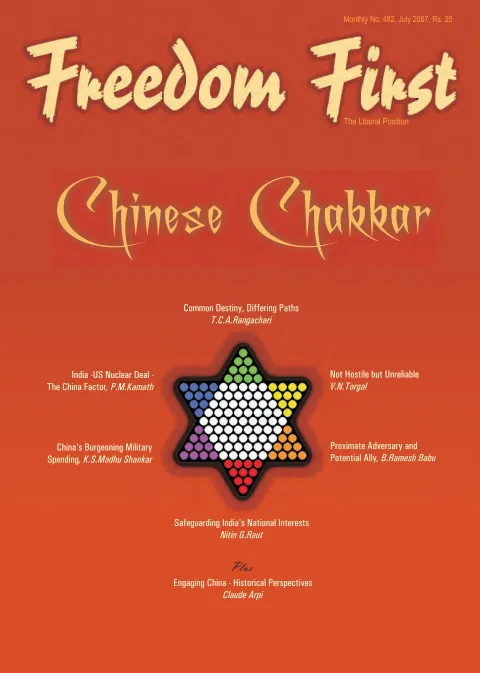
periodical issue
Freedom First
India's Foreign Policy – The Makeover from Ideology to National Self-interest
Published by J. R. Patel for the Indian Committee for Cultural Freedom (ICCF), 3rd Floor, Army & Navy Building, 148, Mahatma Gandhi Road, Mumbai 400 001 · Mumbai · 2006
52 pages
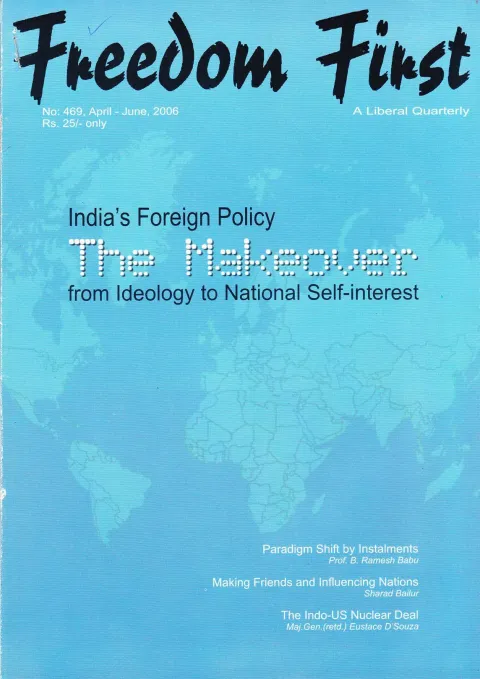
Freedom First
Summary
Freedom First No. 469 (April–June 2006), the 54th year of publication, is a quarterly issue of the liberal magazine built around a cover feature on India’s foreign policy titled “The Makeover from Ideology to National Self-Interest.” Three contributors — B. Ramesh Babu, Sharad Bailur, and Maj. Gen. (retd.) Eustace D’Souza — trace India’s drift from Nehruvian non-alignment toward a realist, US-friendly, interest-based diplomacy, with the pending Indo-US civil nuclear deal as the central test case. The issue also carries Firoze Hirjikaka’s polemic against the health of Indian democracy, the opening of A. Vaidyanathan’s concluding Ambirajan Memorial Lecture instalment on politics and economic development, editorial notes (“Between Ourselves”), a miscellany column (“With Many Voices” and “Of Cabbages and Kings”), a tribute to the late H. D. Shourie of Common Cause, and shorter items on the Jessica Lal case and internet censorship in China. In the rendered pages the volume’s argumentative center is the reassessment of India’s post-Cold War foreign policy realignment, paired with domestic anxieties about the quality of Indian democratic institutions.
Key points
-
Freedom First No. 469 (April-June 2006) devotes its cover feature, “The Makeover from Ideology to National Self-Interest,” to India’s foreign-policy shift from Nehruvian non-alignment toward realist, US-friendly diplomacy, centred on the pending Indo-US civil nuclear deal.
-
B. Ramesh Babu traces the paradigm shift from Indira Gandhi’s post-Emergency de-control policy through the 1991 crisis to the BJP-led NDA’s courtship of Washington after Pokhran-II, while warning India has lost moral standing as a spokesman for the developing world.
-
Sharad Bailur, via a Cold War counterfactual, argues economic strength rather than military power decided global bipolarity’s end, and warns the US pursues a “two-track” policy capping India’s nuclear capacity while cultivating friendliness.
-
Maj. Gen. Eustace D’Souza frames the nuclear deal as a choice between a constraining “trick” and a beneficial “treat,” arguing the NPT’s structure inherently discriminates against India and urging India accept fuel supply while resisting any security-compromising conditions.
-
Firoze Hirjikaka’s polemic asks whether India is a genuine democracy, applying Lincoln’s Gettysburg definition to argue Indian legislators are unrepresentative and voters complicit through venality and apathy.
-
A. Vaidyanathan’s concluding Ambirajan Memorial Lecture instalment credits democratic competition with forcing anti-poverty spending for scheduled castes and tribes, while criticising proliferating, unverified, centrally imposed schemes that leave panchayats with no real accountability role.
Essays
Many Voices
B. Ramesh Babu argues that the US-India Joint Statement of 18 July 2005 and the pending nuclear deal represent a genuine paradigm shift from decades of non-aligned, ideologically driven foreign policy toward pragmatic engagement based on national self-interest. He traces the shift’s roots to Indira Gandhi’s post-Emergency turn away from socialist gimmicks, through Rajiv Gandhi’s de-licensing reforms, the 1991 balance-of-payments crisis and Manmohan Singh’s budget, and the BJP-led NDA’s active courtship of the US after Pokhran-II and Kargil. He credits India’s abstention from the Iraq war coalition to public pressure, and frames the growing warmth with Washington as compatible with continuing good relations with Russia and China, in service of a broader goal of multipolarity. He closes with a caution that this rhetoric-to-realism transition has costs — growing inequality under LPG (liberalisation, privatisation, globalisation) — and that India has lost its old moral standing as a champion of the developing world even as its economic and diplomatic weight has grown.
- The Joint Statement of 18 July 2005 and the nuclear deal mark a paradigm shift from Nehruvian non-alignment to a realist, interest-based Indian foreign policy
- The shift’s beginnings are traced to Indira Gandhi’s post-Emergency ‘de-control’ policy and Rajiv Gandhi’s de-licensing/de-regulation agenda
- The 1991 balance-of-payments crisis under P. V. Narasimha Rao and Manmohan Singh is presented as the decisive watershed for economic liberalisation
- The BJP-led NDA government pursued closer US ties after Pokhran-II and Kargil, partly to outmanoeuvre Pakistan
- India avoided sending troops to Iraq due to public and political opposition, despite pressure
- India pursues good relations simultaneously with the US, Russia and China in pursuit of multipolarity
- Globalisation’s benefits are argued to be unevenly distributed, widening the rich-poor divide domestically
- India has gained economic and diplomatic clout but lost its former moral authority as a spokesman for the developing world
Of Cabbages and Kings
Sharad Bailur uses a thought experiment — imagining a Soviet Union that had won the Cold War and would have absorbed neighbours, commandeered research, and throttled the communications revolution — to argue that economic strength, not military might alone, determined the unipolar outcome of the Cold War. He reframes Marxian economic determinism through a Social Darwinist (Herbert Spencer-inflected) lens: nations that liberalise and integrate into global markets survive and dominate, while those that do not, like the USSR, collapse. He contends the US’s current interest in India stems from India’s large young population and fast growth, and warns that the US is pursuing a ‘two-track’ policy of both capping India’s nuclear capability and befriending it, to prevent India challenging American primacy while also preventing it from becoming hostile. He concludes that India has no real answer to this two-track approach except to grow its economy fast enough to become an ally rather than merely a counterweight to the US, and that non-alignment as a doctrine was never more than realpolitik dressed in ethical language, now quietly being abandoned.
- A counterfactual Soviet-dominant world is sketched to argue that economic strength, not just military power, decided Cold War bipolarity’s end
- Bailur reinterprets Marxian economic determinism as compatible with Herbert Spencer’s social Darwinism applied to nations
- Glasnost and perestroika are framed as the USSR’s failed attempt to match Western economic openness and efficiency
- India’s large, young, growing population is likened to an economic asset comparable to Mao’s manpower logic
- The US pursues a ‘two-track’ policy toward India: capping its nuclear capacity while cultivating friendliness
- India’s only leverage is to accelerate economic growth so it becomes an ally rather than a mere counterpoise to the US
- Non-alignment is dismissed as having ‘never existed’ as a genuine ethic — merely realpolitik in ethical dress, now being abandoned
India’s Foreign Policy: The Makeover from Ideology to National Self-Interest – Paradigm Shifts by Instalments
By B. Ramesh Babu
Maj. Gen. (retd.) Eustace D’Souza examines whether the July 2005 Indo-US nuclear deal will prove a ‘trick’ (forcing India into stricter non-proliferation constraints) or a genuine ‘treat’ (unconditional civilian nuclear fuel supply). He surveys Indian critics like Bharat Karnad, who calls it a trick that could reduce India to a ‘nuclear cripple,’ against American commentators like Jim Hoag and Selig Harrison, who argue the deal serves US interests in reducing pollution, easing oil pressure, and bringing more Indian reactors under international supervision without new conditions. D’Souza argues the NPT’s structure inherently discriminates in favour of existing nuclear powers and against India, notes India’s unblemished non-proliferation record even under provocation (Kargil, the Parliament attack), and recalls India’s 1988 offer to forgo nuclear weapons in exchange for global disarmament. He concludes that India should resist any ‘trick’ compromising its security while accepting the ‘treat’ of assured civilian nuclear fuel.
- The article frames the Indo-US nuclear deal as a binary choice between a constraining ‘trick’ and a beneficial ‘treat’
- Bharat Karnad is cited warning the deal could reduce India to a ‘nuclear cripple’ if Congress adds conditions like full-scope safeguards
- American commentators Jim Hoag and Selig Harrison are cited supporting the deal as reducing pollution and easing energy pressure, provided no new conditions are added
- The NPT is characterised as built on a discriminatory ‘legalistic fiction’ favouring existing nuclear powers, especially benefiting China over India
- India’s record of restraint despite Kargil and the Parliament attack is presented as proof it deserves civilian nuclear access
- India’s 1988 offer to forgo nuclear weapons for global arms reduction commitments is recalled as an underappreciated gesture
- The author urges India to accept the nuclear fuel ‘treat’ while resisting any ‘trick’ compromising national security
Making Friends and Influencing Nations
By Sharad Bailur
Firoze Hirjikaka delivers a polemic asking whether India, five decades on, is a genuine democracy or ‘a hoax played on the great Indian public.’ He contrasts the modest public conduct of Western politicians (citing Tony Blair carrying his own umbrella) with the imperial pomp, security cordons, and sycophancy surrounding Indian leaders. Applying Lincoln’s Gettysburg definition of democracy as government ‘of, for, and by the people,’ Hirjikaka argues Indian legislators are unrepresentative (many with criminal backgrounds), unresponsive to the poor’s interests despite huge anti-poverty budgets, and that voters themselves are complicit through venality, apathy, and vote-selling. He surveys possible remedies — PILs, media scrutiny, judicial activism — as inadequate given a ‘Catch-22’ in which only Parliament can pass laws to rein in the same politicians who need reining in, and closes by urging citizens to treat voting as a civic duty, floating compulsory voting (as in Australia) as one remedy.
- Hirjikaka contrasts the modest public conduct of Western leaders with the imperial pomp and security theatre surrounding Indian politicians
- He applies Lincoln’s Gettysburg definition of democracy (‘of, by, and for the people’) to argue India fails on all three counts
- Many elected representatives are alleged to have criminal backgrounds or no relevant qualifications
- Universal franchise is undermined by poverty and illiteracy, enabling vote-buying with money, saris, or intimidation
- A ‘Catch-22’ exists: politicians can only be held accountable via laws that only politicians can pass
- PILs, media exposure, and judicial activism are described as insufficient checks on political misconduct
- The essay closes urging citizens to treat voting as an active civic duty, citing Australia’s compulsory voting as a possible model
Our Imperial Democracy
By Firoze Hirjikaka
In the concluding instalment of his Fifth Dr. Ambirajan Memorial Lecture, A. Vaidyanathan (in the pages rendered) examines India’s poverty alleviation programmes as a case study in how democratic pressure shapes economic policy. He credits electoral competition with forcing government attention onto scheduled castes, tribes, backward classes and minorities, backed by large financial outlays (roughly Rs. 40,000 crores, near a fifth of public sector plan outlay in 2004-05). However, he argues the programmes are undermined by proliferating, duplicative schemes launched anew by each incoming party, absent independent verification of reported achievements, indifference by the political class to transparency, and an absence of local accountability mechanisms since elected panchayats have no real role in implementation. The rendered pages end mid-argument, discussing how this indifference creates space for ruling parties to direct funds through local cadres.
- This is the second, concluding instalment of Vaidyanathan’s Fifth Dr. Ambirajan Memorial Lecture; the first instalment (not rendered) covered how parties and politicians operate/distort Indian democracy
- Democratic competition is credited with forcing successive governments to fund poverty alleviation programmes for scheduled castes, tribes, backward classes and minorities
- Anti-poverty spending is estimated at roughly Rs. 40,000 crores, near a fifth of total public sector plan outlay in 2004-05
- Programmes proliferate wastefully as each new party in power launches similarly-named schemes without coordination
- There is no independent verification of reported programme achievements at the state level
- Centrally sponsored, rigidly specified programmes leave states with no sense of ownership, leading some to divert funds
- Elected panchayats have no real role in programme design or implementation, removing local accountability
Generated by the v1.5 extraction pipeline. Awaiting editorial review.
Metadata and summary are AI-extracted from the source PDF and reviewed for editorial accuracy. The original work is available via the Read PDF tab above (where present); paragraph-level citation inside the PDF is deferred to a future engagement.