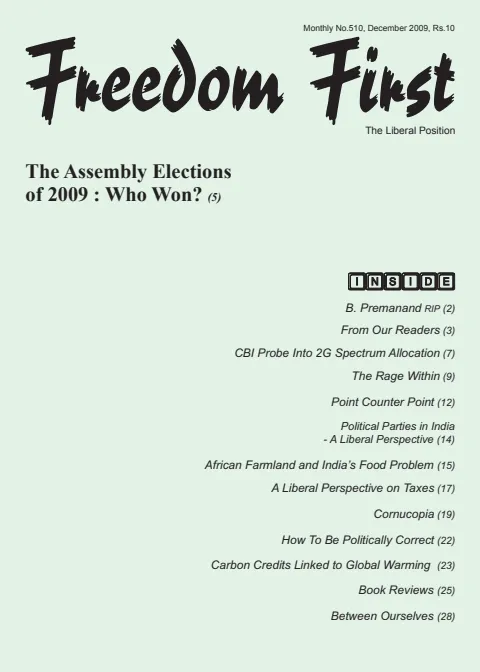
periodical issue
Freedom First
The Liberal Position
By Ashok Karnik, V. Balachandran, Firoze Hirjikaka, Keshav Rau, M. D. Kini, Ashok Karnik, Firoze Hirjikaka, Ram Narayanan
Freedom First · 2010
28 pages
Freedom First
Summary
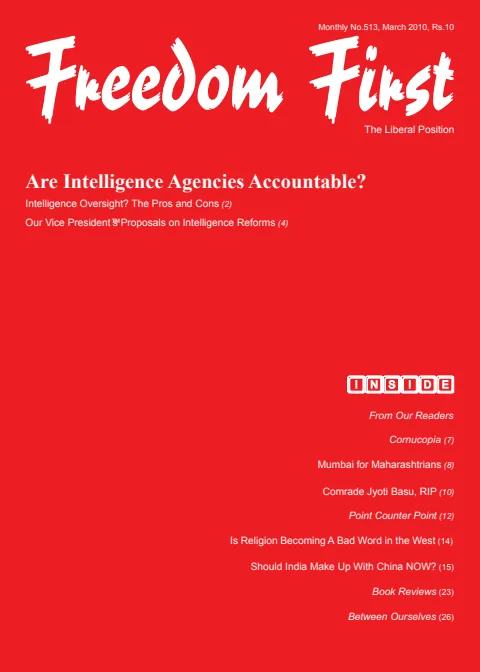
The rendered pages show the March 2010 issue of Freedom First, a liberal periodical issue organized around public accountability, civil liberty, national security, and foreign-policy judgment. The cover foregrounds the question “Are Intelligence Agencies Accountable?”, and the visible pages follow that theme through paired arguments on intelligence oversight, letters on press censorship and political violence, criticism of coercive regional politics in Mumbai, and warnings against both state secrecy and non-state intimidation.
Key points
-
Ashok Karnik presents and comments on Vice-President Hamid Ansari’s case for democratic oversight of intelligence agencies, comparing oversight models in the US, UK, Norway, and Germany and using the Kargil Review Committee as evidence executive-only oversight is inadequate.
-
V. Balachandran welcomes Ansari’s reform proposals but urges caution about parliamentary oversight in India, recommending clearer legal charters for RAW and IB and independent inquiry mechanisms for misuse of secret funds.
-
Firoze Hirjikaka’s “Cornucopia” criticises political pressure on the Marathi film Jhenda and the Shiv Sena’s attacks on Shah Rukh Khan, Mukesh Ambani, and Rahul Gandhi over who belongs in Mumbai, arguing private intimidation is eroding democratic freedoms.
-
Keshav Rau criticises Rahul Gandhi’s remarks minimising the Maharashtra Police’s role in the 26/11 response, arguing anti-migrant Shiv Sena/MNS politics must be resisted through firm law enforcement rather than rhetoric that alienates ordinary Maharashtrians.
-
M. D. Kini’s obituary essay on Jyoti Basu rejects celebratory accounts of his career, crediting land reform but blaming militant trade unionism and public-sector failure for West Bengal’s industrial decline and capital flight.
-
Ashok Karnik’s “Point Counter Point” addresses attacks on Indians in Australia, Pakistan’s post-26/11 evasions, and the rise of private ‘enforcers’ threatening films and public figures, closing with N. Vittal’s contrast between Indian and Chinese freedom of expression.
-
Firoze Hirjikaka argues secularism in the West has curdled into reverse intolerance toward harmless religious expression, while remaining skeptical of organised religion himself.
-
Ram Narayanan publishes an online debate on whether India should seek accommodation with China through territorial concessions, weighted toward retired military officers and analysts warning that surrendering Tawang would invite further pressure.
Essays
From Our Readers
The opening reader letters range across Freedom First’s editorial character, Emergency-era press censorship, Shiv Sena and Maharashtra Navnirman Sena regionalism, non-violence in the face of terrorism, Indian students in Australia, and compulsory voting. The letters repeatedly contrast rights with public duties and argue that democratic life depends on resisting both official censorship and extra-constitutional coercion.
- A reader recalls a court judgment rejecting the Emergency censor’s attempt to force newspapers into one voice.
- Letters criticize the “Maharashtra for Maharashtrians” claim as parochial while acknowledging Mumbai’s migration pressures.
- A letter argues that Gandhian non-violence cannot be applied mechanically to national security situations.
- The compulsory-voting letter frames voting as a civic duty linked to accountability for welfare delivery.
- A short excerpt by J. B. H. Wadia defines liberal secularism as a way to preserve individual liberty and religious choice.
Intelligence Oversight? The Pros and Cons
By Ashok Karnik
Ashok Karnik presents and comments on Vice-President M. Hamid Ansari’s case for democratic oversight of intelligence agencies. The article excerpts Ansari’s argument that modern security demands information-sharing, public accountability, and parliamentary scrutiny, then weighs the Indian difficulty: elected representatives may be mistrusted, but secret agencies cannot remain outside scrutiny in a democracy.
- The essay frames intelligence reform as a problem of balancing secrecy, efficacy, and democratic accountability.
- Ansari’s speech compares oversight models in the United States, United Kingdom, Norway, Germany, and other democracies.
- Karnik argues that India can begin with policy, finance, and failure review before expanding oversight into operational details.
- The article treats the Kargil Review Committee as evidence that executive-only oversight is inadequate.
Our Vice-President’s Proposals on Intelligence Reforms
By V. Balachandran
V. Balachandran welcomes Ansari’s reform proposals but argues for caution about parliamentary oversight in India. Drawing on R. N. Kao’s letters and earlier debates on secrecy, Balachandran proposes public input into intelligence priorities, ministerial scrutiny of operational plans and budgets, clearer legal charters for agencies such as RAW and IB, and independent inquiry mechanisms for misuse of office or secret funds.
- The essay says postcolonial intelligence structures persisted for decades without adequate democratic reform.
- Balachandran supports accountability but doubts whether India’s legislatures can reliably handle sensitive operational details.
- He recommends involving knowledgeable outsiders in setting intelligence priorities.
- He argues that RAW and IB need legal backing, defined charters, and safeguards against misuse.
Cornucopia
By Firoze Hirjikaka
Firoze Hirjikaka’s “Cornucopia” column opens with a free-speech complaint about political pressure on the Marathi film Jhenda, then turns to the Shiv Sena’s attacks on Shah Rukh Khan, Mukesh Ambani, and Rahul Gandhi over who belongs in Mumbai. In the rendered portion, the column argues that private intimidation and street pressure are eroding democratic freedoms even when formal democratic institutions still exist.
- The column objects to unofficial censorship by political actors who hold no public authority.
- It argues that fear of vandalism makes film producers comply with coercive demands.
- The Shiv Sena is portrayed as politically frustrated and reliant on outdated street tactics.
- The article is incomplete in the rendered pages and continues on page 22.
Mumbai for Maharashtrians
By Keshav Rau
Keshav Rau criticizes Rahul Gandhi’s Bihar speech on the role of non-Maharashtrian NSG commandos in the 26/11 Mumbai attacks, arguing that it carelessly insults the Maharashtra Police while trying to oppose Shiv Sena and MNS chauvinism. The rendered portion accepts that anti-migrant politics must be resisted, but insists that the answer is firm law enforcement rather than rhetoric that alienates Maharashtrians who do not support Sena tactics.
- The article rejects claims that Mumbai belongs only to Maharashtrians.
- It argues that Rahul Gandhi’s 26/11 remarks minimize the bravery of Maharashtra Police officers.
- The article traces Shiv Sena’s politics from anti-South Indian mobilization to attacks on U.P. and Bihar migrants.
- It calls migration to metropolitan areas inevitable and says violence must be met by law-and-order action.
- The article is incomplete in the rendered pages and continues on page 22.
Comrade Jyoti Basu, RIP
By M. D. Kini
M. D. Kini’s obituary-essay rejects celebratory accounts of Jyoti Basu’s career and instead presents him as responsible for West Bengal’s industrial decline. The rendered pages contrast land reform with union militancy, strikes, corruption, public-sector failure, capital flight, and the out-migration of educated Bengalis, drawing on commentators and economists to argue that communist rule damaged the state’s economy.
- The essay challenges media praise of Jyoti Basu after his death.
- It credits land distribution but says the Left Front converted party and state power into a durable machine.
- It cites economic data showing West Bengal’s falling share of Indian industrial output and organized employment.
- It argues that militant trade unionism, corruption, and public-sector failure pushed industry away.
- The article is incomplete in the rendered pages and continues on page 22.
Point Counter Point
By Ashok Karnik
Ashok Karnik’s “Point Counter Point” presents paired views on attacks against Indians in Australia, Pakistan’s post-26/11 evasions, and the rise of private “enforcers” who threaten films, books, cricketers, taxi drivers, or public figures. The feature argues that real grievances do not justify coercive politics and closes with N. Vittal’s contrast between India and China on open debate and freedom of expression.
- The Australia section says official denials of racism are morally evasive while also rejecting Indian self-flagellation.
- The Pakistan section argues that dialogue may be necessary but Pakistan’s credibility depends on curbing terrorism.
- The enforcers section warns that non-state actors are acquiring coercive power in public life.
- The China comparison treats freedom of expression and open debate as India’s essential difference from authoritarian China.
Is Religion Becoming A Bad Word in the West?
By Firoze Hirjikaka
Firoze Hirjikaka’s article on religion in the West argues that secularism has been pushed into a reverse intolerance toward religious expression. In the rendered portion, he accepts the separation of church and state and remains skeptical of organized religion, but objects to dismissals, bans, and official overreach against harmless religious speech or symbols.
- The article distinguishes secular governance from treating religion itself as suspect.
- It discusses cases from the United States, Britain, France, and other European settings.
- Hirjikaka criticizes clerical control while defending voluntary religious symbols and expression.
- The article is incomplete in the rendered pages and continues on page 22.
Should India Make Up With China NOW?
By Ram Narayanan
Ram Narayanan publishes an online debate on whether India should seek accommodation with China by territorial concessions or prepare to defend its claims. The rendered debate is weighted toward critics of concession: military officers, analysts, and journalists argue that surrendering Tawang or other territory would invite further pressure, while a minority view says a pragmatic settlement with China could secure India’s long-term interests.
- The debate begins with B. S. Raghavan’s argument for statesmanship and a broad India-China settlement.
- Several retired military officers argue that Tawang has strategic importance and should not be surrendered.
- Contributors repeatedly compare territorial concession to appeasement and invoke Munich as a warning.
- Some respondents argue that China seeks status, compliance on Tibet, or geopolitical superiority rather than merely border adjustments.
- The article is incomplete in the rendered pages and continues beyond printed page 18.
Generated by the v1.5 extraction pipeline. Awaiting editorial review.
Metadata and summary are AI-extracted from the source PDF and reviewed for editorial accuracy. The original work is available via the Read PDF tab above (where present); paragraph-level citation inside the PDF is deferred to a future engagement.