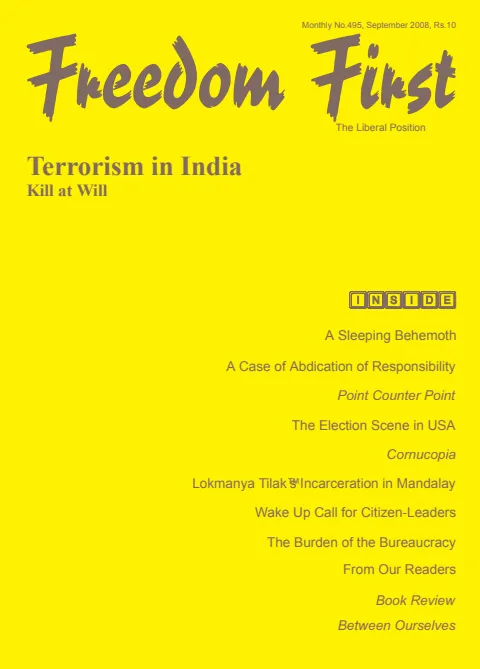
periodical issue
Freedom First
The Liberal Position
Published by J. R. Patel for the Indian Committee for Cultural Freedom (ICCF) and printed by him at Kaiser-E-Hind Private Ltd., Plot No.A-191, Road No.16A, MIDC, Wagle Industrial Estate, Thane (W) - 400 604. · Mumbai · 2008
20 pages
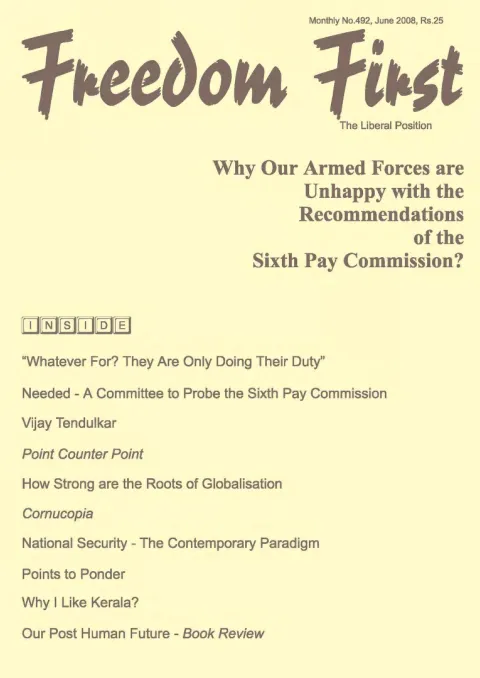
Freedom First
Summary
This is the June 2008 issue (No. 492) of Freedom First, the monthly journal of classical liberal opinion published in Bombay by the Indian Committee for Cultural Freedom. The issue is dominated by a wave of protest over the Sixth Pay Commission’s recommendations for the Armed Forces: a lead essay by retired Major General Eustace D’Souza and a companion piece by Capt. J. N. Choppra argue that the Commission shortchanges soldiers relative to civil servants and call for a dedicated Services Pay Commission. The concluding fourth instalment of V. Balachandran’s series on national security argues for a federal police force modelled on the FBI, illustrated through the historical case study of William Sleeman’s suppression of the Thuggee networks in colonial India. Regular columns cover the Beijing Olympics boycott debate, IPL cheerleaders and moral policing, Raj Thackeray’s Marathi-chauvinist politics, a tribute to the playwright Vijay Tendulkar, a nostalgic reader letter about 1950s Kerala, and a critical review of Francis Fukuyama’s Our Posthuman Future. The masthead notes the issue falls in the journal’s 55th year of publication, ten years after founder Minoo Masani’s death.
Key points
-
Major General Eustace D’Souza and Capt. J. N. Choppra both protest the Sixth Pay Commission’s treatment of the Armed Forces, describing unprecedented unity among all three Service Chiefs and 30 War Memorial protests, and calling for a dedicated Services Pay Commission and one-rank-one-pension.
-
V. Balachandran concludes his four-part national security series by using William Sleeman’s colonial-era suppression of the Thuggee networks as a model for a proposed federal police force to handle terrorism, Naxalism, and trans-border crime.
-
Ashok Karnik’s “Point Counter Point” debates a Beijing Olympics boycott over Tibet, IPL cheerleaders as ‘moral policing,’ and the Animal Welfare Board’s regulation of advertising.
-
Dr. P. M. Kamath’s essay on globalisation, drawing on Alan Greenspan’s memoir, argues globalisation is reshaping economics, politics and even terrorism financing, while criticising Indian Marxists for inconsistency on foreign economic engagement.
-
Firoze Hirjikaka’s “Cornucopia” argues a Beijing Olympics boycott would be counterproductive and condemns Raj Thackeray’s demand to ban non-Marathi festivals in Maharashtra as dictatorial overreach.
-
Kusum Choppra’s “Points to Ponder” criticises TRP-driven media coverage of a cricketer’s slap incident over the Pay Commission’s treatment of soldiers, and questions renewed US interest in Afghanistan as a pattern of resource extraction.
-
Sharad Bailur reviews Francis Fukuyama’s ‘Our Posthuman Future,’ arguing Fukuyama overstates biotechnology’s political dangers while underestimating the more radical, imminent transformations from nanotechnology.
-
Brief tributes mark the deaths of playwright Vijay Tendulkar, remembered for fearless works like ‘Sakharam Binder,’ and political science teacher Prof. S. V. Kogekar, while G. D. Karve contributes a nostalgic letter about his 1955-56 posting in Trivandrum.
Essays
”Whatever For? They Are Only Doing Their Duty” (A Retired Soldier’s Observations on the 6th Pay Commission’s Recommendations)
By Eustace D’Souza
Major General (Retd.) Eustace D’Souza argues that the Sixth Pay Commission’s recommendations have provoked unprecedented, unified anger across serving and retired ranks of India’s Armed Forces. Drawing on personal experience of prolonged family separations during postings in Poonch, North Bengal, Sikkim, and the Kashmir Valley, he contrasts military pay and retirement conditions unfavourably with the Civil Services, recounts bureaucratic indifference (illustrated by anecdotes about the National War Memorial and George Fernandes’s Siachen visit), and lists recommendations including a separate Services Pay Commission, a Group of Ministers review committee, and implementation of one-rank-one-pension.
- All three Service Chiefs met the Defence Minister to register dismay at the Pay Commission’s recommendations, an unprecedented show of unity.
- 30 dignified protest meetings were held at War Memorials across India after the Armed Forces were barred from a demonstration at Amar Jawan.
- The author contrasts his own career sacrifices (family separations, no dedicated schools, a wife’s nervous breakdown) with the comparative comfort of IAS officers.
- Recommends a separate Pay Commission for the Armed Forces, a Group of Ministers review, and one-rank-one-pension.
- Notes falling intake into Officer commissions and rising premature retirements as the practical consequence of pay disparities.
Needed - A Committee to Probe the Sixth Pay Commission
By J. N. Choppra
Capt. J. N. Choppra (Retd.) delivers an impassioned companion piece on the Sixth Pay Commission, arguing that India’s policymaking elite — netas, babus, and industrialists — are insulated from military hardship because none of them send their own children into the Armed Forces. He contrasts the state’s readiness to spend to free a politician’s kidnapped daughter with its parsimony toward soldiers’ pensions and war-widow welfare, and closes by calling for the promised committee probing the Sixth Pay Commission to act.
- Argues that policymakers’ disconnect from military life stems from none of them having children serving in the Armed Forces.
- Cites the Kargil War and unclaimed compensation/pensions for soldiers’ families as evidence of official neglect.
- Recounts Nehru’s remark that ‘not a blade of grass grows’ in the Chinese-occupied Ladakh area, and Mahavir Tyagi’s retort about hair on Nehru’s head.
- Notes broken promises of land grants (16 acres each) to retired Gujarat servicemen.
- Frames soldiers as having no forum to air grievances, leaving retired officers to advocate on their behalf.
Vijay Tendulkar (obituary tribute, January 1928-May 2008)
A brief unsigned tribute marking the death of playwright Vijay Tendulkar (January 1928-May 2008), reprinted as an extract from a DNA obituary. It frames Tendulkar as a fearless, non-conformist chronicler of the darker side of human nature in Marathi literature, citing his controversial plays ‘Silence! The Court is in Session’, ‘Sakharam Binder’, and ‘Gidhade’ (Vultures), and recounts an anecdote of a Chitpavan critic assaulting him over his writing.
- Vijay Tendulkar (1928-2008) is remembered as a fearless writer who portrayed the darker, selfish, and cruel sides of human nature rather than idealized virtue.
- His controversial plays included ‘Silence! The Court is in Session’, ‘Sakharam Binder’, and ‘Gidhade’ (Vultures).
- He was once physically attacked by Kartar Singh Thatte for his ‘unorthodox’ writing and did not retaliate.
- The piece is an extract courtesy of DNA and political commentator Aroon Tikekar.
Point Counter Point (Olympic Boycott?; Moral Police - Yet Again; Cruelty to Animals)
By Ashok Karnik
Ashok Karnik’s ‘Point Counter Point’ column presents structured for-and-against arguments on three current issues: whether India should support a Beijing Olympics boycott over Tibet, whether the IPL’s cheerleaders represent ‘moral policing’ overreach, and whether the Animal Welfare Board’s regulation of animals in advertising has become bureaucratic excess. On the Olympics, the piece leans toward supporting the Tibetan cause while noting India’s diplomatic constraints; on cheerleaders and animal welfare it argues against expanding state-enforced moral policing.
- Frames the Beijing Olympics boycott debate around whether sports and politics can be separated, and whether Tibet is comparable to Kashmir/Northeast insurgencies.
- Cites a Brahma Chellaney op-ed comparing the 1936 Berlin Olympics to a possible turning point for China’s autocracy.
- Argues that banning IPL cheerleaders would extend ‘moral policing’ by the state into private morality with no legal basis.
- Critiques the Animal Welfare Board as bureaucratic overreach following public complaint over an advertisement showing a dog running after a bus.
- Concludes that the people of India, if not the government, should support the Tibetan cause clearly.
How Strong are the Roots of Globalisation?
By P. M. Kamath
Dr. P. M. Kamath examines the roots and reach of economic globalisation via Alan Greenspan’s memoir ‘The Age of Turbulence’, arguing that globalisation — driven by the communications and internet revolution — is an all-embracing process spanning economics, politics, and even terrorism financing. The essay contrasts pre-1990s economic interdependence with today’s fully outsourced, internet-enabled global market, discusses the fall of the Berlin Wall and Gorbachev’s reforms, and closes by noting that India’s continued poverty, farmer suicides, and inflation complicate any simple celebration of globalisation, while criticizing Indian Marxists for inconsistency on foreign economic engagement.
- Alan Greenspan, described as a Libertarian Republican and former US Fed chairman, is presented as crediting globalisation with the swift US economic recovery after 9/11.
- Distinguishes ‘globalisation’ (full market interconnection via the internet) from older ‘economic interdependence’ of the 1960s.
- Argues that globalisation is two-dimensional: it raises growth and spreads technology, but also erodes local culture and national sovereignty.
- Notes Greenspan’s description of India as combining ‘the productiveness of market capitalism and the stagnation of socialism.’
- Criticizes Indian Marxists for demanding insulation from American economic influence while China aggressively acquires overseas oil resources.
- Cites Greenspan’s admission that the Iraq war was ‘largely about oil’ as evidence for pursuing alternate energy via the US-India Civil Nuclear Deal.
Cornucopia (Boycotting The Beijing Olympics - A Good Idea?; Maharashtra Reserved For Marathis Only)
By Firoze Hirjikaka
Firoze Hirjikaka’s ‘Cornucopia’ column argues, via a Washington Post piece by Chinese actress Joan Chen, that Western calls to boycott the Beijing Olympics over Tibet are likely counterproductive, since ordinary Chinese see the Games as a chance to showcase a modern China after the traumas of the Cultural Revolution. The same page carries a second short op-ed, ‘Maharashtra Reserved for Marathis Only’, condemning Raj Thackeray’s demand to ban non-Marathi festivals in Maharashtra as jingoistic and undemocratic.
- Chen’s personal history of hardship during Mao’s Cultural Revolution is used to contextualize contemporary Chinese pride in economic progress.
- Argues that Olympic boycotts have historically failed to achieve durable political change (citing Moscow, Los Angeles).
- Distinguishes Tibet’s push for autonomy from separatist movements in Kashmir/Northeast India as not directly comparable.
- Condemns Raj Thackeray’s call to ban non-Marathi festivals (Uttar Pradesh Day, Chhath Puja) in Maharashtra as dictatorial overreach.
- Notes the irony that many prominent ‘outsider’ business families (Tata, Godrej, Ambani, Mafatlal) are integral to Maharashtra’s economy.
A Student’s Tribute to Prof. S.V. Kogekar
By Dr P. R. Dubhashi
A short tribute by Dr. P. R. Dubhashi marks the first death anniversary of Prof. S. V. Kogekar, recalling him as an inspiring political science teacher at Fergusson College in 1948-49 whose thinking was deeply shaped by his own teacher Harold Laski at the London School of Economics, and who championed ‘Democratic Socialism’ as an intellectual ideal for Maharashtra, though this ambition ultimately went unrealized.
- Prof. S. V. Kogekar taught undergraduate political science at Fergusson College and was remembered for kindling independent thinking rather than rote learning.
- He had studied under Harold Laski at the LSE, whose ideology of ‘Democratic Socialism’ shaped his teaching.
- Kogekar hoped Maharashtra’s intellectual tradition would translate democratic socialism into reality but felt disappointed that this did not happen.
- The author, Dr. Dubhashi, later also studied at the LSE (1962-63), reflecting the lasting influence of this teacher-student lineage.
National Security - The Contemporary Paradigm (4): The Concept of “Federal Crime” and a Federal Police Force
By V. Balachandran
V. Balachandran, former Special Secretary in the Cabinet Secretariat, concludes his four-part series on national security with a case study of the colonial-era suppression of Thuggee by William Sleeman, presented as an early model of centralized federal anti-crime policing. He draws parallels to Britain’s centralized response to IRA terrorism and the US FBI model, and closes with concrete recommendations: a separate federal police force to handle ‘Federal Crime’ (terrorism, Naxalism, transnational crime), Terrorism Intelligence Integration Centres in Delhi and state capitals, and Prime Ministerial leadership in persuading reluctant states to cede such authority, including invoking Emergency provisions if necessary.
- William Sleeman built a centralized intelligence database of 4,000 names to combat the secretive, cross-regional Thuggee networks, leading to the arrest of 350 Thugs by 1830 and disappearance of the menace by 1840.
- The Thuggee suppression department later evolved into the Intelligence Bureau after Indian independence.
- Draws a parallel to Britain’s centralized response to IRA terrorism, including appointing a retired MI-6 chief to coordinate security in Northern Ireland.
- Recommends the state police concentrate on local law and order while a new federal agency (modeled on the FBI) handles terrorism, Naxalism, and trans-border crime.
- Calls for the Prime Minister personally to convince state leaders of the need for a ‘Federal Crime’ framework, with Emergency provisions as a fallback.
- Recommends Terrorism Intelligence Integration Centres in Delhi and state capitals, staffed round the clock like US Homeland Security control rooms.
Points to Ponder (Why Should a Slap make Headlines?; The Tyranny of the TRP; Why is the US Again Eyeing Afghanistan?)
By Kusum Choppra
Kusum Choppra’s ‘Points to Ponder’ column ranges across four short opinion pieces: criticizing the media furor over cricketer Shreesanth’s slap incident as symptomatic of TRP-driven trivia journalism that ignores serious issues like the Pay Commission’s treatment of the Armed Forces; describing the ‘tyranny of the TRP’ distorting news priorities; questioning whether India’s media-driven celebrity obsession signals national decline by analogy to Rome and other fallen empires; and asking why the US is again eyeing Afghanistan, framing US foreign aid historically as a means of extracting resources and sovereignty from recipient nations.
- Criticizes disproportionate media coverage of a slap between cricketers Shreesanth and senior players versus neglect of the Pay Commission’s treatment of the Armed Forces.
- Argues TRP-driven television journalism manufactures a false consensus about audience preference for celebrity gossip.
- Draws historical analogies (Roman orgies, decline of French and British empires) to suggest that elite preoccupation with luxury presages societal downturn.
- Frames renewed US interest in Afghanistan as part of a historic pattern of aid used to extract resources and sovereignty from war-torn countries.
Why I Like Kerala?
By G. D. Karve
A nostalgia piece by G. D. Karve, framed as a letter responding to a previous Freedom First correspondent, recalls his posting as a young Fumigation Assistant in Trivandrum (then in Travancore-Cochin state) in 1955-56. He recounts warm friendships among colleagues, a ghost story in a haunted kitchen-turned-lodging, a rejected leave application to visit the Sabarimala temple, and the enduring hospitality and affection of Malayalees, alongside a strong, almost past-life attachment to Kerala.
- Karve recalls being posted as a Fumigation Assistant with the Regional Directorate (Food) in Trivandrum in 1955-56.
- Describes a ghost encounter in a haunted house kitchen where he lodged with colleagues.
- Recounts being denied leave to visit Sabarimala for Makara Vilakku, but eventually visiting after a colleague’s application workaround.
- Describes a strong personal, quasi-reincarnation attachment to Kerala and its people.
- The piece is presented as a letter written to a fellow reader (Mr. Pankajakshan) whose earlier ‘Farewell letter’ had run in Freedom First in July 2007.
Book Review: Our Post Human Future by Francis Fukuyama
By Sharad Bailur
Sharad Bailur reviews Francis Fukuyama’s ‘Our Posthuman Future’ (2002), situating it against Fukuyama’s earlier ‘The End of History and the Last Man’ and against Karl Popper’s critique of historicism. The review is largely negative, arguing Fukuyama overstates the political dangers of biotechnology while underestimating the more radical, imminent transformations from nanotechnology and molecular engineering, and unfavorably compares the book to Philip Kitcher’s earlier, more scientifically grounded ‘The Lives to Come.’ The reviewer concludes that Fukuyama fits Daniel Boorstin’s definition of a celebrity as someone ‘well known for being well known.’
- Fukuyama argues the biotech revolution could have ‘profound and potentially terrible consequences’ for political order, citing drugs like Ritalin and invoking Aldous Huxley’s Brave New World.
- Fukuyama’s proposed solution is that democratically elected governments should control the pace and scope of technological development.
- The reviewer argues this begs the question, since a democratic government could equally legislate abuses, undermining individual rights.
- Criticizes Fukuyama as not an expert on biotechnology and unaware of more prescient works like Eric Drexler’s ‘Engines of Creation’ (1986) on nanotechnology.
- Predicts nanotechnology and molecular engineering will subsume biotech and other sciences and raise far more profound questions than Fukuyama addresses.
- Cites real-world 2006 examples (nanotech restoring eyesight in blind mice, self-cleaning silver-nano textiles) as evidence molecular engineering is already arriving.
Generated by the v1.5 extraction pipeline. Awaiting editorial review.
Metadata and summary are AI-extracted from the source PDF and reviewed for editorial accuracy. The original work is available via the Read PDF tab above (where present); paragraph-level citation inside the PDF is deferred to a future engagement.