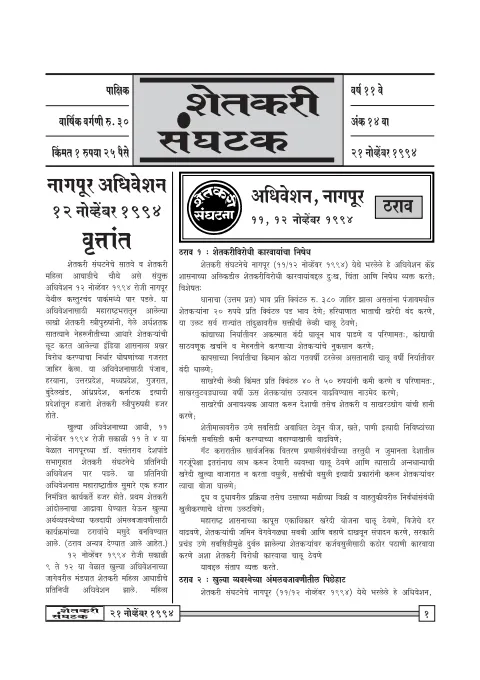
periodical issue
Shetkari Sanghatak
शेतकरी संघटक
By sharad-joshi, श्री. एल. सी. कोळे, sharad-joshi, संचालक मंडळ, शिवार इंडस्ट्रीज लिमिटेड, श्री. राम नेवले, पुरुषोत्तम लाहोटी
शेतकरी संघटक · Pune · 1994
8 pages
Shetkari Sanghatak
Summary
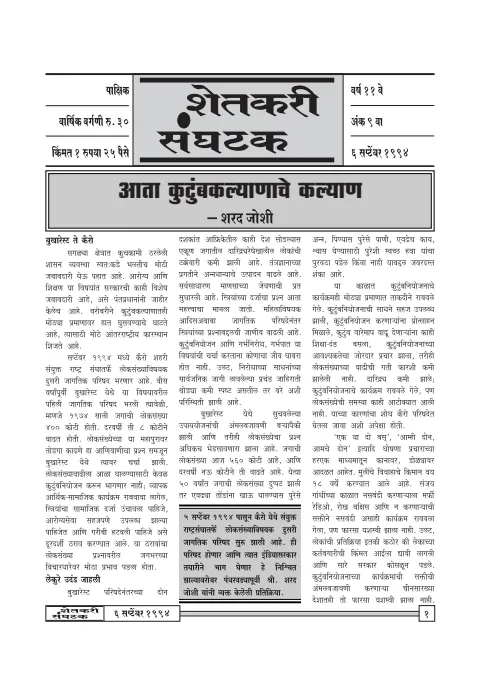
Issue 9 of Year 11 of Shetkari Sanghatak — the Marathi-language fortnightly of Sharad Joshi’s Shetkari Sanghatana — dated 6 September 1994. The eight-page issue is built around five pieces. The lead front-page essay by Sharad Joshi, framed as a reflection on the two-decade arc from the 1974 Bucharest UN population conference to the upcoming 1994 Cairo conference, attacks India’s family-planning bureaucracy and argues that population falls naturally where prosperity and open systems take hold, not through coercion or planning. A second piece is an open letter from a retired teacher, Shri P. L. Kolhe, calling for the same ‘open-system’ logic to be extended to schooling, with a printed reply from Sharad Joshi endorsing competitive, market-based education. A long article and accompanying Memorandum of Association introduce Shivar Industries (India) Ltd., a new Shetkari Sanghatana-promoted retail company that aims to build a chain of farm-to-consumer stores on the Marks & Spencer model. Short news items report Shetkari Mahila Aghadi’s success in shutting six liquor shops in Nagpur district and the preparations under way for the Sanghatana’s sixth all-Maharashtra Adhiveshan in Nagpur on 12 November 1994; the back page carries the convention’s mass-mobilisation appeal.
Key points
-
Sharad Joshi’s lead editorial spans the twenty years from the 1974 Bucharest UN population conference to the 1994 Cairo conference, noting India’s family-planning budget rose from Rs 8 crore to Rs 400 crore with negligible demographic results.
-
Joshi argues that poor families do not experience children as a burden, contending that fertility falls with rising prosperity rather than with state pressure or contraceptive supply.
-
Joshi recalls the Sanjay Gandhi-era forced-sterilisation drives as the canonical failure of bureaucratic population planning and prescribes economic liberty and women’s empowerment as the real remedy.
-
Retired teacher P. L. Kolhe’s open letter calls for the Sanghatana’s ‘open system’ philosophy to be extended to schooling, criticising fixed pay-scales and recognition rules that protect mediocre government-controlled schools.
-
Sharad Joshi’s printed reply endorses Kolhe’s proposal, framing education as another state-monopolised sector where opening entry, fees and recognition would let good schools flourish.
-
A page-four article introduces Shivar Industries (India) Ltd., a Shetkari Sanghatana-promoted retail company modelled on Marks & Spencer that plans thirty farm-to-consumer outlets by 30 September 1994 and one hundred by year end.
-
The Shivar Industries piece argues Marks & Spencer did more for the poor than Marx and Engels, positioning the venture as a way for farmers to bypass middlemen and licensed traders.
-
Short news items report that the Shetkari Mahila Aghadi, the movement’s women’s front, succeeded in shutting six liquor shops in Nagpur district through direct local agitation.
-
The issue previews the Shetkari Sanghatana’s sixth all-Maharashtra Adhiveshan convention, scheduled for Nagpur on 12 November 1994, with the back page carrying a mass-mobilisation appeal for it.
Essays
आता कुटुंबकल्याणाचे कल्याण
By शरद जोशी
Sharad Joshi’s lead front-page editorial ‘आता कुटुंबकल्याणाचे कल्याण’ (‘Now, the welfare of family-welfare itself’) opens by placing India between the 1974 Bucharest UN population conference and the September 1994 Cairo conference on population and development. Joshi notes that India had pinned enormous hopes on family-planning bureaucracy and that the budget of the programme has ballooned from Rs. 8 crore in 1974 to Rs. 400 crore by 1994, yet the demographic results are negligible compared to countries that simply grew richer. He argues that the planners’ assumption — that poor families experience children as a burden — is wrong, that population growth tracks poverty rather than the absence of contraceptive supply, and that wherever incomes, schooling and women’s agency have risen (he points to America, Africa, Australia and the experience of M. S. Swaminathan-style demographic-transition research), fertility has fallen on its own. The piece is also a critique of the coercive Sanjay Gandhi-era sterilisation drives and of the entrenched bureaucratic and social-worker establishment that still pushes top-down ‘planning’ of family size. Joshi’s prescription is the Sanghatana’s standard one: economic liberty, not state coercion, is the path to lower population.
- Frames India’s family-planning policy as the journey from Bucharest (1974) to Cairo (1994), with no real progress despite a fifty-fold rise in budget.
- Argues that the poor do not in fact experience children as a ‘burden’ — fertility falls with prosperity, not with state pressure.
- Recalls the Sanjay Gandhi-era forced-sterilisation drives as the canonical failure of bureaucratic population planning.
- Endorses the demographic-transition logic (associated with M. S. Swaminathan-style research) over coercive birth control.
- Prescribes economic liberty, rural prosperity and women’s empowerment as the real population policy.
शिक्षणातही खुली व्यवस्था हवी…
By श्री. एल. सी. कोळे (पत्र) / शरद जोशी (उत्तर)
An open letter from Shri P. L. Kolhe (श्री. पी. एल. कोल्हे), a retired teacher and college lecturer drawing on a 25-30 year career, urges that the Sanghatana’s ‘open system’ (खुली व्यवस्था) be extended to education. Kolhe describes how government-controlled schools and colleges have stagnated under fixed pay-scales, syllabi and recognition rules that reward neither teaching quality nor student demand, and argues that parents and students should be free to choose schools and that schools should compete on merit. Sharad Joshi’s printed reply (the lower half of the page is signed off ’— शरद जोशी’) endorses the proposal, treating education as one more sector where state monopoly and licensing have crushed quality, and where opening up entry, fees and recognition would let good schools flourish and weak ones close. The argument extends the Sanghatana’s free-market line from agricultural markets to schools.
- P. L. Kolhe, a retired teacher, writes a letter calling for school and college education to be opened up to competition.
- He criticises the state-administered pay-scale and recognition regime that makes private teaching uneconomic and protects mediocrity.
- Sharad Joshi’s printed reply endorses Kolhe’s call, framing schooling as another monopoly sector in need of liberalisation.
- Both arguments extend the Shetkari Sanghatana’s ‘open system’ line from farm produce to schools.
‘शिवार’ ची वाटचाल
By संचालक मंडळ, शिवार इंडस्ट्रीज लिमिटेड
The page-4 article ‘शिवारची वाटचाल’ (signed by the Sanchalak Mandal of Shivar Industries) introduces Shivar Industries (India) Ltd., a new public limited company that the Shetkari Sanghatana is using to break into organised farm-to-consumer retail. The piece describes the first store opened at Pusasarvarni and lays out a plan to set up 30 ‘Shivar’ outlets by 30 September and 100 by year-end, selling pulses, rice, fruit, vegetables, spices and other farm produce graded for quality. The article explicitly holds up Britain’s Marks & Spencer as the model — pointing out, in a now-famous Sanghatana formulation, that Marks & Spencer have done more for the poor than the celebrated socialist titans Marx and Engels. It situates ‘Shivar’ as the next step beyond the Sanghatana’s earlier ‘Pawan Proteins’ and Shetkari Soltrans ventures, and as a way for farmers to bypass middlemen and licensed traders. The accompanying Memorandum of Association on page 6 names the registered office (402, Kamalprabha, Dhantoli, Nagpur) and the board: Sharad Joshi (Chairman, Ambethan), Dr. Vasant L. Bonde (Hinganghat, Wardha), Shri Prakash G. Pohore (Akola), Smt. Sarojtai R. Kashikar (Ramnagar, Wardha), Shri Laxman M. Wange (Parli Vaijnath, Beed), Shri Vilasrao V. Kore (Warnanagar, Kolhapur) and Shri Laxmikant P. Deshmukh as Executive Director, with P. S. Thakare as Auditor.
- Announces Shivar Industries (India) Ltd. as a Shetkari Sanghatana-promoted retail company for farm produce.
- Targets a chain of 30 ‘Shivar’ outlets by 30 September 1994 and 100 by year-end.
- Holds up Marks & Spencer as the model of organised retail that serves the poor better than socialist ideology has.
- Frames ‘Shivar’ as the next venture after ‘Pawan Proteins’ and Shetkari Soltrans Ltd. in the Sanghatana’s market-building work.
- Page-6 Memorandum of Association formally names Sharad Joshi as Chairman and lists the seven-member board and auditor.
MEMORANDUM OF ASSOCIATION — Shivar Industries (India) Ltd.
A page-6 news report records that Shetkari Mahila Aghadi (the Sanghatana’s women’s wing) has succeeded in getting six country-liquor shops in Nagpur district shut down. The campaign was led by Mahila Aghadi president Sou. Geetatai Khoke and secretary Sou. Sulekhatai Bhandakwar, with Kamlabai Kakade and other karyakartis mobilising women across 10-12 villages. A decisive meeting at Bharsavada on 28 August 1994 produced a written ultimatum to the District Collector, after which the Collector ordered the closure of liquor shops at Katoli, Kharsoli, Lohari Sawangi (Tal. Narkhed), Tekkhamari (Tal. Sawner) and Vadoda (Tal. Kamtee). The piece is presented as a continuation of the anti-liquor agitation begun at the Aurangabad Adhiveshan.
- Shetkari Mahila Aghadi forces closure of six country-liquor shops across Nagpur district.
- Campaign led by president Sou. Geetatai Khoke and secretary Sou. Sulekhatai Bhandakwar.
- A 28 August 1994 mass meeting at Bharsavada delivered an ultimatum to the District Collector.
- Liquor shops closed at Katoli, Kharsoli, Lohari Sawangi, Tekkhamari and Vadoda.
शेतकरी महिला आघाडीच्या प्रयत्नाने नागपूर जिल्ह्यातील सहा दारुदुकाने बंद
The closing news pages report on preparations for the Shetkari Sanghatana’s sixth all-Maharashtra Adhiveshan (convention), to be held at Kasturchand Park, Nagpur, on 12 November 1994 at 5 p.m. A district-level karyakarta meeting at Nagpur on 28 August 1994 — chaired by Shetkari Sanghatana president Shri Pasha Patel and attended by Sou. Saroj Kashikar (president of Shetkari Mahila Aghadi), Shri Ram Newale (karyavah), Shri Morarka Tejuji of Swatantra Bharat Paksh, Vasantrao Bonde, Lakshmikant Deshmukh, Wamanrao Newale and others — finalised the convention programme and a roster of village-level meetings. Sharad Joshi’s own district tour (Solapur, Usmanabad, Latur, Beed, Nanded, Parbhani, Jalna, Aurangabad, Ahmednagar, Kolhapur, Sangli, Satara, Nashik, Mumbai, Dhule, Jalgaon, Buldhana, Akola, Amravati, Yavatmal, Wardha, Chandrapur, Gadchiroli, Bhandara, Nagpur) is printed as a calendar from 20 August to 4 November 1994. The page also notes that the office’s fax number has changed to 02713-422255. The back cover then carries the convention’s mass-mobilisation appeal in the joint name of Sou. Saroj Kashikar, Pasha Patel, P. S. Thakre and Ram Newale, calling on farmers to attend in lakhs.
- Announces the Shetkari Sanghatana’s sixth Adhiveshan for 12 November 1994 at Kasturchand Park, Nagpur, 5 p.m.
- Pasha Patel chairs the preparatory district-level meeting; Ram Newale is karyavah and Saroj Kashikar leads Shetkari Mahila Aghadi.
- Morarka Tejuji of Swatantra Bharat Paksh is named as a leading participant.
- Prints Sharad Joshi’s full district tour calendar from 20 August to 4 November 1994 across western and central Maharashtra and Vidarbha.
- Back-cover appeal frames the convention as a stand against state-protected casteist forces and the bureaucratic blocking of the open economic system.
Generated by the v1.5 extraction pipeline. Awaiting editorial review.
Metadata and summary are AI-extracted from the source PDF and reviewed for editorial accuracy. The original work is available via the Read PDF tab above (where present); paragraph-level citation inside the PDF is deferred to a future engagement.