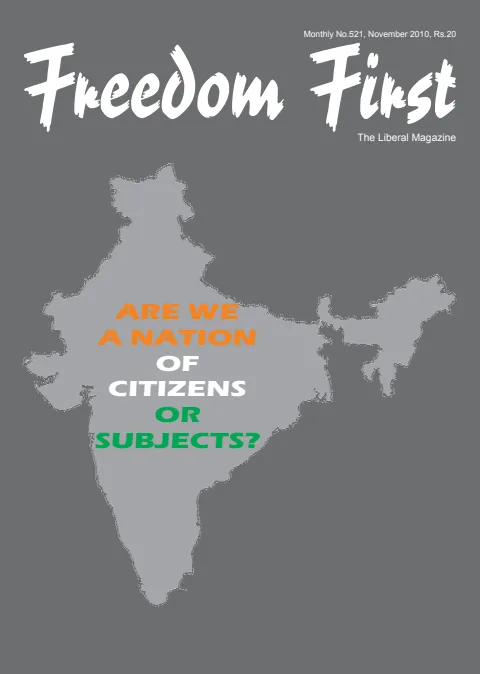
periodical issue
Freedom First
The Liberal Magazine
By N. Vittal
Publisher: Indian Committee for Cultural Freedom (ICCF), 3rd Floor, Army & Navy Building, 148, Mahatma Gandhi Road, Mumbai 400 001. · Mumbai · 2010
44 pages
Freedom First
Summary
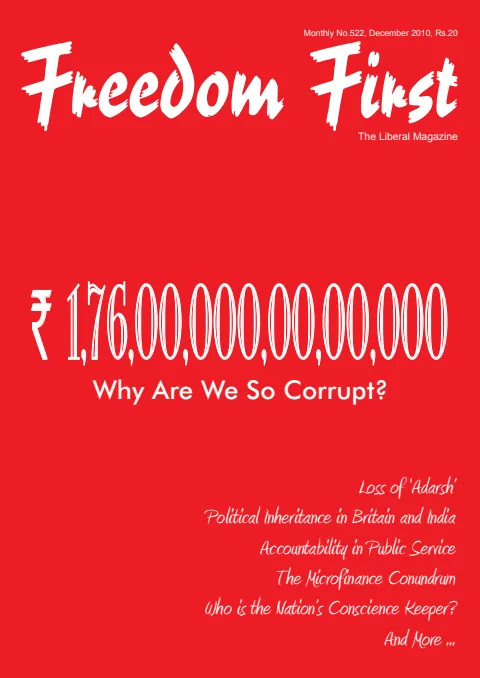
The rendered pages show the December 2010 issue of Freedom First, a liberal magazine organized around corruption, accountability, dynastic politics, Kashmir, public service reform, and civil liberties. The editor’s opening note frames the issue through Aung San Suu Kyi’s release, India’s corruption scandals, and the magazine’s long memory of earlier liberal debates. The visible issue then moves through reader letters, essays on political inheritance and corruption, a retrospective page from December 1953, and short polemical pieces on Kashmir interlocutors, public security during Barack Obama’s Mumbai visit, and Shiv Sena’s campaign against Rohinton Mistry’s Such a Long Journey.
Key points
-
The editor’s note welcomes Aung San Suu Kyi’s release from detention as a standard against which Indian public life appears lacking in moral courage, framing the issue around the Adarsh scandal and broader corruption.
-
Christie Davies compares British and Indian political inheritance, arguing Britain suffers from interlocking elite cliques but not kinship-based rule, while India has repeatedly converted charisma and bereavement into dynastic succession from Indira Gandhi through Sonia and Rahul Gandhi.
-
Ashok Karnik’s cover essay asks why India is so corrupt, using Transparency International rankings and contrasting China’s punishment of corrupt officials with India’s procedural delay, connecting Bhopal, the Commonwealth Games, and Adarsh as evidence that bribery has been normalised from the traffic constable up.
-
Firoze Hirjikaka reads the Adarsh Housing Society scandal as proof of an entrenched postcolonial ‘mai-baap sarkar’ mentality, but credits the Right to Information Act and independent television with beginning to force officials to explain themselves.
-
N. Vittal’s second installment on “Accountability in Public Service” identifies institutional weaknesses including Article 311 protections and inflated confidential reports, proposing transparency, e-governance, and process redesign as remedies.
-
Ashok Karnik’s “Point Counter Point” takes a skeptical view of Pervez Musharraf’s return to Pakistani politics and Omar Abdullah’s accession-versus-merger rhetoric on Kashmir, while V. Balachandran separately questions what Kashmir interlocutors can contribute beyond existing Track-II dialogues.
-
Firoze Hirjikaka’s “Cornucopia” criticises Mumbai’s over-securing of South Bombay during President Obama’s visit and condemns the Shiv Sena’s intimidation campaign against Rohinton Mistry’s Such a Long Journey as stale politics unsuited to a smarter electorate.
-
A retrospective page reprints December 1953 Freedom First material including Narie Oliaji’s essay against subordinating art to political uplift and a note on press liberty following a Calcutta clash between newspapermen and police.
Essays
Between Ourselves…
The editor’s note welcomes Aung San Suu Kyi’s release from detention and uses it as a standard against which Indian public life appears lacking in moral courage. It previews the issue’s main preoccupations: the Adarsh scandal, broader corruption, Christie Davies’s essay on political inheritance, and a retrospective from the magazine’s 1953 predecessor.
- Welcomes Aung San Suu Kyi’s release and contrasts her courage with Indian public life.
- Frames corruption as the issue’s central problem, especially through Adarsh and the Commonwealth Games atmosphere.
- Introduces Christie Davies’s critique of political inheritance and family-led politics.
- Connects the current issue to Freedom First’s 1953 archive.
From Our Readers
The letters page ranges widely: readers praise Freedom First, protest the banning of Rohinton Mistry’s Such a Long Journey, discuss Kashmir’s possible futures, comment on Jaswant Singh and the BJP/RSS, and denounce the Adarsh, Commonwealth Games, and 2G scandals. The strongest current running through the letters is anger at public cowardice, corruption, and partisan opportunism.
- Readers defend the magazine’s liberal tradition and praise its provocation.
- The ban on Such a Long Journey is treated as a sign of democratic fragility.
- Kashmir letters argue over independence, federal division, and Indian policy.
- A corruption letter links Adarsh, the Commonwealth Games, and the 2G spectrum case.
Political Inheritance in Britain and India
By Christie Davies
Christie Davies compares British and Indian political inheritance. He argues that Britain may suffer from interlocking political cliques, but not from kinship-based rule, while India has repeatedly converted charisma, bereavement, and family lineage into political succession. The essay moves from the Miliband brothers and Labour politics to Indira Gandhi, Sonia Gandhi, Rahul Gandhi, and the Nehru line, concluding that dynastic inheritance eventually becomes incompatible with democracy.
- Contrasts British elite cliques with Indian family-based political succession.
- Uses the Miliband leadership contest to show non-dynastic fraternal rivalry in Britain.
- Treats Indira Gandhi’s rise as an instance of inherited charisma rather than democratic choice alone.
- Argues that later Nehru-Gandhi succession made the dynasty unmistakable.
- Ends by warning that dynasticism betrays Nehru’s democratic ideals.
Why Are We So Corrupt?
By Ashok Karnik
Ashok Karnik’s cover essay asks why India is so corrupt by combining international ranking data, contemporary scandals, and everyday petty bribery. He argues that India hides behind legality, delay, and process while public officials, ministers, and criminals evade accountability; the common citizen then learns to treat bribery as the normal way to get things done.
- Uses Transparency International’s 2009 and 2010 rankings to puncture civilizational self-congratulation.
- Contrasts China’s punishment of corrupt officials with India’s procedural delay and legal evasion.
- Connects Bhopal, the Commonwealth Games, Adarsh, and everyday public-service corruption.
- Argues that corruption is normalized from the traffic constable to higher officials.
- Concludes that leadership credibility and accountability are more important than rhetoric.
Loss of Adarsh
By Firoze Hirjikaka
Firoze Hirjikaka reads the Adarsh Housing Society scandal as both proof of entrenched corruption and a possible sign that elite impunity is weakening. He argues that postcolonial rulers inherited and deepened a mai-baap sarkar mentality, but that the Right to Information Act and independent television media have begun forcing leaders and bureaucrats to explain themselves.
- Treats the Adarsh scandal as an example of long-normalized elite acquisition of public wealth.
- Criticizes ministers, elected representatives, and bureaucrats as postcolonial overlords.
- Credits the Right to Information Act with changing the balance between citizens and officials.
- Argues that independent television news has made selective government information control harder.
- Sees public pressure as an early sign that impunity may be ending.
Freedom First This Month in December 1953
The retrospective page reprints material from December 1953: Narie Oliaji’s short essay on whether art has a purpose, notes on the Assam incident, and a comment on press liberty after Justice P. B. Mukharji’s investigation into a Calcutta clash between newspapermen and police. The page balances individualist aesthetics, cultural preservation, democratic restraint, and press responsibility.
- Oliaji rejects subordinating art to political or moral uplift.
- The Assam note urges investigation and redress while refusing to condone ambush or hostage-taking.
- The press-liberty note distinguishes free reporting from a claim to resist lawful police action.
- The page shows continuity between earlier liberal concerns and the 2010 issue’s themes.
Accountability in Public Service
By N. Vittal
N. Vittal’s second installment on accountability in public service identifies institutional weaknesses that blunt responsibility: civil-service protections under Article 311, weak reward and punishment systems, inflated confidential reports, lack of transparency, and corruption. He argues that transparency, information technology, process redesign, and clearer accountability can reduce corruption, while warning that technology cannot substitute for human integrity.
- Argues that government rules often punish initiative and reward inaction.
- Criticizes Article 311 protections for making dismissal nearly impossible.
- Says annual confidential reports inflate performance and discourage honest adverse remarks.
- Links transparency, the Right to Information Act, and accountability.
- Proposes industrial-engineering methods and e-governance to reduce corruption opportunities.
Point Counter Point
By Ashok Karnik
Ashok Karnik’s Point Counter Point page takes a skeptical view of Pervez Musharraf’s return to Pakistani politics, Omar Abdullah’s accession-versus-merger rhetoric on Kashmir, and the Government of India’s use of interlocutors. The page argues for clarity, constitutional limits, and action over performative dialogue.
- Portrays Musharraf as evasive about militancy, Kargil, and military power.
- Rejects accession-versus-merger arguments as a confusion that New Delhi has failed to settle.
- Warns that Kashmir interlocutors can overreach by pretending to negotiate policy.
- Argues that thought must guide action, not replace it.
Do We Need Such Interlocutors for Kashmir?
By V. Balachandran
V. Balachandran criticizes the appointment and conduct of Kashmir interlocutors, asking what they can contribute that has not already emerged from think tanks, Track-II dialogues, and prior recommendations. He argues that New Delhi mishandled the announcement, overreacted to stone-throwing, and should have relied on better information before internationalizing anxiety around Kashmir.
- Questions whether the interlocutor team can offer anything genuinely new.
- Criticizes public commentary and internal ego clashes among interlocutors.
- Argues that stone-throwing incidents were limited and politically manipulated.
- Contrasts alarmist narratives with police recruitment data from Kashmir districts.
Cornucopia
By Firoze Hirjikaka
Firoze Hirjikaka’s Cornucopia column contains two short critiques. The first argues that Mumbai authorities over-secured South Bombay during President Obama’s visit and treated ordinary residents, drivers, traders, and hawkers as obstacles. The second condemns Shiv Sena’s reaction to Rohinton Mistry’s Such a Long Journey as stale intimidation politics and says the party has failed to notice that voters are less gullible than in earlier decades.
- Condemns road closures and public restrictions during Obama’s Mumbai visit.
- Argues that police should protect the public without unnecessarily banishing them from public space.
- Treats the Such a Long Journey controversy as a manufactured television drama.
- Says Shiv Sena’s older tactics no longer fit a smarter electorate.
Generated by the v1.5 extraction pipeline. Awaiting editorial review.
Metadata and summary are AI-extracted from the source PDF and reviewed for editorial accuracy. The original work is available via the Read PDF tab above (where present); paragraph-level citation inside the PDF is deferred to a future engagement.