periodical issue
Freedom First
A Liberal Quarterly
By C. Rajagopalachari, Jayaprakash Narayan, Achyut Patwardhan, Indumati Parikh, V. V. John, L. K. Jha, Piloo Mody
Indian Committee for Cultural Freedom, 3rd Floor, Army & Navy Building, 148, Mahatma Gandhi Road, Mumbai 400 001. Published by J. R. Patel for the Indian Committee for Cultural Freedom and printed by him at Kaiser-E-Hind Private Ltd., 300, Perin Nariman Street, Mumbai 400 001. · Mumbai · 2002
108 pages
Freedom First
Summary
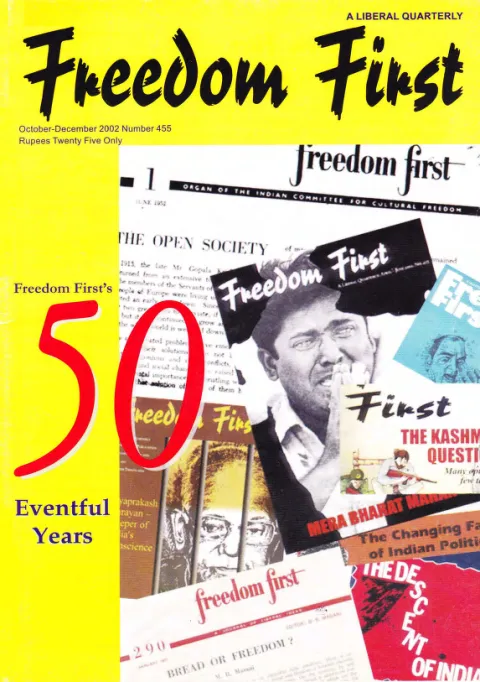
This is the 50th Anniversary Commemorative Issue of Freedom First (Number 455, October-December 2002), a special retrospective anthology assembled by guest editor Dr. Mary Thomas, who read every issue of the magazine from its founding in June 1952 through July 2002 and selected articles spanning that half-century for republication. In the rendered pages, the volume opens with editor S. V. Raju’s “Between Ourselves” note explaining the issue’s genesis (planned as 200 pages, reduced for lack of advertising support) and its dedication to the First National Convention of the Indian Liberal Group in Hyderabad, December 6-7, 2002 — billed as the first Liberal political convention in 75 years. Guest editor Mary Thomas’s own essay, “Fifty Years of Freedom First,” traces the magazine’s evolution from a monthly organ of the Indian Committee for Cultural Freedom (later the Democratic Research Service) fighting Communism, to its 1985 conversion into a quarterly Liberal journal, naming past editors and contributors including Minoo Masani, Dinkar Sakrikar, V. B. Karnik, and Nissim Ezekiel. The reprinted articles seen in this chunk — grouped under the section header ‘Freedom, Human Rights, Democracy’ — include M. R. Masani on the universality of human values against Cold War relativism (Nov 1952), C. Rajagopalachari on culture, self-control, and true freedom rooted in the Upanishads and Gita (Oct 1953), Sampurnanand’s address on the ‘neuroses’ of the Indian intelligentsia caught between communism and democracy (Oct 1953), and the opening of Malcolm Muggeridge’s ‘The Art of Non-Conforming,’ a Vogue-originated essay on intellectual non-conformity as resistance to mass orthodoxy.
Key points
-
This 50th Anniversary Commemorative Issue is a retrospective anthology assembled by guest editor Dr. Mary Thomas, who read every issue from the magazine’s June 1952 founding through July 2002 to select articles spanning its half-century for republication.
-
Mary Thomas’s own essay traces Freedom First’s evolution from a monthly organ fighting Communism to its 1985 conversion into a quarterly Liberal journal, naming past editors and contributors including Minoo Masani, Dinkar Sakrikar, V. B. Karnik and Nissim Ezekiel.
-
A reprinted 1952 M. R. Masani essay rebuts the relativist claim that non-Western peoples care only about bread and not liberty, invoking Gandhi’s spiritual self-control against Communist materialism.
-
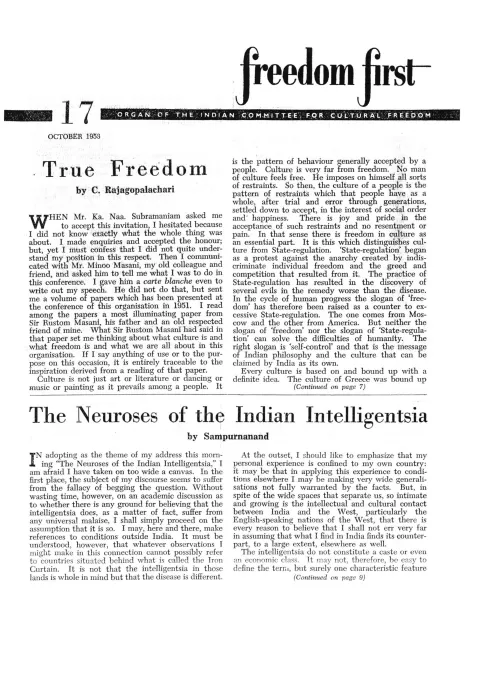
A reprinted 1953 C. Rajagopalachari address, “True Freedom”, grounds a distinctively Indian answer to both Soviet-style state regulation and unrestrained Western liberty in the Isa Vasya Upanishad’s and Bhagavad Gita’s teaching of self-control.
-
Sampurnanand’s 1953 address diagnoses a “neurosis” in the Indian intelligentsia caught between democracy and Communism, citing ancient India’s historic tolerance of heterodox thought as against Communist orthodoxy.
-
Malcolm Muggeridge’s “The Art of Non-Conforming”, originally published in Vogue, argues the mid-twentieth century is marked by exceptional ideological credulity and presents the “Non-Conforming Man” as a necessary resistance figure against mass orthodoxy.
-
The issue is dedicated to the First National Convention of the Indian Liberal Group in Hyderabad, billed as the first Liberal political convention in 75 years.
Essays
The Universality of Human Values
By M. R. Masani
In the rendered pages, this reprint of M. R. Masani’s essay (originally Freedom First, November 1952) argues for the universal applicability of human values against relativist claims — voiced by British socialist R. H. S. Crossman in the New Fabian Essays — that the ‘coolie in Malaya’ or ‘tribesman in Nigeria’ cares only for bread, not liberty. Masani rebuts this as fallacious, invoking Gandhi’s contrast between Communism’s materialism and India’s spiritual traditions, and Jayaprakash Narayan’s stated disillusionment with dialectical materialism. He closes by insisting that empty minds are as fertile ground for Communism as empty stomachs, and that the world cannot remain half slave and half free.
- Rebuts R. H. S. Crossman’s claim in the New Fabian Essays that non-Western peoples care only about bread, not liberty
- Cites Mahatma Gandhi’s philosophy of self-control and spirit over matter as the antithesis of Communist materialism
- Quotes Jayaprakash Narayan’s public renunciation of dialectical materialism as spiritually unsatisfying
- Argues empty minds are as good a breeding ground for Communism as empty stomachs, citing Czechoslovakia and Vienna as counter-examples to the ‘poverty causes Communism’ thesis
- Concludes democracy versus Communism hinges on whether a people has a superior ideology, will to resist, and capable leadership
True Freedom
By C. Rajagopalachari
C. Rajagopalachari’s ‘True Freedom’ (Freedom First, October 1953), delivered as an address, argues that culture is not art or literature but ‘the pattern of behaviour generally accepted by a people’ and that true freedom is bound up with self-control rather than either unrestrained liberty or state regulation. Drawing on the Isa Vasya Upanishad and the Bhagavad Gita, he contends that India’s distinctive contribution to civilization is the idea of self-restraint achieved through faith in a Divine order, as against both Soviet-style state regulation and Western untrammelled individual liberty. He closes by proposing that the organization’s true banner should be ‘self-control’ rather than ‘freedom’ as commonly understood.
- Defines culture as a people’s accepted pattern of behavioural restraint, distinct from and prior to freedom
- Frames ‘freedom’ and ‘State-regulation’ as opposing modern slogans, both inadequate; proposes ‘self-control’ as the true Indian answer
- Grounds the argument in close reading of the opening verses of the Isa Vasya Upanishad and the Bhagavad Gita
- Warns against both Hitlerism and Communism as attempts to control minds as if they were raw material like coal and iron
- Concludes that self-control, sustained by faith in Divine rule, is the basis of true freedom, as against licence or tyranny
The Neuroses of the Indian Intelligentsia
By Sampurnaand
Sampurnanand’s address, ‘The Neuroses of the Indian Intelligentsia’ (Freedom First, October 1953), diagnoses the Indian intellectual class as caught in a state of chronic uncertainty between competing ideologies of democracy and Communism. He argues ancient India tolerated the widest possible freedom of thought — citing Buddha’s and Mahavira’s dissent from Vedic orthodoxy — and contrasts this with the intolerance of Communist regimes, where thought must serve Party orthodoxy. He faults Indian universities for failing to develop a new synthesis of old and new culture, contrasts Russia’s cultural continuity under Marxism (aided by figures like Lenin and Gorky) with India’s post-independence spiritual vacuum following the loss of Gandhi, and closes by rejecting both religious ‘mumbo-jumbo’ framing and the false ‘struggle for existence’ import from Western biology as bases for social cooperation, appealing instead to the Vedic Rishi’s teaching that all beings are part of one cosmic whole (the Virat).
- Diagnoses a specific ‘neurosis’ in the Indian intelligentsia distinct from Western intellectual malaise, rooted in ideological uncertainty between democracy and Communism
- Cites ancient India’s tolerance of heterodoxy (Buddha, Mahavira, Charvaka materialism, Kapila’s atheism) as proof of a historic freedom of thought absent under Communism
- Criticizes Indian universities for failing to forge a living synthesis between old Indian culture and modern needs
- Contrasts Russia’s cultural continuity through Marxism under Lenin’s leadership with India’s post-Gandhi spiritual vacuum and loss of leadership ‘attuned to the Indian mind’
- Invokes the Vedic teaching ‘The Absolute Existence is one, the wise call it by many names’ as a better foundation for cooperation than Darwinian struggle imported from the West
- Concludes India’s leaders must actively shape cultural life to rescue the intelligentsia from imperialism-induced frustration and cynicism
The Art of Non-Conforming
By Malcolm Muggeridge
In the rendered pages, this is only the opening portion of Malcolm Muggeridge’s ‘The Art of Non-Conforming’ (originally published in Vogue in the U.S., republished with exclusive Indian rights secured by Freedom First). The essay argues that the mid-twentieth century, despite appearing enlightened, is marked by exceptional credulity and servility, with mass ideologies (Fascism, Nazism, Communism) and even distorted readings of Marx and Freud furnishing dogmas that individuals adopt uncritically. Muggeridge presents the ‘Non-Conforming Man’ as a necessary resistance figure against unchallenged collective orthodoxy, invoking Christian individualism’s stress on the sanctity of the separate soul as against the collectivist erasure of the individual, and continues into a discussion of mob judgment historically being untrustworthy, and Jonathan Swift’s defiant epitaph as an emblem of the non-conforming spirit.
- Argues the mid-20th century is an age of unusual credulity and ideological servility despite its self-image of enlightenment
- Identifies Fascism, Nazism, and Communism as neo-barbarisms that subordinate the individual to the collectivity, against which institutional Christianity’s doctrine of separate, precious souls stands opposed
- Frames the ‘Non-Conforming Man’ as a necessary check on unchallenged mass and elite orthodoxies
- Cites historical instances (the crowd at Golgotha, the Gadarene swine, mob judgments of Coriolanus and Caesar) to argue mob judgement is characteristically unreliable
- In the rendered portion, ends with Jonathan Swift’s self-composed epitaph as an example of unwavering non-conformist defiance
- This essay is only partially seen: it continues past page 20, the last rendered page in this chunk
Generated by the v1.5 extraction pipeline. Awaiting editorial review.
Metadata and summary are AI-extracted from the source PDF and reviewed for editorial accuracy. The original work is available via the Read PDF tab above (where present); paragraph-level citation inside the PDF is deferred to a future engagement.