periodical issue
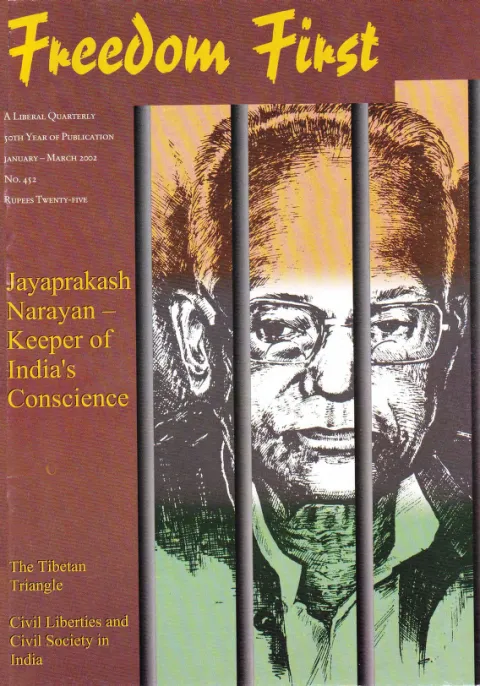
Freedom First
A Liberal Quarterly
By Arvind Deshpande, Jayaprakash Narayan
Publishers: Indian Committee for Cultural Freedom, 3rd Floor, Army & Navy Building, 148, Mahatma Gandhi Road, Mumbai 400 001. Published by J. R. Patel for the Indian Committee for Cultural Freedom and printed by him at Kaiser-E-Hind Private Ltd., 300, Perin Nariman Street, Mumbai 400 001. · Mumbai · 2002
52 pages
Freedom First
Summary
Freedom First No. 452 (January-March 2002), marking the magazine’s 50th year of publication, dedicates its issue to the birth centenary of Jayaprakash Narayan (JP), honouring him with the title “Loknayak” ahead of the Sarva Seva Sangh-led centenary observances. In the rendered pages, the issue opens with its regular “With Many Voices” digest of press quotations and the editorial “Of Cabbages and Kings” column commenting on English-language enrichment, the national flag, cable-operator censorship, judicial delays, and a restaurant-trade tax protest. The bulk of the rendered content is the JP tribute package: an unsigned biographical feature tracing JP’s life from birth in 1902 through his American education, conversion from Marxism to Gandhian thought, Quit India imprisonment, Sarvodaya leadership, the Bihar drought relief and ‘Free Kitchen’ movement, the Total Revolution call, detention during the Emergency, and death in 1979; a personal tribute by Arvind Deshpande; and a first-person account by documentary filmmaker Prem Vaidya, “JP: The Architect of India’s Second Liberation,” covering his own reporting on the 1966-67 Bihar/UP drought and JP’s role in organizing relief. The rendered pages end partway into a reprinted “Testament of Protest” - JP’s open letter to Indira Gandhi written from Jaslok Hospital in December 1975, protesting the Emergency.
Key points
-
Marking the magazine’s 50th year, the issue is dedicated to the birth centenary of Jayaprakash Narayan, honouring him as “Loknayak” ahead of Sarva Seva Sangh centenary observances.
-
An unsigned biographical feature traces JP’s life from his 1902 birth through his American education and reading of Marx, repeated imprisonment by the British including torture at Lahore Fort, his post-Independence turn from Marxism to Gandhian Sarvodaya, the 1966 Bihar drought “Free Kitchen Movement”, the 1974 Total Revolution call, and his death in 1979.
-
Arvind Deshpande’s personal tribute recalls meeting JP through the Indian Committee for Cultural Freedom in the early 1960s, defends him against charges of political “failure”, and recounts a 1969 episode in which JP reacted with sorrow rather than anger to Sheikh Abdullah’s harsh treatment over a Kashmir miscommunication with Indira Gandhi.
-
Prem Vaidya’s first-person account of filming Bihar’s 1966 drought relief documents systemic distribution fraud and missionary organisations outperforming government agencies, then follows JP’s arc through the 1974 Bihar agitation, Emergency detention and declining health, and the 1977 Janata Party victory.
-
The issue reprints JP’s December 1975 “Testament of Protest”, an open letter to Indira Gandhi written from Jaslok Hospital and originally suppressed in the Indian press, in which he denies plotting to paralyse the government and defends the Bihar movement’s constructive aims.
-
The regular “Of Cabbages and Kings” column comments on English-language enrichment, the national flag, and cable-operator censorship.
Essays
Jayaprakash Narayan - Keeper of India’s Conscience
In the rendered pages, this unsigned biographical feature (credited only to “www.indiaisthebest.com”) narrates Jayaprakash Narayan’s life from his 1902 birth in Sitabdiara, through his education at Patna College and in the United States (Berkeley, then Iowa State, where he read Marx’s Das Capital and M. N. Roy), his marriage to Prabhavati, his conversion under Congress Socialist Party organizing, repeated imprisonment by the British (Nasik, Deoli, Lahore Fort torture), his post-Independence shift from Marxism toward Gandhian thought, his 1954 dedication to Vinoba Bhave’s Sarvodaya movement, his role in the Bihar drought relief and ‘Free Kitchen Movement’ of 1966, his 1974 call for ‘Total Revolution,’ his arrest and detention during the 1975 Emergency, and his death on October 8, 1979.
- JP was born October 11, 1902, in Sitabdiara on the UP-Bihar border; studied at Patna College before leaving early, moved by Maulana Abul Kalam Azad’s oratory on the Non-cooperation movement.
- He studied sociology in the US (Berkeley, then Iowa State after fee hikes), working manual jobs, and there read Marx’s Das Capital and M. N. Roy, concluding Marxism was the way to alleviate mass suffering.
- Imprisoned repeatedly by the British; endured 16 months of torture at Lahore Fort in 1943 and escaped Nasik jail with Ram Manohar Lohia via an underground ‘Azad Dasta’ guerrilla group.
- After Independence and Gandhi’s assassination, JP moved from Marxism toward Gandhian non-violence, later dedicating his life (jeewan daan) to Vinoba Bhave’s Sarvodaya movement in 1954 and winning the Ramon Magsaysay Award for ‘The Reconstruction of Indian Polity.’
- Led Bihar drought relief in 1966 through the ‘Free Kitchen Movement,’ walked unarmed into Naxalite-held territory, and later launched the 1974 ‘Total Revolution’ call against inflation, unemployment and corruption.
- Arrested during the 1975 Emergency and detained (much of it in solitary confinement), his health collapsed from kidney failure; he was released on parole in November 1975 and later helped found the Janata Party.
- Died October 8, 1979, hailed as “Loknayak” (leader of the people).
A Personal Tribute
By Arvind Deshpande
Arvind Deshpande’s personal tribute recalls first meeting JP alongside Minoo Masani and Ashok Mehta at an Indian Committee for Cultural Freedom biennial meeting in the early 1960s, and describes a close association that continued through the Leslie Sawhny Programme until JP’s death in 1978 [sic, JP died 1979]. Deshpande defends JP against charges of political ‘failure,’ arguing that his choice to serve through moral witness rather than office was itself a kind of success, and recounts a 1969 episode in which Sheikh Abdullah’s harsh treatment of JP over a Kashmir message from Indira Gandhi left JP wounded but without anger toward her.
- Deshpande met JP, Minoo Masani and Ashok Mehta in the early 1960s through Prof. A. B. Shah’s Indian Committee for Cultural Freedom meetings.
- He argues JP, Achyut Patwardhan, Lohia and Masani were natural successor-leaders to Nehru who instead ‘went their own ways.’
- Describes a 1969 incident where Sheikh Abdullah angrily confronted JP over a miscommunication involving Indira Gandhi’s assurances on Kashmir; JP reacted with sorrow, not anger, calling Gandhi ‘like my elder brother’s daughter.’
- Rejects the ‘failure’ label applied to JP, comparing him to Gopal Krishna Gokhale’s remark that some are ‘destined to serve through failure.’
- Closes by calling JP a man of ‘no power or authority, no wealth, but innate goodness, compassion, patriotism’ before whom the powerful bowed.
The Architect of India’s Second Liberation
By Prem Vaidya
Documentary filmmaker Prem Vaidya’s first-person account, seen through page 16 of the rendered pages (essay continues in the printed magazine to page 17 and possibly beyond), recounts his own reporting assignments covering Indira Gandhi’s 1966 Independence Day address and, from November 1966, the drought-relief effort across Bihar and UP. Vaidya describes filming starving villagers, a ‘red-card’ holder receiving dirty foodgrains, callous local politicians and bureaucratic apathy, and international missionary relief efforts, before turning to JP’s chairmanship of the Bihar Relief Committee and its ‘Free Kitchen Movement,’ which he credits with saving hundreds from starvation. The essay then follows JP’s arc through the 1974 Bihar agitation, the 1975 Emergency arrest and detention, his declining health and dialysis, the 1977 Janata Party victory, and Vaidya’s own later meeting alongside Sir Edmund Hillary at JP’s house in September 1977, closing with JP’s death in 1979 and a final couplet JP kept posted on his door.
- Vaidya covered Indira Gandhi’s August 1966 Independence Day speech at the Red Fort, then a two-day flying tour of drought-hit Bihar/UP in November 1966 with a five-member film unit.
- He documented systemic distribution fraud: a ‘red-card’ holder given foodgrains 700 grams short and mixed with dirt, and a village official (Mukhiya) reluctant to correct it.
- Missionary organizations (Ramakrishna Mission, Catholic Relief Society/CARE) were doing more visible relief work in the field than government agencies, per his account.
- JP, as Chairman of the Bihar Relief Committee, ran a ‘Free Kitchen Movement’ feeding roughly 700 people daily per kitchen and pushed for an in-depth study of the ‘Palamau Experiment’ food-for-work scheme.
- The essay traces the Emergency period: JP’s arrest, midnight arrests of opposition leaders (Vajpayee, Advani, Chandrashekhar, Charan Singh, and others), press censorship, and the Sanjay Gandhi-driven sterilisation targets (24.85 lakh planned for 1975-76 against 26.24 lakh actually sterilised).
- JP’s health failed under detention (kidney failure requiring dialysis); he was released on parole in November 1975 and refused a special medical fund offered by Indira Gandhi’s government.
- The Janata Party, formed under J. B. Kripalani and JP’s guiding influence, defeated Congress in 1977; Vaidya later accompanied Sir Edmund Hillary to meet JP at his Kadamkuan home in September 1977.
Testament of Protest - An Open Letter to Mrs. Indira Gandhi
By Jayaprakash Narayan
A reprint of JP’s December 5, 1975 open letter to Indira Gandhi, written from Jaslok Hospital and originally suppressed in the Indian press but published by the Far Eastern Economic Review (Hong Kong) in its February 20, 1976 issue. In the rendered portion (through page 20 of 20, cut off mid-letter), JP rebuts the charge that he sought to ‘paralyse the government’ or incite army/police mutiny, defends the Bihar movement’s ‘janata sarkars’ as constructive rather than subversive, and challenges Gandhi’s refusal to hold a plebiscite testing public support for her government.
- JP denies plotting to paralyse the government or to spread disaffection among the civil and military forces, calling these Gandhi’s ‘major notes’ of accusation against him.
- He argues the Bihar ‘janata sarkars’ (people’s organisations) pursued constructive aims: regulating the public distribution system, curbing corruption, implementing land reforms, and addressing social evils like dowry and divorce practices.
- He distinguishes the Bihar movement’s use of non-cooperation and satyagraha from the freedom struggle’s parallel tactics against British rule, noting the current government was constitutionally elected, unlike the colonial regime.
- JP asserts that mass rallies, the three-day Bihar bandh, and large gatherings at Gandhi Maidan were sufficient proof of the people’s will, and that he had repeatedly (and unsuccessfully) called for a plebiscite to settle the question.
- The rendered excerpt ends mid-argument on page 20 (printed page 18), before the letter’s conclusion.
Generated by the v1.5 extraction pipeline. Awaiting editorial review.
Metadata and summary are AI-extracted from the source PDF and reviewed for editorial accuracy. The original work is available via the Read PDF tab above (where present); paragraph-level citation inside the PDF is deferred to a future engagement.