Freedom First
Summary
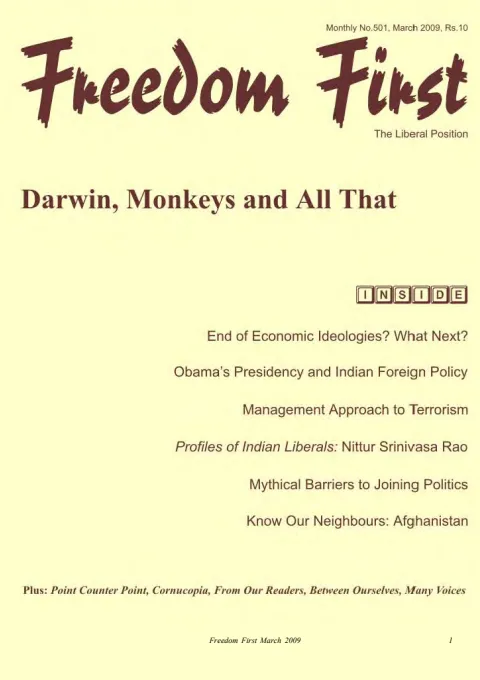
The rendered pages show the March 2009 issue of Freedom First, a liberal periodical centered here on science, economics, constitutionalism, foreign policy, terrorism, public accountability, and political participation. The issue opens with R. Srinivasan’s bicentenary reflection on Darwin and then turns to A. D. Moddie’s diagnosis of the 2008 global recession as a crisis for twentieth-century economic ideologies. Several pages address post-26/11 anxieties: police capacity, the National Investigation Agency, bureaucratic accountability, terrorism as prejudice hardened into violence, the rule-of-law duty to defend even Ajmal Kasab, and India’s diplomatic handling of Pakistan after the Mumbai attacks.
Key points
-
R. Srinivasan’s bicentenary essay on Darwin situates him alongside Marx and Freud as a shaper of modern thought, explaining natural selection and tracing public controversies over evolution from the Huxley-Wilberforce exchange to the Scopes trial.
-
A. D. Moddie argues the 2008 global financial crisis has shaken the twentieth century’s major economic ideologies — Soviet communism, state socialism, Chinese pragmatism, and American capitalism — and calls for pragmatic new institutions and a shift from Atlantic to Pacific economic power.
-
Ashok Karnik’s “Point Counter Point” weighs police courage during 26/11 against systemic failures, welcomes the new National Investigation Agency while warning that inter-agency turf protection remains the harder problem, and argues courts and voters must prevent convicted candidates from normalising criminality in politics.
-
Sadanand B. Kumte shifts blame for 26/11 from politicians to the permanent bureaucracy, arguing bureaucrats hide behind procedure and status while escaping accountability for security and administrative failures.
-
P. R. Dubhashi urges India not to read Barack Obama’s presidency narrowly through Kashmir, CTBT, and NPT anxieties, welcoming a prospective shift from Bush-era unilateralism toward diplomacy and multilateralism.
-
Sharu S. Rangnekar frames terrorism as an extreme, learned form of group prejudice rather than a product of any one religion or education level, arguing cosmopolitan interaction and counter-propaganda can convert prejudice into tolerance.
-
Firoze Hirjikaka’s “Cornucopia” defends the constitutional obligation to provide Ajmal Kasab a legal defence, argues India’s post-26/11 diplomatic ambiguity toward Pakistan usefully preserves American pressure, and reads the murder of Paloma Fernandes as a symptom of instant-gratification culture.
-
B. Leela profiles Justice Nitoor Srinivasa Rau as a Gandhian liberal humanist whose Kannada publishing work, nationalist activity, and legal career culminated in his role as India’s first Central Vigilance Commissioner, while Sanjeev Sabhlok argues Indian liberals should overcome myths about electoral violence and cost to enter organised politics.
Essays
Darwin, Monkeys And All That
By R. Srinivasan
R. Srinivasan presents Darwin as one of the figures, alongside Marx and Freud, who transformed modern thought, then explains natural selection through variation, survival, reproduction, and inheritance. The article stresses Darwin’s challenge to orthodox Christianity and follows the public controversies around evolution from Huxley’s Oxford exchange with Bishop Wilberforce to the Scopes trial in Tennessee.
- Darwin is placed with Marx and Freud as a maker of modern worldviews.
- The article explains natural selection as the survival and reproduction of favourable variations.
- It notes Darwin’s impact on Marx, Freud, Herbert Spencer, and Social Darwinism.
- It treats the Huxley-Wilberforce controversy and the Scopes trial as public battles over evolution.
End of Economic Ideologies? What Next?
By A. D. Moddie
A. D. Moddie argues that the global financial crisis has shaken the great economic ideologies of the twentieth century: Soviet-style communism, state socialism, Chinese pragmatism, American capitalism, and the emerging BRIC story. He reads the crisis through deregulation, financial malfeasance, sub-prime lending, revolving doors between finance and government, and the limits of both laissez-faire and state control.
- The article treats 1989-2008 as a period in which both left and right economic certainties collapsed.
- It cites the US financial crisis, sub-prime mortgages, and deregulation as central causes of global turmoil.
- It argues that neither invisible-hand capitalism nor commissar-style state control can answer the crisis.
- It calls for pragmatic global leadership, new institutions, and a shift from Atlantic to Pacific economic power.
Point Counter Point
By Ashok Karnik
Ashok Karnik’s Point Counter Point weighs opposing arguments on police image, the National Investigation Agency, and candidates with criminal convictions. The column defends the bravery of police during 26/11 while distinguishing routine policing from specialised counter-terror capacity, welcomes stronger investigation mechanisms while warning that intelligence coordination is the harder problem, and argues that courts and voters must prevent convicted candidates from normalising criminality in politics.
- The column balances criticism of police failures with recognition of frontline courage during 26/11.
- It warns that the NIA and MAC will matter only if agencies share intelligence rather than protect turf.
- It criticises the use of pending appeals to keep convicted candidates electorally viable.
- It places rule-of-law consistency above theatrical outrage.
The Guilty Men of 2008 - Bureaucracy’s Accountability
By Sadanand B. Kumte
Sadanand B. Kumte’s essay shifts blame for 26/11 from politicians alone to the permanent bureaucracy. He argues that India’s bureaucratic class hides behind procedure, status, and ministerial responsibility while escaping accountability for failures in law, order, security preparedness, and administrative reform.
- The essay calls 26 November 2008 a defining moment for India’s psyche and destiny.
- It indicts bureaucrats as protectors of delay, privilege, and the status quo.
- It argues that corruption links politicians, bureaucrats, and police.
- It demands identification and accountability for the administrative lapses behind the Mumbai tragedy.
Obama’s Presidency and Indian Foreign Policy
By P. R. Dubhashi
P. R. Dubhashi urges India not to interpret Barack Obama’s presidency narrowly through Indo-Pak relations or anxieties over Kashmir, CTBT, and NPT. He reads Obama’s election as a global democratic and civil-rights moment and argues that India should welcome a shift from Bush-era unilateral military power toward diplomacy, multilateralism, social spending, and a more independent Indian foreign policy rooted in peace, equality, freedom, and fair play.
- The essay contrasts Bush’s strategic closeness to India with Obama’s potentially broader world agenda.
- It warns India against reducing Obama to Kashmir, Pakistan, CTBT, and NPT concerns.
- It welcomes diplomacy, multilateralism, and world peace over military unilateralism.
- It asks India to stop acting as a junior partner of the United States.
A Demand for Indian ‘Hyenas’
By KASHINATH DIVECHA
No summary was extracted for this article. Listed for completeness.
Management Approach to Terrorism Terrorists - R - Us
By Sharu S. Rangnekar
Sharu S. Rangnekar presents terrorism as an extreme form of prejudice: the terrorist believes his own group is wholly acceptable and the other group deserves punishment. The essay distinguishes moral training from group prejudice, argues that cosmopolitan interaction can modify inherited hostility, and proposes counter-propaganda, inter-group cooperation, and a culture of equality as remedies.
- The essay rejects the idea that terrorism belongs to one religion or educational type.
- It frames prejudice as a learned centrifugal force that can harden into violence.
- It argues that interaction across groups can turn prejudice into exception-making and then broader tolerance.
- It uses UNESCO and Iqbal to argue that peace must be built in minds, not only by security technology.
The Shoe Legacy
By TENZIN TSUNDUE
No summary was extracted for this article. Listed for completeness.
Cornucopia (Subverting Due Process; Is India’s Diplomacy Working; For Love Or Money)
By Firoze Hirjikaka
Firoze Hirjikaka’s Cornucopia column includes three short pieces. The first defends due process and the constitutional obligation to provide a legal defence even to Ajmal Kasab; the second argues that India’s post-26/11 ambiguity toward Pakistan is tactically useful because it keeps American pressure on Pakistan; the third reads the murder of Paloma Fernandes as a symptom of instant-gratification culture and low tolerance for rejection among the young.
- The column insists that defending an accused is a constitutional imperative, not betrayal.
- It argues that India can use American self-interest to pressure Pakistan after 26/11.
- It contrasts contemporary Indian diplomatic realism with earlier moral posturing.
- It links a workplace-era romantic murder to entitlement, recession, and immature rejection.
Profiles of Indian Liberals: Justice Nitoor Srinivasa Rau
By B. Leela
B. Leela’s profile of Justice Nitoor Srinivasa Rau presents him as a South Indian liberal whose Gandhian commitments, Kannada publishing work, legal career, and public service reinforced one another. The essay follows his education, early nationalist influences, translation and publishing activity, defence work in sedition cases, role in the Gokhale Institute of Public Affairs, and later service as Advocate General, judge, Chief Justice, and India’s first Central Vigilance Commissioner.
- Nitoor is portrayed as both Gandhian and liberal humanist.
- His Satya Shodhan Pustak Bhandara helped build modern Kannada literary culture.
- He took part in nationalist and Congress activity in Mysore and Karnataka.
- His later legal and public offices are presented as extensions of civic service and probity.
Mythical Barriers to Joining Politics
By Sanjeev Sabhlok
Sanjeev Sabhlok argues that Indian liberals have stayed out of electoral politics because of myths about violence, money, ego, and leadership. He maintains that elections are not as violent or expensive as assumed, that good candidates need message, time, credibility, and commitment more than illicit spending, and that liberals should join organised politics through a credible platform rather than remain spectators.
- The essay says liberal writing has not translated into electoral action since the Swatantra Party ended.
- It challenges the belief that elections are too violent for liberals to enter.
- It argues that money helps but does not determine electoral success.
- It calls for liberals to accept possible defeat as good citizenship and join a serious platform.
”The Fault Line is not between wealthy and poor, but…”
By Anand Giridharadas
No summary was extracted for this article. Listed for completeness.
Know Our Neighbours: Afghanistan
By Suresh Chandra Sharma
Suresh Chandra Sharma surveys Afghanistan’s modern conflict from Soviet invasion and Taliban rule to Operation Enduring Freedom, ISAF, reconstruction, Pakistan’s double game, and the resurgence of Taliban power. The essay argues that weak national authority, ethnic division, warlords, Pakistani militants, strategic fatigue among allies, and the US economic crisis all threaten Afghanistan’s stability.
- The essay presents Afghanistan as a buffer state with ethnic and linguistic complexity.
- It traces the Taliban’s rise, US intervention after 9/11, and Karzai’s emergence.
- It highlights India’s reconstruction role and Pakistan’s use of the Taliban to check Indian influence.
- It warns that talks with the Taliban, strategic fatigue, and weak institutions may produce a failed state.
From Our Readers (The Nuclear Deal; Islamic Banking)
The rendered From Our Readers page contains letters on the India-US nuclear deal and Islamic banking. Sharad Bailur defends the 123 Agreement against fears that the Hyde Act can override a sovereign agreement, while Suresh Chandra Sharma recounts a skeptical anecdote about replacing interest with profit-sharing terminology.
- The nuclear-deal letter distinguishes US domestic law from an international agreement between sovereign nations.
- It argues that reimposing an NSG embargo would be commercially and diplomatically unlikely.
- The Islamic banking letter treats interest bans and profit-sharing substitutes as semantic evasion.
- A joke from page 12 is resolved at the bottom of the readers’ page.
Generated by the v1.5 extraction pipeline. Awaiting editorial review.
Metadata and summary are AI-extracted from the source PDF and reviewed for editorial accuracy. The original work is available via the Read PDF tab above (where present); paragraph-level citation inside the PDF is deferred to a future engagement.