periodical issue
Freedom First
A Quarterly of Liberal Ideas
By Minoo Masani
Published by J.R. Patel for the Democratic Research Service and printed by him at Parsiana Publications Pvt. Ltd., 300 Perin Nariman Street, Bombay 400 001 · Bombay · 1993
52 pages
Freedom First
Summary
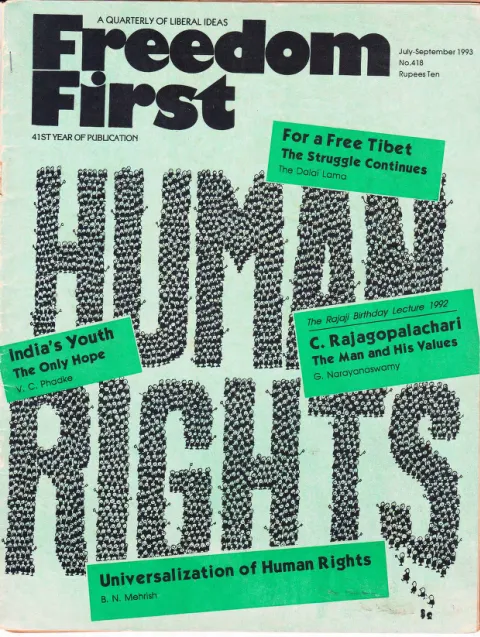
This is issue No. 418 (July-September 1993) of Freedom First, the Bombay-based quarterly of liberal ideas founded by Minoo Masani, edited in this issue by S. V. Raju and R. Srinivasan. The cover theme is Human Rights, and in the rendered pages the issue opens with a compressed press-quotes column (“With Many Voices”), a notes-and-comment section (“Of Cabbages and Kings”) on cycle-rickshaws and the environmental costs of the East Asian “tiger” economies, an obituary tribute to the d’Avoine family of Bombay rationalists, a report on a college essay survey of Bhiwandi youth on the 1992-93 communal riots, two poems, a review of Osborne and Gaebler’s “Reinventing Government,” B. N. Mehrish’s account of the 1993 UN World Conference on Human Rights in Vienna, the Dalai Lama’s statement on the 34th anniversary of the Tibetan uprising, a Minoo Masani column reminiscing about his sister Mehra Masani, a satirical piece personifying a suitcase amid the Harshad Mehta scandal, and the opening pages of G. Narayanaswamy’s Rajaji Birthday Lecture on C. Rajagopalachari’s values. In the rendered pages, editorial concerns cluster around human rights (domestic and international), critique of bureaucratic/socialist governance in favour of market and entrepreneurial alternatives, and reverence for classical-liberal and nationalist-liberal exemplars (Rajaji, Minoo Masani).
Key points
-
B. N. Mehrish reports on the UN World Conference on Human Rights in Vienna (June 1993), noting the UN Centre for Human Rights received over 125,000 complaints that year, nearly triple 1992’s total, and detailing the Vienna Declaration’s action programme.
-
S. V. Raju’s obituary for Irene d’Avoine recounts her father Dr. Charles d’Avoine’s career as a Bombay rationalist tried and acquitted in 1933 under IPC Section 295, with both father and daughter buried without religious rites.
-
V. C. Phadke reports on an essay exercise given to 300 Bhiwandi college students on the 1992-93 communal riots, finding many blamed religious fanaticism and opportunistic politicians while also invoking Gandhian universalism.
-
Adi Doctor reviews Osborne and Gaebler’s “Reinventing Government,” explaining “entrepreneurial government” that steers rather than rows, citing New Zealand’s airline deregulation and Chicago’s parent-controlled school councils.
-
The Dalai Lama’s statement on the 34th anniversary of the Tibetan uprising warns that China’s new “special economic zone” status for the Tibet Autonomous Region risks accelerating demographic and cultural assimilation.
-
Minoo Masani’s column pays personal tribute to his late sister Mehra Masani, a senior All India Radio official denied the Director-General post, and criticises a Supreme Court decision permitting fee-based reservation of college seats after a student suicide over an unaffordable donation.
-
A satirical piece by S. S. Bankeshwar “interviews” a suitcase personifying cash-bribe politics after the Harshad Mehta scandal, referencing the Rs. 67 lakh suitcase allegedly delivered to PM Narasimha Rao.
-
G. Narayanaswamy’s Rajaji Birthday Lecture recounts C. Rajagopalachari’s Vedantic philosophy of detached duty and his record as Madras Chief Minister opening the Meenakshi Temple to Harijans and pioneering prohibition.
Essays
s aphorism that
A compilation of quotations from the Indian and international press (May-August 1993) on themes including communal theocracy, corruption, Indian bureaucracy’s suspicion of markets, capitalism, Marxism, and the state of Indian democracy. In the rendered pages, the column ranges from Nirad Chaudhuri on Indian emigres to Swaminathan S. A. Aiyar’s aphorism that “Marxism may also be odious, but Karl Marx was a great man,” to the Dalai Lama on Indian democracy’s untapped strength.
- Compiles short newspaper quotations from named columnists and public figures, dated May-August 1993
- Touches on communalism, corruption, capitalism vs socialism, and quality of Indian political leadership
- Includes a quote from the Dalai Lama (via The Times of India, June 5) on Indian democracy’s strength
Many Voices
An unsigned notes column in two parts. “Two Cheers for Cycle-Rickshaws” argues, drawing on Ivan Illich’s Energy and Equity and a study of Dhaka’s rickshaw economy, that cycle-rickshaws remain an underappreciated, high-employment, low-pollution transport mode that Indian and Bangladeshi policy discourages through high import duties and neglect. “The Unknown Story of the Dragons” punctures the East Asian miracle narrative by cataloguing the severe environmental costs of industrialisation in Taiwan and South Korea (river pollution, rising cancer and asthma rates, agricultural contamination).
- Cites Ivan Illich’s Energy and Equity on the social value of bicycle-based transport
- Reports that cycle-rickshaws account for over half of Dhaka’s vehicles and 70% of its passengers, citing scholar Rob Gallagher
- Criticises government neglect and high taxation of rickshaw manufacture in India/Bangladesh
- Details environmental costs of industrialisation in Taiwan and South Korea: polluted rivers, contaminated farmland, rising asthma and cancer
- References the magazine’s own earlier reporting (Freedom First, April 1988, p.4) on Taiwan’s pollution costs
Cabbages & Kings
By RS
An obituary tribute by S. V. Raju marking the death of Irene d’Avoine (died July 28, 1993), headmistress of Walsingham High School, and recounting the life of her father Dr. Charles d’Avoine, a Mauritius-born, France/Belgium-educated physician who settled in Bombay, became a leading rationalist, edited the journal Reason for the Rationalist Association of India, and was tried and acquitted in 1933 under Section 295 of the Indian Penal Code for an article on “Religion and Morality.”
- Irene d’Avoine, headmistress of Walsingham High School and a Freedom First reader, died July 28, 1993
- Her father Dr. Charles d’Avoine (b. 1875, Mauritius) settled in Bombay, treated plague victims, and became editor of Reason, journal of the Rationalist Association of India (RAI)
- Dr. d’Avoine was prosecuted in December 1933 under IPC Section 295 for his article “Religion and Morality” in Reason, and was acquitted
- Both father and daughter were buried without religious rites in unconsecrated ground in Bombay’s Sewree Cemetery
- Names numerous RAI members and Bombay public figures of the era (editors of Bombay Chronicle and The Bombay Sentinel, etc.)
The d’Avoines of Bombay
By S. V. Raju
Prof. V. C. Phadke reports on an essay exercise he administered to 300 first-year B.A. students at Bhiwandi Nizampur Nagarpalika College, in which two-thirds chose to write on “Riots, Riots, Riots” reflecting on the communal violence that followed the Babri Masjid demolition. The essay synthesises the students’ recorded views: many blamed religious fanaticism and politicians who incite riots for power, some invoked Gandhian universalism, and others pointed to unemployment and government weakness as root causes. Phadke frames the students’ spontaneous, ungraded responses as evidence that Indian youth are not the ivory-tower innocents they are assumed to be, and voices cautious hope in the youth’s professed desire for communal harmony.
- Based on an essay survey of 300 Bhiwandi college students (age 18-20) writing on the 1992-93 Bombay/Bhiwandi communal riots
- About 200 of 300 students chose to write on the riots topic rather than alternatives like ‘My Own Budget’
- Common themes in student essays: blame on religious fanatics and opportunistic politicians, invocation of Gandhian brotherhood, and structural causes like unemployment
- Notes Bhiwandi’s history of communal violence and a student observation that it stayed peaceful relative to its ‘mini-Pakistan’ reputation despite Babri Masjid provocations
- Concludes with a qualified affirmation that youth represent hope for India’s future
India’s Youth - The Only Hope
By V. C. Phadke
Two poems under “Poets’ Corner” by Ms. Sanskritirani Desai (Gujarati-language poet, translated into English): “In The Waiting Room Of Life,” a meditation on transient human relationships and unfulfilled understanding of life’s purpose, and “Mountains of Possibilities,” an allegory of God sifting through a mountain of life-possibilities with a sieve to give each person only what suits them, framed as a dialogue between the poet and God.
- Two poems by Ms. Sanskritirani Desai, a Gujarati-language poet published since the 1960s
- First poem uses a waiting-room metaphor for transient human connection and unexamined purpose
- Second poem allegorises fate/providence as God sifting a ‘mountain of possibilities’ through a sieve for each individual
Rethinking Government
By Adi Doctor
Prof. Adi H. Doctor (Head, Department of Politics, University of Goa) reviews David Osborne and Ted Gaebler’s “Reinventing Government” (Prentice-Hall of India, 1992), explaining the book’s concept of “entrepreneurial government” as one that steers rather than rows: promoting competition among service-providers, empowering communities rather than servicing them as dependent clients, focusing on outputs/performance rather than inputs/rules, decentralising decision-making, and emphasising prevention over crisis response. Examples cited include US private vs municipal garbage collection costs, New Zealand’s airline deregulation, Chicago’s parent-controlled school councils, California’s DMV computerisation, and a lead-paint bureaucratic bottleneck at a US federal housing agency. Doctor also flags the book’s caution against romanticising competition, since communities cannot always be forced into self-organisation.
- Reviews Osborne & Gaebler’s ‘Reinventing Government,’ proposing ten principles of ‘entrepreneurial government’
- Central thesis: entrepreneurial government steers (sets policy, fosters competition) rather than rows (directly provides services) via monopoly agencies
- Cites a US example: private garbage collection cost $17/ton vs $49/ton for municipal agencies due to inefficiency under monopoly
- Cites New Zealand’s move from a monopoly domestic airline to competition, sharply improving service
- Describes Chicago’s decentralised school governance via elected parent/community/teacher councils that hire and fire principals on performance
- Notes the book’s own caveat that government cannot force communities to organise or take control if they are unable to
Universalization of Human Rights
By B. N. Mehrish
Dr. B. N. Mehrish (Reader in International Law, Bombay University) reports on the UN World Conference on Human Rights held in Vienna, June 14-25, 1993, attended by delegates from about 180 states plus NGOs, amid a sharp rise in reported violations (over 125,000 complaints received by the UN Centre for Human Rights that year, nearly triple 1992). The article summarises the Vienna Declaration’s action programme (anti-racism measures, women’s rights, anti-torture steps, proposed UN High Commissioner for Human Rights and International Human Rights Court), India’s position at the conference (including Dr. Manmohan Singh’s and Dr. L. M. Singhvi’s interventions on Kashmir, self-determination, and terrorism), and the broader emerging doctrine of humanitarian intervention overriding state sovereignty, including a quoted position from Boris Yeltsin.
- Covers the UN World Conference on Human Rights, Vienna, 14-25 June 1993, with ~5,000 delegates from 180 states
- UN Centre for Human Rights received over 125,000 complaints in 1993, nearly triple 1992’s total
- Details the Vienna Declaration’s action programme: anti-racism, women’s rights, anti-torture measures, proposed High Commissioner for Human Rights and International Human Rights Court
- Describes India’s delegation position on Kashmir self-determination, opposing Pakistan’s framing of ‘liberation struggles’
- Notes Amnesty International representatives were refused permission by the Indian Government to visit Bombay in July 1993 to investigate post-riot police conduct
- Discusses the tension between national sovereignty and an emerging doctrine of humanitarian intervention, with the Soviet bloc historically opposing a High Commissioner on sovereignty grounds
For A Free Tibet - The Continuing Struggle
By The Dalai Lama
The full text of the Dalai Lama’s statement on the 34th anniversary of the Tibetan National Uprising Day (10 March 1993). He surveys renewed but inconclusive contact with the Chinese government (via the Beijing-Dharamsala channel and envoy Kalon Gyalo Thondup), calls for progress on four fronts (dialogue with China, international education about Tibet, monitoring the impact of new Chinese economic policies on Tibetan cultural survival, and democratisation of the Tibetan government-in-exile), and warns that China’s demographic policy of population transfer and the new ‘special economic zone’ status for the ‘Tibet Autonomous Region’ risk completing Tibet’s colonisation. He reaffirms his personal commitment to a genuinely democratic future Tibet, restates he will not hold office in a free Tibet, and closes with an affirmation that human dignity and freedom cannot ultimately be suppressed by dictatorship.
- Marks the 34th anniversary of the 1959 Tibetan National Uprising
- Reports renewed but strained direct contact between Dharamsala and Beijing via envoy Kalon Gyalo Thondup, with China maintaining a hard-line negotiating position
- Describes new official contact established with Taiwan as a hopeful development
- Warns that China’s new ‘special economic zone’ designation for the Tibet Autonomous Region risks accelerating demographic and cultural assimilation of Tibetans
- Calls for continued international pressure, education efforts, and democratisation of the Tibetan administration-in-exile
- Reaffirms his ‘Guidelines For Future Tibet’s Polity’ and his personal pledge not to hold office in a future free, demilitarised, non-violent Tibet
Masani Viewpoint
By Minoo Masani
In this instalment of ‘The Masani Viewpoint,’ Minoo Masani writes a personal tribute to his late sister Mehra Masani, an accomplished All India Radio official (Director of External Services, later denied the Directorship-General despite topping the merit list) who fought a long illness (rheumatoid arthritis) and died in 1990. He also touches on three unrelated notes: support for the convention that the Chairman of the Public Accounts Committee (PAC) be drawn from the leader of the Opposition (recalling his own 1967-69 term succeeded by Atal Behari Vajpayee), and a comment on a student suicide over inability to pay a college admission donation, criticising both social pressure and a Supreme Court decision permitting fee-based reservation of seats.
- Personal tribute to Mehra Masani, Minoo Masani’s sister, a senior All India Radio official who was denied the Director-General post despite topping the merit list, seen by Masani as due to ‘male chauvinism and intrigue’
- Recounts her career from AIR’s External Services Directorship to her later post as Director of the Leslie Sawhney Centre, Deolali, and her death in 1990 after a long struggle with rheumatoid arthritis
- Separately notes the 1967 convention (which Masani says should be maintained) that the PAC Chairman should come from the Opposition leader, referencing his own term succeeded by Atal Behari Vajpayee
- Criticises a case of a student suicide over an unaffordable college donation as exposing failures in India’s education system and objects to a Supreme Court decision permitting fee-based seat reservation
An Interview with Mr. Suitcase
By S. S. Bankeshwar
A satirical piece by S. S. Bankeshwar in which the author ‘interviews’ his own suitcase, personified as newly jubilant after suitcases (in the guise of cash-stuffed bags) became notorious symbols of political corruption following the Harshad Mehta stock scandal (the Rs. 67 lakh suitcase allegedly delivered to PM Narasimha Rao) and after unnamed MPs (‘suitcases’) were said to have saved the Narasimha Rao government in a no-confidence vote. The suitcase boasts of demand from VIPs, mocks the going rate for a Bombay University degree, and jokes about export prospects for India’s endemic corruption.
- A satirical dialogue personifying a suitcase as a stand-in for cash-bribe politics after the Harshad Mehta scandal
- References the Rs. 67 lakh suitcase allegedly delivered to PM Narasimha Rao as a first installment of political patronage
- Mocks MPs who allegedly took bribes (‘suitcases’ themselves) to save the government in a no-confidence vote, comparing it to Kapil Dev’s World Cup batting feat
- Jokes that a Bombay University B.A./B.Sc./B.Com. degree now ‘costs’ Rs. 9,000, naming a Shiv Sena leader as reference
- Ends with the suitcase declining to say which newspaper would publish the interview unless bribed itself
C. Rajagopalachari - The Man and His Values
By G. Narayanaswamy
No summary was extracted for this article. Listed for completeness.
The British Political Scene
By Ian Tickle
G. Narayanaswamy delivers the Rajaji Birthday Lecture 1992 on C. Rajagopalachari’s life and values, covering (in the rendered pages) Rajaji’s attitude to life and his personal qualities. Narayanaswamy, who knew Rajaji personally for over 12 years, structures the talk around five themes: attitude to life, personal qualities, concern for the poor and downtrodden, respect for law, and economic philosophy. The rendered pages cover the first two themes and open the third (concern for the downtrodden), describing Rajaji’s Vedantic/Gita-inflected philosophy of detached duty, anecdotes illustrating his personal integrity (the Ma Po Si anecdote, the fake-doctor prosecution), and his record as Chief Minister opening temples to Harijans, introducing debt relief for agriculturists, and pioneering prohibition as social policy from 1937. This essay continues past the rendered pages (TOC lists it running to p.25); coverage here is partial.
- Delivered as the Rajaji Birthday Lecture, 5 December 1992, by G. Narayanaswamy, who was closely associated with Rajaji for over 12 years
- Structures the talk into five themes: attitude to life, personal qualities, concern for the poor, respect for law, economic philosophy
- Rajaji’s philosophy draws on the Gita and Upanishads: detached performance of duty (‘yoga is the effort to purify our character’)
- Anecdotes illustrate personal humility and integrity, including refusing to let VIP status override friendship (the Ma Po Si story) and testifying candidly in a fraud trial against a fake doctor claiming to have treated him
- As Chief Minister of Madras (1937), opened the Meenakshi Temple at Madurai to Harijans roughly 50 years before the Mandal-era reservations debate, introduced the Debt Relief Act for agriculturists, and pioneered prohibition as both social and economic policy
- As Chief Minister he also backed labour rights (the Pannayar Act for agricultural workers’ share of produce) and stood up to the English Governor over a 1938 Harvey Mills lock-out dispute
Generated by the v1.5 extraction pipeline. Awaiting editorial review.
Metadata and summary are AI-extracted from the source PDF and reviewed for editorial accuracy. The original work is available via the Read PDF tab above (where present); paragraph-level citation inside the PDF is deferred to a future engagement.