periodical issue · festschrift
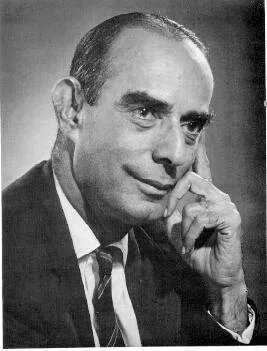
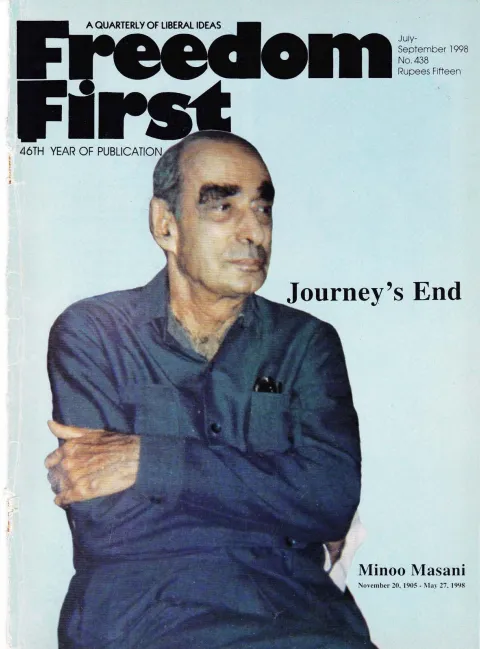
Minoo Masani 90
A Tribute to The Founder of Freedom First
By Minoo Masani
Published by S. V. Raju for Freedom First, Army & Navy Building, 3rd Floor, 148, Mahatma Gandhi Road, Bombay 400 001. · Bombay · 1995
101 pages

Minoo Masani 90
By Minoo Masani
Summary
In the rendered pages, this is a special tribute issue of Freedom First (‘A Quarterly of Liberal Ideas’), dated 20 November 1995, marking the 90th year of the magazine’s founder, Minoo Masani. Edited by S. V. Raju, the volume gathers extracts from Masani’s own books and speeches across more than five decades — each chapter tagged with its year of origin — rather than commissioned tributes from others, so that (in the rendered pages) the honouree speaks in his own voice. The editorial ‘Between Ourselves’ note frames the collection as a ‘wealth of knowledge and wisdom’ offered to a younger generation, and the acknowledgements credit sources including Our India, We Indians, The Growing Human Family, Picture of A Plan and Against the Tide. The rendered pages cover the front matter and the first three chapters, drawn from Masani’s early popular works of 1940-1945; the remaining seventeen chapters (on the Swatantra Party, the Emergency, foreign policy, the Constitution and more) lie beyond this chunk.
Key points
-
The issue is a tribute marking Freedom First founder Minoo Masani’s ninetieth year, compiled by editor S. V. Raju from extracts of Masani’s own books and speeches spanning more than five decades rather than commissioned essays by others.
-
In ‘Hindostan Hamara,’ drawn from his 1940 primer Our India, Masani argues national progress depends on the character of ordinary citizens rather than on government, since ‘every nation gets the government it deserves.’
-
The same essay stages a debate between a ‘Modernist’ favouring machines and a ‘Back-to-the-Village-Man,’ which Masani resolves with the formula ‘Maximum Employment plus Maximum Production plus Equitable Distribution’ for industrialising India.
-
‘Reconsidering Socialism,’ reproduced from his 1944 essay that became Socialism Reconsidered, revisits Masani’s earlier faith in nationalisation and warns that a fully collectivised economy can hand control to a new bureaucratic and managerial class.
-
That essay insists production being socialised is not the same as distribution being socialised, concluding that bureaucracy is merely replaced by more bureaucracy rather than by genuine socialism.
-
Masani defends individual liberty and democratic means over ends, repudiating the communist maxim that the end justifies the means, and points to the Scandinavian democracies and Gandhi’s ethics as models of humane socialism.
-
In ‘Planning,’ dated 1945, Masani likens a national Plan to a medical injection that can cure or kill a country depending on who administers it, so it must be entrusted only to a genuinely representative government.
-
That essay echoes Lincoln’s formulation of government ‘of the people, by the people and for the people’ as the only kind of authority fit to organise increased production and its equitable distribution.
Essays
Hindostan Hamara
By Minoo Masani
In the rendered pages, ‘Hindostan Hamara’ is an extract from Masani’s 1940 popular primer Our India, addressed in a plain, conversational voice to the ordinary young Indian reader. Masani argues that the country’s destiny rests on its citizens (‘Yes, YOU… you alone can fit together the odd pieces’), that governments do only as much as the people force them to (‘every nation gets the government it deserves’), and that India is squandering its possibilities by living ‘higgledy-piggledy, from day to day and from hand to mouth.’ A long set-piece dramatises the debate between the ‘Modernist’ who wants machines and big industry and the ‘Back-to-the-Village-Man,’ which Masani resolves with a characteristically pragmatic formula for industrialisation that still keeps people on the land.
- In the rendered pages the chapter is an extract from Our India (1940), Masani’s primer for young Indian readers.
- It insists national progress depends on what kind of citizens Indians become, not on government alone.
- It stages the machinery-versus-village debate and invokes Gandhi’s qualified objection to ‘the craze for machinery.’
- Masani offers the formula ‘Maximum Employment + Maximum Production + Equitable Distribution’ for industrialising India.
Reconsidering Socialism
By Minoo Masani
In the rendered pages, ‘Reconsidering Socialism’ reproduces Masani’s 1944 self-critical re-examination of his own socialism, the basis of his book Socialism Reconsidered. Twenty-five years after the Russian Revolution, he revisits the assumptions on which he had built his faith in socialism as ‘the solvent of almost all the world’s ills’ and concludes they need revision. His central worry is that nationalisation does not automatically yield a classless society: in a fully collectivised economy a new managerial and bureaucratic class can come to monopolise control, so that ‘production is socialised, but not distribution… Bureaucracy is replaced, not by socialism, but by bureaucracy.’ He insists on the primacy of individual liberty and democratic means over ends, repudiating the ‘end justifies the means’ slogan, and looks to the Scandinavian democracies and to Gandhi’s ethical contribution for a humane, democratic socialism.
- In the rendered pages the chapter is drawn from Masani’s 1944 essay that became Socialism Reconsidered.
- He revisits and revises his earlier faith that nationalisation alone would end the world’s ills.
- He warns a collectivised economy can hand control to a new bureaucratic-managerial class.
- He defends individual liberty and democratic means, rejecting the Communist ‘end justifies the means.’
- He points to the Scandinavian democracies and to Gandhi as guides to a humane socialism.
Planning
By Minoo Masani
In the rendered pages, ‘Planning’ (dated 1945) opens with Masani asking who is to organise increased production and ensure its benefits are equitably shared, answering ‘we ourselves, all of us,’ through the instrument of a responsible, democratically accountable government. Echoing Lincoln’s definition of government ‘of the people, by the people and for the people,’ he argues that a national Plan, like a medical injection, can cure or ruin a country, and so must be entrusted only to a genuinely Indian and representative government rather than to self-serving cliques.
- In the rendered pages the chapter (1945) argues that planning must be carried out by the people through responsible democratic government.
- Masani likens a Plan to a medical injection that can ‘cure or kill,’ depending on who administers it.
- He invokes Lincoln’s formulation of democratic government as the only kind that can be trusted with such a Plan.
Generated by the v1.5 extraction pipeline. Awaiting editorial review.
Metadata and summary are AI-extracted from the source PDF and reviewed for editorial accuracy. The original work is available via the Read PDF tab above (where present); paragraph-level citation inside the PDF is deferred to a future engagement.