periodical issue
शेतकरी संघटक
पाक्षिक
Shetkari Sanghatak
By sharad-joshi, पंतप्रधान, सुभाष बोधेकर, किशोर माधवराव, sharad-joshi
पाक्षिक शेतकरी संघटक; मालक — मोहन विठाणीराव परदेशी; मुद्रण स्थळ — गणेश प्रिंटर्स, ६९३, बुधवार पेठ, पुणे - २; संपादक, मुद्रक, प्रकाशक: सुरेशचंद्र म्हात्रे; प्रकाशन स्थळ व पत्रव्यवहाराचा पत्ता: अंगारमळा, मु. पो. आंबेठाण (४१० ५०१), ता. खेड, जि. पुणे. Regd. No. 39926/83. Posted at Market Yard, PSO, Pune 37, On 23rd, October 1992. Licence to post without prepayment No. 87, PNCW 281. · आंबेठाण, ता. खेड, जि. पुणे · 1992
12 pages
शेतकरी संघटक
Summary
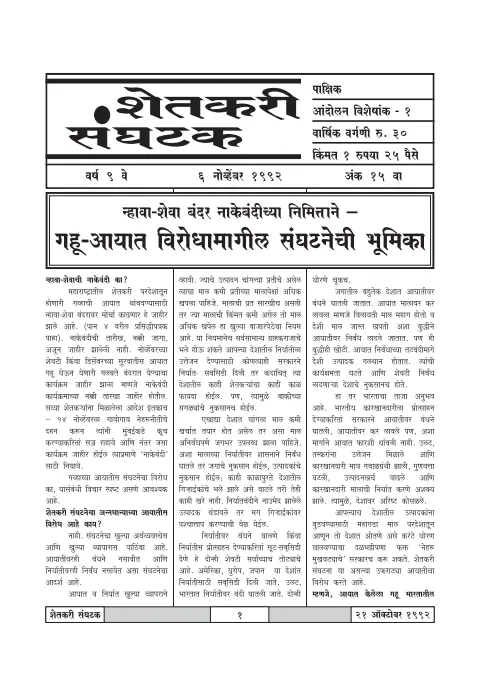
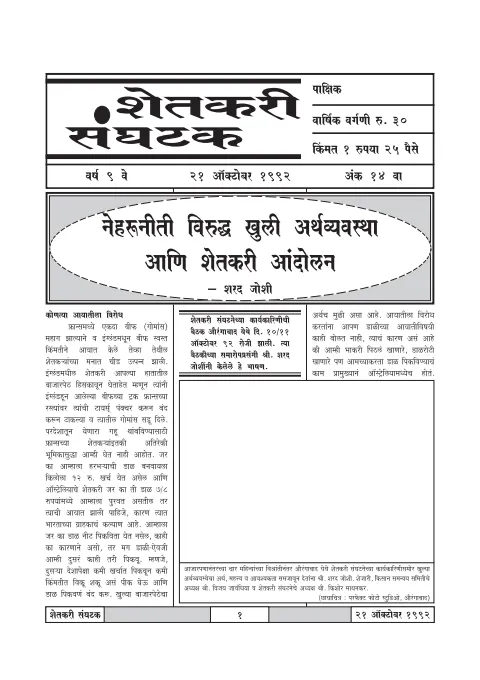
This Marathi fortnightly (Shetkari Sanghatak, Year 9 No. 14, 21 October 1992) is built around the lead article “नेहरूनीती विरुद्ध खुली अर्थव्यवस्था आणि शेतकरी आंदोलन” — Sharad Joshi’s address to the Shetkari Sanghatana’s executive committee meeting at Aurangabad (10–11 October 1992) and his speech to the public rally on 12 October. Joshi opens by contrasting the French farmers’ tyre-burning protests against subsidised British wheat (“Goamans”) imports with the Indian peasantry’s own position: the Shetkari Sanghatana is not opposed to imports per se, but it cannot accept subsidised imports that price domestic growers (whose wheat costs around Rs. 280/quintal) out of their own market when foreign wheat is dumped at Rs. 9–8 per kg. He uses this to distinguish genuine friends of the open economy from its self-styled advocates who actually want one-sided liberalisation that punishes farmers.
The second half of Joshi’s speech traces the tradition of opposition to the Nehruvian planning order — from Gandhi-era idealists through later dissenters — and argues that no honest farmer leader can today work within Lenin-and-Marx frames; the rural movement has its own anti-statist genealogy. He attacks the current Narasimha Rao–Manmohan Singh dispensation for confining liberalisation to “India” (urban industrial interests) while leaving Bharat (the village) shackled to Nehruvian controls on agriculture, citing the maxim “Power corrupts, absolute power corrupts absolutely” to explain why minimum government is a precondition of farmer prosperity. The address ends with the call to build a single front of supporters of the open economy across regions.
The issue’s news and resolution pages document the Sanghatana’s October 10–11 Aurangabad meeting, which passed three resolutions: blockading the ports at which imported wheat would be unloaded; banning state and central ministers from entering villages from Farmers’ Martyr Day, 10 November 1992; and building a unified front of open-economy supporters. Joshi’s own letter to Prime Minister P. V. Narasimha Rao — alleging that the Centre has “dashed farmers’ hopes” — is reproduced (p. 10), alongside Economic Times clippings on India’s planned import of 30 lakh tons of wheat, the falling wheat prices in Haryana after the 25 per cent procurement-bonus hike, and the World Bank’s call for India to lift its export bans. The issue closes (p. 7) with Subhash Bodhekar’s Marathi poem “बळी” and (p. 12) the news that Sanghatana worker Baban Jadhav lost a foot in a tractor accident on a protest convoy.
Key points
-
Lead article is a verbatim address by Shetkari Sanghatana founder Sharad Joshi delivered at the executive committee meeting in Aurangabad (10–11 Oct 1992) and the public rally on 12 October.
-
Joshi opens with the French farmers’ protests against subsidised British wheat imports to argue that the Sanghatana opposes only subsidised dumping, not foreign trade as such.
-
He distinguishes “friends” of the open economy (those who want it for both India and Bharat) from its enemies — including liberalisers who want it only for industry while keeping agriculture under Nehruvian controls.
-
The speech invokes “Power corrupts, absolute power corrupts absolutely” and the formula “समाजात किमान शासन असावे” (society should have minimum government) as the moral basis of the open-economy demand.
-
Joshi attacks the Narasimha Rao–Manmohan Singh dispensation for keeping the Nehruvian framework intact in agriculture even as it liberalises elsewhere, and locates the Sanghatana’s politics in a longer anti-planning, anti-Marxist genealogy.
-
The Aurangabad meeting’s three resolutions are reproduced: port blockades of imported wheat; a ministers’ village-ban from 10 November 1992 (Farmers’ Martyr Day); and a single front of all open-economy supporters.
-
Economic Times reprints document the Centre’s plan to import 30 lakh tons of wheat between March 1993 and April 1993, the falling wheat prices in Haryana after the procurement bonus, and the World Bank’s appeal that India lift its export bans.
-
Subhash Bodhekar’s Marathi poem “बळी” and a report on Sanghatana worker Baban Jadhav losing a foot in a tractor accident round out the issue.
Generated by the v1.5 extraction pipeline. Awaiting editorial review.
Metadata and summary are AI-extracted from the source PDF and reviewed for editorial accuracy. The original work is available via the Read PDF tab above (where present); paragraph-level citation inside the PDF is deferred to a future engagement.