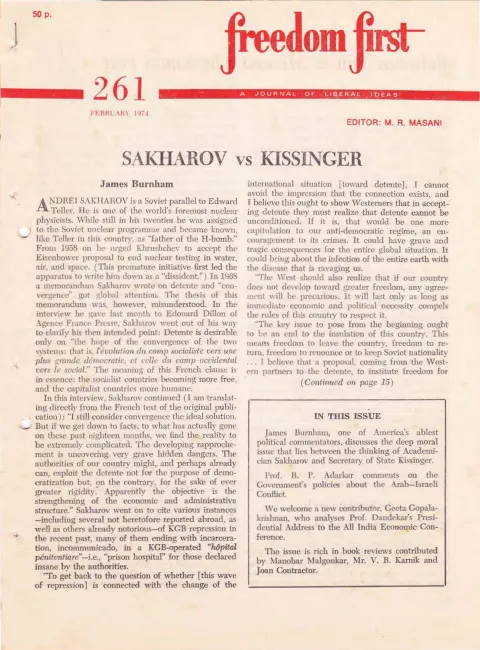
periodical issue
Freedom First
A Journal of Liberal Ideas
By S. V. Raju, M. R. Pai
Published for the Democratic Research Service by J. R. Patel, Associate Editor, Freedom First at 127, M. Gandhi Road, Bombay 1 ('Phone: 254341) and printed by him at Inland Printers, 55 Gamdevi Road, Bombay 7. · Bombay · 1973
16 pages
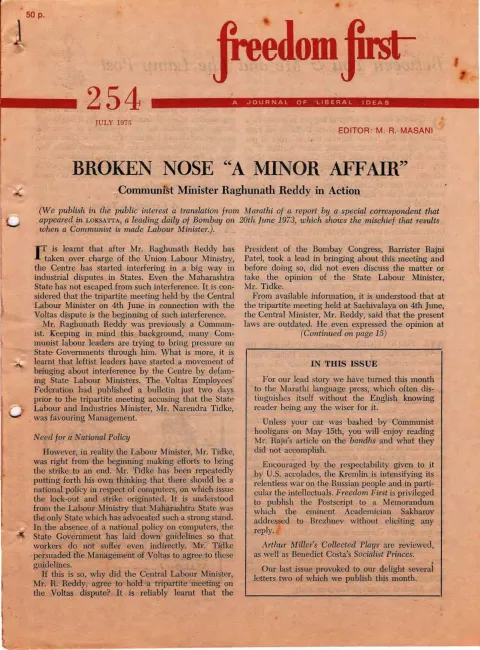
Freedom First
Summary
This is the complete July 1973 issue (No. 254) of Freedom First, the Bombay-based liberal monthly edited by M. R. Masani. The lead story, translated from a Marathi Loksatta report, accuses Union Labour Minister Raghunath Reddy, a former Communist, of improperly interfering in state-level industrial disputes (Voltas, Indian Explosives Kanpur, Indian Drugs and Pharmaceuticals Rishikesh) in favour of striking unions. The regular ‘Between You & Me and the Lamp Post’ column takes up Indian Airlines’ monopoly, Swatantra Party factional troubles in Orissa, Ronald Reagan’s proposed California tax ceiling versus Soviet income tax rates, the bicentenary of Adam Smith’s birth, and diplomatic slights to Ambassador T. N. Kaul in Washington. S. V. Raju contributes a satirical account of Bombay’s May 1973 bandhs called by trade unions and George Fernandes against the backdrop of drought and price rises. The issue reprints, as a documentary exclusive, the Postscript that Soviet physicist Andrei Sakharov appended in June 1972 to his 1971 Memorandum to Brezhnev, indicting Soviet apathy, psychiatric persecution of dissidents, and militarisation. Two book reviews follow: Joan Contractor on Arthur Miller’s Collected Plays, and M. R. Pai on Benedict Costa’s India’s Socialist Princes and Garibi Hatao, a polemic against India’s ‘socialist’ political class. The letters section carries an exchange on judicial independence prompted by an earlier editorial, and a rebuttal concerning a review of a seminar volume on India’s Vietnam policy. The issue closes with ‘Who Invited Whom?’, juxtaposing Gustav Husak’s 1968 denial of inviting Warsaw Pact troops into Czechoslovakia with his 1971 thanks to the CPSU, and the ‘With Many Voices’ page of aphoristic quotations.
Key points
-
A translated Loksatta report accuses Union Labour Minister Raghunath Reddy, a former Communist, of interfering in Maharashtra industrial disputes at Voltas, Indian Explosives and Indian Drugs and Pharmaceuticals to favour striking unions.
-
The “Notes” column welcomes Ronald Reagan’s proposed California tax ceiling, marks Adam Smith’s 250th birth anniversary, and mocks the diplomatic slight given to Ambassador T. N. Kaul in Washington.
-
S. V. Raju’s “A Tale of Two Bandhs and a Half” satirises Bombay’s rival May 1973 bandhs by Communist unions and George Fernandes, concluding neither delivered relief to the drought-hit population.
-
Freedom First publishes as a documentary exclusive Andrei Sakharov’s 1972 Postscript to his Memorandum to Brezhnev, indicting Soviet apathy, psychiatric persecution of dissidents and militarisation.
-
Joan Contractor reviews Arthur Miller’s Collected Plays, tracing a recurring pattern of ordinary heroes achieving tragic stature through free will, and M. R. Pai reviews Benedict Costa’s polemic on India’s “socialist princes”.
-
Letters debate the June “Freedom is Indivisible” editorial’s charge of a press “conspiracy of silence” and a review of a seminar volume on India’s Vietnam policy.
-
A short item juxtaposes Gustav Husak’s 1968 denial and 1971 thanks to the CPSU over the Warsaw Pact invasion of Czechoslovakia, closing before “With Many Voices”.
Essays
Broken Nose “A Minor Affair”: Communist Minister Raghunath Reddy in Action
An unsigned lead article, translated from a Marathi report in the Bombay daily Loksatta (20 June 1973), accuses Union Labour Minister Raghunath Reddy, a former Communist, of interfering in Maharashtra’s industrial relations to favour striking unions, beginning with a tripartite meeting he convened on the Voltas dispute without consulting the State Labour Minister Narendra Tidke. The piece reports that Reddy dismissed a 1969 case in which a worker broke a supervisor’s nose as ‘a minor affair’, and that he considers existing industrial laws outdated and employer-oriented. The article (continued from page 1 to page 15) adds two further cases of alleged Centre interference: at Indian Explosives Ltd’s fertilizer division in Kanpur, where Marxist-led unions repeatedly broke agreements amid a power-cut-driven lay-off, and at Indian Drugs and Pharmaceuticals, Rishikesh, where Reddy demanded reinstatement of all workers and took over responsibility for adjudicating a strike’s legality despite continuing indiscipline.
- Alleges Union Labour Minister Raghunath Reddy, a former Communist, is enabling Centre interference in state industrial disputes
- Central to the case is a 4 June tripartite meeting on the Voltas dispute called without consulting Maharashtra’s Labour Minister Narendra Tidke
- Reddy dismissed a 1969 assault in which a supervisor’s nasal bone was broken as ‘a minor affair’
- Maharashtra Labour Minister Tidke is presented favourably as pushing for a national computers policy and securing guidelines from Voltas management
- Extends the interference charge to Indian Explosives Ltd (Kanpur) and Indian Drugs and Pharmaceuticals Ltd (Rishikesh), citing repeated breach of agreements and Reddy’s intervention on reinstatement and strike legality
A Tale of Two Bandhs and a Half
By S. V. Raju
The unsigned ‘Between You & Me and The Lamp Post’ column runs six short editorial items. It ridicules a Delhi announcement bringing Indian Airlines under closer Civil Aviation Ministry control as proof the real problem is government monopoly, not insufficient oversight. It reports on Swatantra Party discord in Orissa between Piloo Mody and Biju Patnaik over the Pragati Party alliance. It welcomes California Governor Ronald Reagan’s proposed constitutional tax ceiling, noting Milton Friedman’s endorsement, and contrasts it with high Indian taxation and, ironically, with the Soviet Union’s own comparatively low income-tax ceiling. A short item marks the 250th anniversary of Adam Smith’s birth, crediting Wealth of Nations and Ludwig Erhard’s ‘German Miracle’ as living rebuttals to Marx. Another item mocks the ceremonial delay given to Indian ambassador T. N. Kaul in presenting credentials to President Nixon, contrasted with the access given to a Chinese envoy. The column closes with two boxed reprints: ‘Precept & Practice’, on Finance Minister Y. B. Chavan’s motorcade despite urging petrol economy, and ‘Expropriation’, an excerpt from O. A. Altayev in Survey (Winter 1973) on the moral costs of Soviet housing expropriation.
- Argues Indian Airlines’ problems stem from state monopoly, not insufficient ministerial control
- Covers a Swatantra Party rift in Orissa between Piloo Mody and Biju Patnaik over the Pragati Party alliance
- Praises Reagan’s proposed California tax ceiling and notes Milton Friedman’s support, contrasting it with Indian and even Soviet tax rates
- Marks Adam Smith’s 250th birth anniversary, linking Wealth of Nations to Ludwig Erhard’s postwar German recovery
- Contrasts the diplomatic reception given to India’s ambassador T. N. Kaul with that given a Chinese envoy in Washington
- Reprints anecdotes critiquing official hypocrisy (Y. B. Chavan’s motorcade) and Soviet housing expropriation (via Survey magazine)
Sakharov Writes to Brezhnev: Postscript to a Memorandum
S. V. Raju’s satirical account of Bombay’s back-to-back bandhs in May 1973. The Communist-aligned United Council of Trade Unions planned a bandh for 15 May, but George Fernandes postponed his rival bandh to 25 May, prompting CITU’s Comrade S. Y. Kolhatkar’s fury at the suggestion that the movement depended on Fernandes. The 15 May ‘collective action’ fizzled — only 12 of 62 mills and 58 of 259 factories closed — degenerating into vandalism (one car burnt, over 500 windscreens smashed) rather than an effective strike, while police were notably passive. On 25 May, George Fernandes ran a more successful bandh with a ‘positive programme’ including opposition to the ‘Twin City project’, joined by the Jan Sangh’s Bharatiya Mazdoor Sangh and grain retailers but not the Communists; Bal Thackeray’s Shiv Sena opposed it and kept its bus depots running, while Shiv Sainiks were later accused of intimidating shopkeepers to close on 26 May. The essay concludes that neither bandh achieved anything of substance for the drought-hit population, and closes by noting Fernandes’ announcement, from Delhi, that he would contest a Lok Sabha by-election from a Bombay constituency, with several parties denying having invited him to do so.
- Recounts two rival Bombay bandhs in May 1973: 15 May (Communist-led, United Council of Trade Unions) and 25 May (George Fernandes-led)
- The 15 May bandh largely failed as an organised strike (only a fraction of mills/factories closed) and degenerated into car and property vandalism, with police notably passive
- The 25 May bandh, backed also by the Jan Sangh’s Bharatiya Mazdoor Sangh, was comparatively more effective, while Bal Thackeray’s Shiv Sena opposed it and kept buses running
- Concludes neither bandh delivered any real relief for the drought-affected population; food prices and power failures continued regardless
- Notes Fernandes’ subsequent announcement of a Lok Sabha by-election bid from Bombay, with parties denying they invited his candidacy
Reviews: Arthur Miller’s Collected Plays
By Joan Contractor
Freedom First publishes, as a translated documentary exclusive, the Postscript that Soviet physicist Andrei Sakharov appended in June 1972 to his May 1971 Memorandum to Communist Party General Secretary Brezhnev, having received no reply. Sakharov writes that while he does not deny genuine social and economic progress in the USSR over 50 years, Soviet society is marked by apathy, hypocrisy, and ‘petit bourgeois egoism’, with a privileged party-state apparatus indifferent to human rights violations and a population sunk in alcoholism. He calls for democratization, rule of law, and full intellectual freedom, and argues capitalism and the socialist regime must converge, with reduced militarism on both sides. The Postscript details ‘hidden’ failures in health care and education, condemns continuing psychiatric persecution of dissidents (naming Grigorenko, Gershuni, Fainberg, Borisov, and the poet Lupynis) and religious persecution particularly in the Baltic states, and singles out arms-race militarization — noting Soviet military expenditure exceeds 40 percent of national income — as a threat to peace. He closes by urging the establishment of an ‘International Council of Experts’ with standing to make recommendations to national governments.
- Sakharov’s June 1972 Postscript follows an unanswered May 1971 Memorandum to Brezhnev
- Diagnoses Soviet society as suffering apathy, hypocrisy, privilege-hoarding by the party-state apparatus, and endemic alcoholism
- Calls for democratization, rule of law, and full intellectual freedom as the basis for ‘spiritual regeneration’
- Argues resolution of Cold War tensions requires convergence of capitalism and socialism, with reduced militarism on both sides
- Documents continued psychiatric persecution of dissidents (naming Grigorenko, Gershuni, Fainberg, Borisov, Lupynis) and religious persecution in the Baltic states
- States Soviet military spending exceeds 40% of national income and calls for an International Council of Experts to advise governments
Reviews: India’s Socialist Princes and Garibi Hatao by Benedict Costa (Hypocricy + Parasitism = Radicalism)
By M. R. Pai
Joan Contractor reviews Arthur Miller’s Collected Plays (Allied Publishers, India, Rs. 15), covering All My Sons, Death of a Salesman, The Crucible, A Memory of Two Mondays, and A View from the Bridge. She praises the volume’s readability and Miller’s introduction, and traces a recurring pattern across the plays: heroes of ordinary station who attain tragic stature not through high status but through free will exercised within an iron-bound set of circumstances, culminating in each protagonist’s self-destructive reckoning with truth, guilt, or love (Joe Keller’s suicide, Willy Loman’s suicide-as-insurance-policy, John Proctor’s refusal to falsely confess, Eddie Carbone’s fatal stabbing). The review closes by noting Miller’s own claim that he is committed to the ‘un-mod pre-twentieth century notion’ that man is more than the sum of his stimuli.
- Reviews Arthur Miller’s Collected Plays (Allied Publishers India), covering five plays including Death of a Salesman and The Crucible
- Identifies a recurring Miller pattern: ordinary-station heroes who attain tragic stature via free will within circumstance, not high social rank
- Summarises the moral arcs of Joe Keller (All My Sons), Willy Loman (Death of a Salesman), John Proctor (The Crucible), and Eddie Carbone (A View from the Bridge)
- Frames Miller, despite his contemporary image, as an old-fashioned moralist committed to human agency against determinism
Letters: “Freedom is Indivisible”
By M. R. Pai
M. R. Pai reviews Benedict Costa’s India’s Socialist Princes and Garibi Hatao (Kalyani Publishers, Ludhiana, Rs. 18), a collection of eight essays, some previously published in Illustrated Weekly of India, exposing the hypocrisy of India’s ‘radical’ socialist political class — ministers with tax-free perquisite income, governors living in feudal splendour, black-money holders, and smugglers — under the formula ‘Hypocrisy + Parasitism = Indian Radicalism’. Pai commends the book’s integration of material and its unusually careful sourcing, but flags factual inconsistencies (contradictory kisan-holding figures on pages 40 and 77; a demonetisation figure on page 82 that doesn’t match a Reserve Bank Governor C. D. Deshmukh figure) and the absence of an index. Pai partly dissents from Costa’s framing, arguing it is unfair to liken today’s parasitic politicians to India’s former princely class, many of whom had genuine nobility and love for their subjects, and situates the phenomenon instead within a feudal society straining under industrialisation, where ‘equality’ rhetoric masks vote-catching necessity. He closes endorsing Costa’s central question of whether Indira Gandhi can succeed ‘where others have failed’, concluding the book itself answers ‘No’, and calls for a revised, up-to-date pocket-book edition.
- Reviews Benedict Costa’s India’s Socialist Princes and Garibi Hatao (Kalyani Publishers), eight essays on hypocrisy among India’s socialist political class
- Summarises the book’s central formula: Hypocrisy + Parasitism = Indian Radicalism
- Notes factual inconsistencies in the book (contradictory kisan-holding and demonetisation figures) and the lack of an index
- Pai partly disagrees with equating current ‘socialist princes’ with the historic princely class, arguing many princes had genuine nobility
- Frames the phenomenon as a feudal society straining under technological and industrial change, using egalitarian rhetoric as political cover
- Concludes the book itself answers ‘No’ to whether Indira Gandhi’s government can succeed where predecessors failed, and calls for a revised paperback edition
Letters: “India and the World”
By A. P. Jain
The Letters page carries two exchanges. In the first, ‘Freedom is Indivisible’, Leela P. Trikamdas responds to the June 1973 editorial of the same name, defending the late Purshottam Trikamdas’s long record of warning against erosion of judicial independence (including his 1968 clash with Nehru over the 25th Amendment) and disputing the editorial’s charge of a ‘conspiracy of silence’ among the press and intelligentsia, citing extensive coverage in the Hindustan Times, Times of India, and the Hindu. The Editor’s reply (unsigned, presumably Masani) responds that Mrs. Trikamdas has missed the editorial’s point, which was that none of the protests explicitly called the supersession of the three judges a step toward Communist takeover, unlike Kumaramangalam’s parliamentary defence, which the editorial had likened to Vyshinsky’s justification of Stalin’s show trials. In the second letter, ‘India and the World’, A. P. Jain challenges Mr. Chatterjee’s review of a seminar volume on India’s Vietnam policy, defending the book’s Part I as a careful analysis by Prof. L. P. Singh, Dr. J. M. Mukhi, Mr. Mankekar, Dr. Parimal Das, and Mr. Chakravarti of India’s ambivalent position between the US, USSR, and China, and accusing Chatterjee of pro-American bias evident in his uncritical citation of Nixon’s rhetoric.
- Leela P. Trikamdas defends her late husband Purshottam Trikamdas’s record on judicial independence, referencing his 1968 warnings to Nehru about the 25th Amendment
- The Editor’s reply clarifies the June 1973 editorial’s point: that no protester explicitly framed the judges’ supersession as a step toward Communist takeover, unlike Kumaramangalam’s Vyshinsky-like parliamentary defence
- A. P. Jain rebuts Mr. Chatterjee’s review of a seminar volume (‘India and the World’), defending its Part I essays by L. P. Singh, J. M. Mukhi, Mankekar, Parimal Das, and Chakravarti on India’s Vietnam policy
- Jain accuses Chatterjee of pro-American sympathies, citing his approving quotation of Nixon statements like ‘one time exception’ and ‘extenuating circumstances’
Who Invited Whom?
A short unsigned documentary item juxtaposes two statements by Gustav Husak, First Secretary of the Czechoslovak Communist Party: his August 1968 denial, reported in Pravda, that any Czechoslovak leader had invited Warsaw Pact troops into the country, against his April 1971 address to the 24th CPSU Congress thanking the Soviet people for having ‘understood the anxieties of the Czechoslovak Communists regarding socialism and their appeals for help’ — presented as evidence of the earlier denial’s falsity.
- Juxtaposes Gustav Husak’s August 1968 denial (Pravda) that Czechoslovak leaders invited Warsaw Pact intervention
- Contrasts this with Husak’s April 1971 CPSU Congress address thanking the USSR for responding to Czechoslovak Communists’ ‘appeals for help’
- The juxtaposition is presented without further comment, implying the 1971 statement contradicts the 1968 denial
With Many Voices
The closing ‘With Many Voices’ page is a compilation of short quotations from world and Indian press and public figures on politics, corruption, and power, framed by an epigraph from Tennyson. Quoted sources include Romesh Thapar, Christopher Hollis, Ronald Reagan, P. M. Kamath, Indira Gandhi, George Fernandes, Edwina Mountbatten (on Nehru), Hugh Scott, President Nixon, and The Economist on Brezhnev’s foreign travels and on Pakistan’s break-up. The page also carries the issue’s subscription form and the publication’s colophon naming J. R. Patel as Associate Editor and the Democratic Research Service as publisher, based at 127 Mahatma Gandhi Road, Bombay.
- A compilation of press and public-figure quotations on power, corruption, and Cold War politics, framed by a Tennyson epigraph
- Includes Indira Gandhi on US-China-Asia diplomacy and George Fernandes calling her ‘the biggest fraud in Indian politics’
- Includes Edwina Mountbatten’s remark that Nehru is ‘God’s dream of an Indian model for an ideal world’
- Carries the subscription form and colophon: published for the Democratic Research Service by J. R. Patel, Associate Editor, at 127 M. Gandhi Road, Bombay
Generated by the v1.5 extraction pipeline. Awaiting editorial review.
Metadata and summary are AI-extracted from the source PDF and reviewed for editorial accuracy. The original work is available via the Read PDF tab above (where present); paragraph-level citation inside the PDF is deferred to a future engagement.