periodical issue
Freedom First
Published for the Democratic Research Service by Adam Adil at 127 Mahatma Gandhi Road, Bombay 1. Printed by Adam Adil at Inland Printers, 55 Gamdevi Road, Bombay 7. · Bombay · 1964
12 pages
Freedom First
Summary
Freedom First issue 142 (March 1964) is a monthly opinion periodical published from Bombay by the Democratic Research Service, edited by Raman K. Desai. In the rendered pages it carries six signed pieces plus an unsigned closing column of quotations. V. B. Karnik opens with a piece on the Asoka Mehta-PSP controversy, arguing that Indian democrats should prioritise building a political consensus over cultivating conflict. Saadi contributes a polemical piece warning against restoring G. M. Sadiq to the Kashmir cabinet, framing him as a communist infiltrator of the National Conference. A. G. Mulgaonkar reflects on Nehru’s succession following his illness, urging a freely chosen new prime minister and a high-powered interim council. M. R. Pai reports on the Swatantra Party’s Third (Bangalore) Convention, noting its growing institutionalisation, the influence of Masani’s candid organisational report, and Rajaji’s inaugural address. N. S. Ranganath Rao proposes statutory reforms to India’s obscenity law under the Indian Penal Code. M. A. Venkata Rao surveys how Vedic, Buddhist, and Jain traditions might answer Marxist materialism on questions of self, ethics, and the state. The issue closes with ‘With Many Voices,’ a page of aphoristic quotations culled from world and Indian press. Together the pieces reflect the magazine’s classical-liberal, anti-communist, Swatantra-aligned editorial stance in early 1964.
Key points
-
V. B. Karnik’s “Consensus Or Conflict?” addresses the Asoka Mehta-PSP disciplinary controversy to argue Indian democrats should prioritise building a shared civic consensus over pursuing conflict, since India lacks the entrenched consensus that lets Anglo-American democracies safely tolerate party rivalry.
-
Writing as “Saadi,” “Danger In Kashmir” warns against restoring G. M. Sadiq to the Kashmir cabinet after the Hazratbal relic theft, tracing his political biography to argue he is a “confirmed communist” who has embedded sympathisers in Kashmir’s unions, student bodies and press.
-
A. G. Mulgaonkar’s “Question Of Succession,” prompted by Nehru’s illness, argues non-alignment has repeatedly failed India’s interests and proposes a small Supreme Emergency Council including opposition figures like Rajaji and Kripalani to manage foreign and defence policy during a transition.
-
M. R. Pai’s “Bangalore Convention Of Swatantra Party” reports on the party’s Third Convention, highlighting Masani’s candid organisational report on its weak cadre and dependence on “supine” Big Business funding, and its shifting social base toward young professionals.
-
N. S. Ranganath Rao’s continuing “The Law Of Obscenity” proposes recasting IPC Section 292 to require knowledge and intent, judge works as a whole, and admit expert evidence on literary merit, modelled partly on Britain’s 1959 Obscene Publications Act.
-
M. A. Venkata Rao’s “Tradition Looks At Marx” argues Vedic, Buddhist and Jain traditions share Marxism’s concern for the poor but reject its materialism, describing a traditional dharma-based social order that ranked truth-seekers above rulers and rulers above the bourgeoisie.
-
The closing “With Many Voices” column quotes Mao Tse-tung predicting the collapse of Khrushchev, “that paper tiger,” and reproduces the statutory ownership statement naming Adam Adil as printer/publisher and Raman K. Desai as editor.
Essays
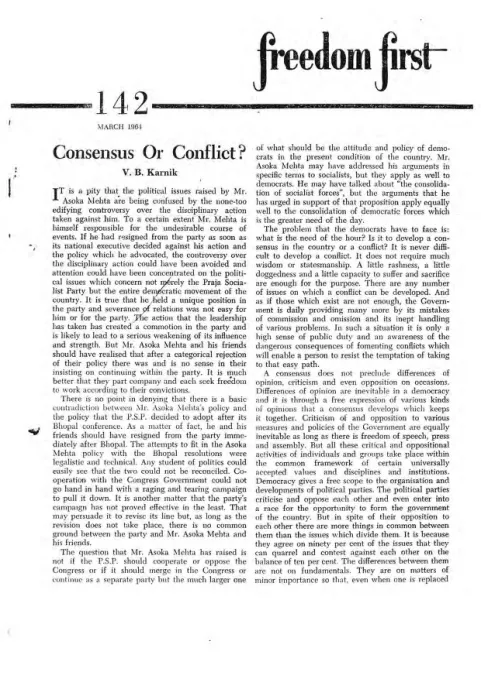
Consensus Or Conflict?
By V. B. Karnik
V. B. Karnik addresses the controversy over disciplinary action taken against Asoka Mehta by the Praja Socialist Party, arguing the deeper issue is not procedural but a basic contradiction between Mehta’s line and the PSP’s Bhopal resolutions. Karnik contends that Indian democrats face a more fundamental choice between fostering national consensus or conflict, and that conflict-driven politics — however tempting — risks weakening democracy in an emerging nation still without an entrenched consensus. He compares India’s situation to established democracies like Britain and America, where a background consensus lets party conflict occur safely, and to Communist states, where dictatorship suppresses dissent instead of building consensus. He closes by urging democrats of all stripes to prioritise the patient work of building a shared civic consensus.
- Frames the Asoka Mehta/PSP dispute as reflecting a real policy contradiction, not just a disciplinary spat
- Argues India lacks an established political consensus of the kind that sustains Anglo-American democracy
- Warns that pursuing conflict as a strategy, absent consensus, risks disintegration of Indian democracy
- Distinguishes acceptable democratic conflict (bounded by shared institutions) from Marxist/Communist conflict aimed at total victory
- Calls on democrats — socialist and non-socialist alike — to work toward consensus rather than confrontation
Danger In Kashmir
By Saadi
Writing under the byline ‘Saadi,’ the author argues that the theft of the sacred relic from Hazratbal shrine and the ensuing violence exposed the incompetence of the Kashmir government, and warns against the possible return of Ghulam Mohammed Sadiq to the Kashmir cabinet or premiership. The essay traces Sadiq’s political biography — his entry into the Muslim Conference, his alignment with communist figures, his role in converting the Muslim Conference into the National Conference, and his formation of the rival Democratic National Conference after falling out with Bakshi Ghulam Mohammed — to argue that Sadiq is a ‘confirmed communist’ who has used government and party positions to embed communist sympathisers in Kashmir’s labour unions, student bodies, and press. It calls for Sadiq and his associates to be publicly exposed and kept out of power, arguing a communist-led Kashmir government would be a far graver danger than an incompetent one.
- Blames the Kashmir government’s incompetence for failing to control post-Hazratbal-relic-theft disturbances
- Alleges collusion by ‘high placed persons in New Delhi’ to restore G. M. Sadiq to office
- Recounts Sadiq’s biography: Muslim Conference to National Conference to founding the Democratic National Conference
- Documents alleged communist infiltration of Kashmir labour unions, student groups, and the press under Sadiq’s influence
- Argues Sadiq favoured a Soviet/Pakistan-inclusive plebiscite formula and criticises Anglo-American ‘imperialists’
- Concludes a communist prime minister would be a greater disaster for Kashmir than mere government incompetence
Question Of Succession
By A. G. Mulgaonkar
A. G. Mulgaonkar uses Nehru’s recent illness as the occasion for reflecting on the question of succession to his leadership, distinguishing his role as Congress party leader from his role as Prime Minister. Mulgaonkar argues that Nehru, despite unmatched vote-getting power built over three elections, is ‘irreplaceable’ in an electoral sense but has left the Congress organisation directionless and reliant on his personal authority rather than settled policy. Surveying India’s foreign policy of non-alignment, he traces the history of similar postures (Splendid Isolation, isolationism, neutralism) to argue that non-alignment has repeatedly failed to secure India’s interests, citing contradictions over Suez, Hungary, and the recent China conflict. He proposes that Nehru step down from day-to-day charge in favour of a small Supreme Emergency Council of seven or eight members, including opposition stalwarts like Rajaji and Acharya Kripalani, to manage foreign and defence policy and ensure a smooth, orderly transition of power, warning that unstable government is the greatest danger facing Indian parliamentary democracy.
- Separates Nehru’s role as Congress party leader from his role as Prime Minister in discussing succession
- Argues Nehru’s electoral ‘vote-getting’ power makes him irreplaceable in the short term despite policy failures
- Surveys the history of isolationism/neutralism/non-alignment as strategies that repeatedly proved unworkable
- Criticises India’s foreign policy contradictions, citing differing standards applied to Suez and Hungary
- Proposes a small Supreme Emergency Council under Nehru, including opposition figures, to manage foreign and defence policy
- Calls for the Congress Parliamentary Party to freely elect its own leader rather than anoint a ‘compromise candidate’
- Warns that unstable governments, not conflict itself, pose the greatest threat to Indian parliamentary democracy
Bangalore Convention Of Swatantra Party
By M. R. Pai
M. R. Pai reports on the Swatantra Party’s Third Convention, held in Bangalore on 1-2 February, comparing it to the party’s 1959 Bombay and 1960 Patna gatherings. He highlights General Secretary M. R. Masani’s candid organisational report acknowledging the party’s lack of a devoted cadre and its financial dependence on a ‘supine and cowardly’ section of Big Business. Pai reviews the convention’s thirteen resolutions — on economic policy, non-alignment and Communist China, the 17th Constitution Amendment Bill, and states’ rights — and notes two internally important resolutions on converting the party into a cadre-based organisation and pursuing electoral understandings with non-Communist opposition parties. He offers three impressions: that the party has become institutionalised, that its philosophy has crystallised (aided paradoxically by government measures like Compulsory Deposit and Gold Control), and that its social composition is shifting from ex-Congress dissidents and pre-Independence politicians toward small businessmen and professionals in the 25-40 age range. He closes noting the convention’s failure to address Indo-Pak relations or link its philosophy to everyday concerns like civic administration and education.
- Reports on the Swatantra Party’s Third Convention in Bangalore, 1-2 February, comparing it with 1959 and 1960 gatherings
- Highlights Masani’s unusually candid organisational report on the party’s cadre and financing weaknesses
- Summarises the convention’s thirteen resolutions, especially on economic policy, non-alignment, and the 17th Amendment Bill
- Notes internal resolutions to build a cadre-based party and seek electoral understandings with non-Communist opposition
- Observes the party’s changing social base: shift from ex-Congress dissidents to small businessmen and young professionals
- Criticises the convention for not addressing Indo-Pak relations or linking free-enterprise philosophy to everyday civic concerns
The Law Of Obscenity
By N. S. Ranganath Rao
N. S. Ranganath Rao, continuing a discussion begun in earlier issues, sets out defects in India’s law of obscenity as it stands under the Indian Penal Code — notably its reliance on the English Hicklin test, its disregard of authorial intent, its focus on isolated passages rather than a work as a whole, and its imposition of absolute liability even on booksellers. He proposes recasting Section 292 with an explanatory clause modelled partly on Britain’s Obscene Publications Act, 1959, requiring ‘knowingly and without lawful justification’ as an element of the offence, judging a work by its effect taken as a whole, allowing expert evidence on literary, artistic, or scientific merit, and exempting objects intended for the public good.
- Lists six defects in the existing obscenity law: Hicklin-derived test, disregard of intent, ignoring literary/artistic/scientific merit, isolated-passage focus, weakest-reader standard, and absolute liability
- Proposes recasting IPC Section 292 with knowledge/intent as a required element of the offence
- Recommends judging obscenity by the work’s effect ‘taken as a whole’ rather than isolated passages
- Proposes admitting expert evidence on literary, artistic, or scientific merit
- Draws on Britain’s Obscene Publications Act, 1959 as a partial model
- Notes the proposal could mitigate the absence of jury trial in India for such cases
Tradition Looks At Marx
By MA Venkata Rao
M. A. Venkata Rao examines how India’s Vedic, Buddhist, and Jain traditions might respond to Marxism, arguing that while traditionalists share Marxism’s humanitarian concern for the poorest and most disinherited, they reject its materialist account of human nature and history. He surveys Vedic conceptions of the universal self (sarvatma bhava, brahman), the Buddhist goal of nirvana as the death of egoistic desire, and Jain teachings on ahimsa and the potential infinite self (jiva), arguing all three traditions see the first egoistic impulses of human nature as controllable rather than final, unlike Marxism’s view of man as determined by economic conditions. He describes a traditional social order of dharma-bound occupational groups (sreni, nagar sabhas) that resolved conflicting interests through law rather than class struggle, in which the class of rulers and administrators, not capital-holders, held the second rank of social honour after truth-seekers, with the bourgeoisie relegated to third place. He concludes that Marxism, while not to be accepted as materialist doctrine, has served as a useful catalytic agent, sharpening the social conscience of tradition-rooted Indians and making them more receptive to radical social reform and the dignity of the common man.
- Argues Vedic, Buddhist, and Jain traditions share Marxism’s concern for the poor but reject its materialism
- Explains sarvatma bhava/brahman (Vedic), nirvana (Buddhist), and ahimsa/jiva (Jain) as alternative bases for universal ethics
- Holds that all three traditions treat man’s egoistic first impulses as controllable, not as the final word on human nature
- Describes a traditional social order of dharma-based guilds (sreni) and rulers bound by raja dharma, contrasted with Marxist class analysis
- Notes tradition ranked truth-seekers first and rulers/administrators second in social honour, with the bourgeoisie only third — unlike Western plutocracy
- Credits Dayanand Saraswati, Ramakrishna, Aurobindo, and Vivekananda as figures reconciling tradition with reform without accepting Marxist materialism
- Concludes Marxism has acted as a catalytic agent quickening India’s social conscience toward reform, without traditionalists accepting class war or materialism
With Many Voices
‘With Many Voices’ is the magazine’s regular unsigned closing column, a page of pointed quotations drawn from world and Indian press coverage, opening with a Tennyson epigraph. Quoted figures include a Zanzibari rebel leader threatening mass executions, Mao Tse-tung predicting Khrushchev’s collapse, U.S. commentary on Nehru and on Kwame Nkrumah, West German Chancellor Ludwig Erhard on American protection, UN Secretary-General U Thant on diversity, and Indian political figures including K. K. Shah, N. V. Gadgil, D. R. Mankekar, and Punjab Chief Minister Pratap Singh Kairon. The page also reproduces the issue’s statutory ‘Statement About Ownership and Other Particulars of Freedom First,’ naming Adam Adil as printer and publisher and Raman K. Desai as editor, with the Democratic Research Service as owner.
- Unsigned column collecting quotations from world and Indian press, opening with a Tennyson epigraph
- Includes a quote from ‘Field Marshal’ John Okello threatening mass executions, reported via Time magazine
- Quotes Mao Tse-tung predicting the collapse of Khrushchev, ‘that paper tiger’
- Includes West German Chancellor Ludwig Erhard on needing but not being an American protectorate
- Quotes Indian political figures K. K. Shah, N. V. Gadgil, D. R. Mankekar, and Punjab CM Kairon on domestic politics
- Reproduces the statutory ownership statement for Freedom First, naming Adam Adil (printer/publisher) and Raman K. Desai (editor)
Generated by the v1.5 extraction pipeline. Awaiting editorial review.
Metadata and summary are AI-extracted from the source PDF and reviewed for editorial accuracy. The original work is available via the Read PDF tab above (where present); paragraph-level citation inside the PDF is deferred to a future engagement.