periodical issue
Freedom First
A Journal of Liberal Ideas
By Vrunda Moghe, Geeta Doctor, David Rees, Bertram D. Wolfe, G. D., K. Vasudeva Rao
Published for the Democratic Research Service by J. R. Patel, Associate Editor, Freedom First at 127, M. Gandhi Road, Bombay 1 (Phone: 254341) and printed by him at Inland Printers, 55 Gamdevi Road, Bombay 7. · Bombay · 1973
16 pages
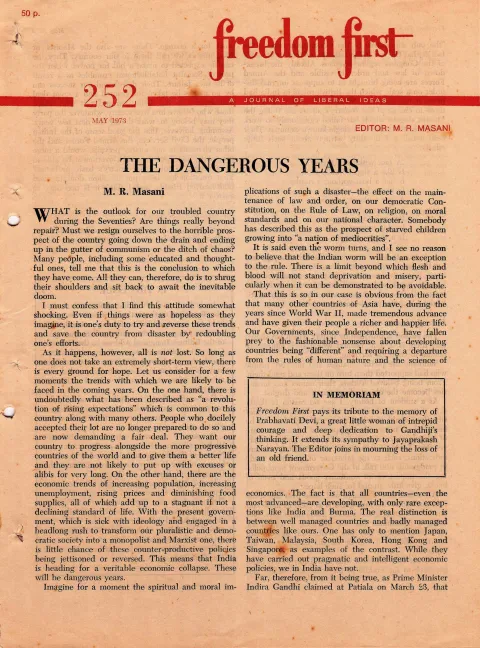
Freedom First
Summary
Freedom First No. 252 (May 1973), edited by M. R. Masani, opens with Masani’s lead editorial “The Dangerous Years,” a gloomy but not fatalistic survey of India’s economic and political outlook for the 1970s, warning of drift toward a “monopolist and Marxist” society under Indira Gandhi’s government and setting out a seven-point liberal reform programme as an alternative. Vrunda Moghe contributes a short investigative piece breaking down the costs of maintaining Pakistani prisoners of war in Indian custody after the 1971 war. A reprinted press report from The Weekly Mail (Madras) covers Masani’s inaugural address to the Sixth National Convention of the Swatantra Party, in which he criticised the Orissa unit of his own party for aligning with Biju Patnaik. Geeta Doctor reviews a Theatre Group production of Harold Pinter’s The Birthday Party, and separately reviews Arthur Koestler’s novel The Call-Girls. David Rees reports on a Brussels-based international committee’s findings on Soviet forced-labour camps. Bertram D. Wolfe contributes an extract from his conference address on the theoretical nature of totalitarianism, arguing that the totalitarian party-state claims total, undivided sovereignty over every social institution and the individual conscience. K. Vasudeva Rao reviews Jean-François Revel’s Without Marx or Jesus. The issue closes with “With Many Voices,” a back-page compilation of press quotations from Indira Gandhi, Willy Brandt, Henry Kissinger, Germaine Greer, Barry Goldwater, Romesh Thapar and others, alongside the subscription form and colophon.
Key points
-
M. R. Masani’s “The Dangerous Years” surveys India’s economic outlook, blaming the government’s drift toward a “monopolist and Marxist” society and setting out a seven-point liberal reform programme.
-
Vrunda Moghe’s investigative piece estimates the cost of detaining Pakistani POWs at roughly Rs. 19.5 crores over thirteen months, questioning whether prolonged detention is worth its diplomatic cost.
-
A reprinted press report covers Masani’s address to the Swatantra Party’s Sixth National Convention, rebuking the Orissa unit for aligning with Biju Patnaik.
-
David Rees reports an international committee’s finding of over a million prisoners across roughly a thousand Soviet forced-labour camps, including the case of samizdat editor Yury Galanskov’s death in custody.
-
Bertram D. Wolfe’s “The Nature of Totalitarianism” defines totalitarianism as the claim that party and State are coextensive with society, denying autonomy to unions, churches and individuals.
-
Geeta Doctor reviews a Theatre Group staging of Pinter’s “The Birthday Party” and, separately, Arthur Koestler’s novel “The Call-Girls”.
-
K. Vasudeva Rao reviews Jean-François Revel’s “Without Marx or Jesus”, crediting its rebuttal of European myths about America while faulting its own utopian prescriptions.
Essays
The Dangerous Years
By M. R. Masani
M. R. Masani’s lead editorial asks what the outlook is for India during “the Seventies,” rejecting the fatalism of those who believe the country is doomed to “communism” or “chaos.” He argues India is not fated to fail merely because it is a developing country, pointing to Japan, Taiwan, Malaysia, South Korea, Hong Kong and Singapore as contrasting examples of well-managed development, and lays blame on the present Indian government’s ideological rigidity and drift toward a “monopolist and Marxist” society. He disputes Indira Gandhi’s claim that “the only alternative to the Congress is chaos,” arguing the Congress regime’s own continuance is producing chaos, evidenced by the government’s reliance on the Armed Forces to maintain internal order. The editorial (continued on page 14) sets out a detailed seven-point liberal reform programme covering taxation, currency stabilisation, labour-intensive development priorities, an end to further nationalisation, industrial productivity, deregulation along Ludwig Erhard’s prescription, and population control, closing with a call to “rally the reasonable” across party lines against the socialist establishment.
- Rejects fatalism about India’s prospects, arguing that the country’s troubles stem from bad governance rather than an inevitable fate of developing nations.
- Contrasts India’s stagnation with the pragmatic, successful economic policies of Japan, Taiwan, Malaysia, South Korea, Hong Kong and Singapore.
- Accuses the current government of pursuing a headlong, ideologically driven transformation of India’s ‘pluralistic and democratic society into a monopolist and Marxist one.’
- Disputes Indira Gandhi’s claim at Patiala that ‘the only alternative to the Congress is chaos,’ arguing instead that continuance of the Congress regime is itself producing chaos, visible in the Armed Forces being used to suppress internal disorder.
- Predicts that, per historical precedent, popular figures who fail to deliver eventually turn into objects of ‘contempt and disgust’ once their failures become evident.
- Sketches an alternative seven-point reform programme: tax cuts, currency stabilisation without deficit financing, priority for labour-intensive development (agriculture, irrigation, roads), an end to further nationalisation, doubling industrial output via better utilisation of capacity, deregulation following Ludwig Erhard’s dictum to ‘let men and the money loose,’ and population control.
- Calls on Liberals and the ‘sensible elements’ across party lines to ‘rally the reasonable’ against the Socialist Establishment, while accepting that Liberals must be prepared to remain a minority.
POWs — The Economics of Detention
By Vrunda Moghe
Vrunda Moghe examines the cost of detaining Pakistani prisoners of war in India after the 1971 war, disputing the government’s official expenditure figures and arriving at a higher estimate of roughly Rs. 19.5 crores over thirteen months. The piece details how India, going beyond the strict requirements of the Geneva Convention, extends ‘civilians under protective custody’ the same privileges as regular POWs, describes the security, welfare, and escape-prevention regime across an estimated fifty camps, and itemises hidden costs including floodlighting, documentation, and medical treatment for wounded prisoners. The essay closes by questioning whether the diplomatic and financial cost of prolonged detention is worth it given Bangladesh’s non-recognition by Pakistan and the stalled war-crimes trials.
- Challenges the government’s official estimate (Rs. 13 crores through January 1973, per Minister V. C. Shukla) as understated, calculating a higher figure of about Rs. 19.5 crores over thirteen months based on a Rs. 5-a-day per-prisoner feeding cost.
- Explains that India treats ‘civilians under protective custody’ (CPUC) — around 23,000 of the roughly lakh-plus prisoners — more generously than the Geneva Convention’s category of ‘followers’/menial staff requires.
- Describes the security regime: barbed-wire perimeters, roll-calls, emergency generators, and heavy floodlighting estimated at about Rs. 1,000 per camp per day, totalling around Rs. 1.8 crore to date.
- Notes about 1,400 severely wounded prisoners have already been repatriated, with ongoing medical costs for the remainder, and estimates documentation/mail costs at a minimum of Rs. 25 lakhs.
- Questions whether continued detention — beyond the Geneva Convention’s three-to-four month limit for POWs — is justified given stalled war-crimes trials and Bangladesh’s non-recognition by Pakistan, and weighs the cost against the risk of alienating world opinion and India’s diplomatic missions.
Coffee, Freud and Me
By Geeta Doctor
A reprinted news report from The Weekly Mail (Madras, April 14, 1973) covers M. R. Masani’s inaugural address to the Sixth National Convention of the Swatantra Party at Rajaji Nagar, in which the former party president publicly rebuked the Orissa unit of the Swatantra Party for aligning with Biju Patnaik in a manoeuvre to topple the state government, calling it a case of the ‘SVD disease’ infecting the party’s own camp. Party President Piloo Mody separately accused the ruling Congress of ‘violating the laws of the land’ and ‘destroying the Constitution.’ Masani urged the party to ‘think afresh and boldly,’ rejected joining opportunistic groupings merely to gain office, and warned against India’s overcommitment to the Soviet Union in foreign policy.
- Masani, inaugurating the Sixth National Convention of the Swatantra Party, castigated the Orissa party leadership for aligning with Biju Patnaik in a ‘toppling operation’ against the state government, calling it the ‘SVD disease’ infecting his own camp.
- Piloo Mody, party president, accused the ruling Congress party of ‘violating the laws of the land’ and ‘destroying the Constitution.’
- Masani asked party members to ‘think afresh and boldly’ and jettison ‘dogmas and other intellectual baggage’ weighing the party down.
- Masani rejected the idea of the party joining opportunistic groupings ‘by hook or by crook’ merely to win the next elections, calling recent efforts led by Biju Patnaik ‘counter-productive.’
- Masani warned against India’s overcommitment to the Soviet Union and called for a more balanced foreign-policy stance among the three Super Powers.
Soviet Forced Labour Camps
By David Rees
Geeta Doctor recounts attending a Theatre Group performance of Harold Pinter’s The Birthday Party, opening with a comic description of the audience’s nervous over-punctuality and the play’s unsettling, Pinteresque atmosphere. She describes varied audience reactions during the post-play discussion — from earnest Freudian readings of Stanley’s ‘Oedipus complex’ to a Jungian dissent and a Mafia-thriller misreading — using these to illustrate Pinter’s characteristic refusal to supply a single, fixed interpretation. The review concludes that this interpretive openness is precisely what makes the discussion valuable, and praises the Theatre Group’s staging as inventive and versatile despite some overacting.
- Describes the strict 7 p.m. deadline and audience’s schoolchild-like obedience before a performance billed as a ‘Comedy of Menace.’
- Portrays the claustrophobic staging — a seedy drawing room, clinical lighting, doors shut noiselessly — and two contrasting audience neighbours’ reactions during the performance itself.
- Recounts the post-show discussion in which audience members offered competing readings: a Freudian ‘Oedipus complex’ interpretation of Stanley and Meg, a dissenting Jungian view, and a misreading of the play as a Mafia thriller about a drug addict.
- Uses the range of interpretations to argue Pinter deliberately withholds a single fixed meaning, making the audience complicit in constructing the play’s sense.
- Credits the Theatre Group’s production for its ‘ingenuity and versatility,’ while noting some criticism of Meg’s performance as stagey and calling Goldberg’s portrayal ‘Mephistophelian.‘
The Nature of Totalitarianism
By Bertram D. Wolfe
David Rees reports on an interim study by the Brussels-based International Committee for the Defence of Human Rights, concluding that over one million prisoners are held in roughly a thousand Soviet forced-labour camps, with an accompanying map showing camps spread across most Soviet provinces, especially European Russia. The article surveys the committee’s methodology (samizdat literature, defector testimony, official Soviet publications), cites the case of imprisoned samizdat editor Yury Galanskov, who died in a labour camp in 1972 after being denied adequate medical treatment, and details conditions of chronic hunger, malnutrition, and post-release stigmatisation. It closes by noting the report’s finding that 0.5 percent of the Soviet population is in captivity — far higher than Western democracies — and its charge that Western human-rights appeals to Soviet institutions go systematically unanswered.
- Cites the International Committee for the Defence of Human Rights (founded 1971, patronised by Nobel laureate Rene Cassin, presided over by Dr Albert Guerisse) as the source of the interim report finding over a million prisoners across roughly 1,000 Soviet labour camps.
- Describes the report’s methodology drawing on samizdat literature, official Soviet publications, and cross-checked testimony of escapees and defectors.
- Recounts the case of Yury Galanskov, editor of the samizdat journal Phoenix, who died in a Morovian labour camp in late 1972 after being denied treatment for a stomach ulcer while forced to perform manual labour.
- Notes malnutrition is systemic: camp rations of about 2,400 calories fall well short of the British Medical Association’s recommended 4,000+ calories for heavy physical labour.
- Describes further coercive measures (banned food parcels, restricted visitors, inadequate medical care) and the difficulty released prisoners face reintegrating, including a 100-kilometre exclusion zone from major Soviet cities.
- Concludes the report estimates 0.5 percent of the Soviet population is held captive — two-and-a-half to seven times the rate in Britain, France, and the United States — and criticises Western governments and institutions for failing to answer desperate appeals from camp prisoners.
Reviews: Cassandra Turns Call-Girl (The Call-Girls by Arthur Koestler)
By G. D.
Bertram D. Wolfe argues that the essence of totalitarianism lies not primarily in tyranny or terror but in the literal meaning of the word ‘total’: the claim that party and State are coextensive with society itself, leaving no autonomous space for individuals, unions, churches, or any other institution. He contrasts this with five defining features of Anglo-American democracy — a society wider than the State, definite limits on State power, recourse against arbitrary official acts, opposition as a constructive right, and the people’s right to turn out a government — and illustrates totalitarian practice with examples from Soviet history, including Vyshinsky’s dictum on Russian women’s reproductive duty, the fate of constitution-drafter Bukharin, and prosecutor Krylenko’s own later purge. He closes by describing totalitarianism as a doctrine claiming infallible authority over past, present and future, locked in permanent struggle against ‘the wayward human spirit.’
- Defines totalitarianism’s essence as the claim that party and State are identical with and coextensive with society, denying autonomy to individuals and to all non-State organisations (unions, churches, clubs, lodges, chambers of commerce).
- Contrasts totalitarianism with five defining features of Anglo-American democracy: a society wider than the State’s sphere of action, defined limits on State power, recourse against arbitrary official acts, opposition as a constructive democratic right, and the people’s right to turn out the government.
- Cites Vyshinsky’s statement that ‘the duty of Russian women… is to produce Soviet children, not children for the Canadian government’ as an example of the totalitarian State’s claim over private life.
- Recounts that Bukharin, author of the Soviet constitution’s Bill of Rights, was later put on trial and killed within a year of its adoption, and that prosecutor Krylenko was himself later purged after praising that same constitution.
- Describes totalitarianism’s use of mass propaganda, terror, isolation, indoctrination, and total organisation as historically unprecedented tools enabled by modern technology (loudspeaker, tank, plane, police wagon).
- Closes by framing totalitarian rulers as claiming exclusive, infallible interpretive authority over history, and describes the ongoing conflict between this claim to total control and ‘the wayward human spirit’ as an unresolved drama of the century.
Reviews: “Revolution” (Without Marx or Jesus by M. Jean-Francois Revel)
By K. Vasudeva Rao
Geeta Doctor (signed ‘G. D.’) reviews Arthur Koestler’s novel The Call-Girls (Hutchinson), describing it as a tragicomedy about a group of international call-girls — distinguished scientists and academics who travel the world’s seminar circuit — gathered in the Alps to debate ‘Approaches to Human Survival.’ The review praises Koestler’s ability to render abstruse scientific ideas vividly and traces the novel’s framing device (prologue on the Cross, epilogue on a psychiatrist’s couch), its central figure Nikolai Solovief, and its escalating scenarios of neuro-engineering experimentation gone wrong, while judging the book ultimately more cynical than grief-stricken, with Koestler undercutting his protagonist Cassandra-figure by making her personally unsympathetic.
- Describes the novel’s structure as divided into a prologue, main story, and epilogue, framing a ‘tragicomedy’ with the central theme of humanity’s predicament and possible remedies.
- The main narrative gathers distinguished ‘international call-girls’ — scientists and academicians who travel the seminar circuit — at an Alpine conference on ‘Approaches to Human Survival.’
- Praises Koestler’s ability to render abstruse scientific propositions (hypnosis, neuro-engineering, Cartesian duality, embryology) into vivid, cogent prose.
- Summarises the character Nikolai Solovief as a charming but world-weary figure who frames the survival question, and the epilogue figure Mr. Anderson, who cannot convince his psychiatrist that people around him are turning into chimeras.
- Judges the novel not so much grief-stricken as cynical, finding that Koestler undercuts the Cassandra-like tragic figure of the protagonist by making her personally unsympathetic in the guise of a ‘call-girl.‘
Masani Indicts Orissa Swatantra Party (reprint from The Mail, Madras, Apr 14 1973)
By A Staff Reporter
K. Vasudeva Rao reviews Jean-François Revel’s Without Marx or Jesus (Allied Publishers), describing Revel as a provocateur who, having previously debunked French myths, now sets out to write a book praising the United States as the sole possible site of a coming world revolution. The review summarises Revel’s rebuttal of three common European ‘myths’ about American conformity, materialism, and reaction, while criticising his sweeping, utopian prescriptions (world government, abolition of national sovereignty, birth control) and his selective blindness to genuine flaws in American society, concluding that Revel, in mythologising the U.S. as the seedbed of a new ‘Homo novus,’ ends up creating his own myth even as he sets out to slay others.
- Frames Jean-François Revel as a French provocateur and L’Express columnist previously known for debunking French myths (including about Charles de Gaulle and Italian virility).
- Summarises Revel’s twin premises: mankind must have a revolution to survive, and such a revolution can start only in the United States.
- Details Revel’s rebuttal of three European ‘myths’ about America: that conformity and uniformity define American society, that Americans are slaves to gadgets, and that America is ‘the citadel of reaction.’
- Criticises Revel’s utopian prescriptions — the end of national sovereignty, worldwide economic and educational equality, abolition of war, worldwide birth control — as vague and totalising.
- Notes Revel’s selective praise for American phenomena (Andy Warhol films, Playboy, American TV) while overlooking significant flaws, and his prediction that revolution will spread by ‘political osmosis’ to produce ‘world government’ and a new ‘Homo novus.’
- Concludes that Revel’s own act of myth-slaying itself creates a new myth, though the reviewer credits the book’s shrewd polemical high points and predicts it will be a talked-about ‘pundit’ book of the season.
With Many Voices
The back-page feature ‘With Many Voices’ compiles brief quotations from contemporary Indian and international press on politics and current affairs, including Indira Gandhi’s remarks on poverty and on Marx, Willy Brandt’s line that ‘Berlin is a lie-detector,’ Henry Kissinger on foreign-policy priorities, Germaine Greer’s quip about venereal disease, Barry Goldwater on women and guns, a UN Security Council veto scoreboard, a satirical description of how a Communist agenda ‘prejudges all issues,’ and Romesh Thapar’s aphorism that ‘subservience usually accompanies incompetence.’
- Opens with a Tennyson epigraph (‘The deep / Moans round with many voices…’) framing the compiled-quotations format.
- Quotes Indira Gandhi twice: on poverty’s ‘very deep roots’ persisting through her tenure, and on not being ‘afraid of Marx.’
- Includes Willy Brandt’s remark that ‘Berlin is a lie-detector’ and Henry Kissinger’s comment on knowing ‘what the man thinks about in the morning when he is shaving.’
- Reports a UN veto scoreboard (US 3, France 4, Britain 10, Russia 109) and a satirical account of how a ‘Communist agenda’ would structure a meeting to prejudge its own outcome.
- Closes with Romesh Thapar’s aphorism ‘Subservience usually accompanies incompetence’ and The Economist’s observation that Russian power is expanding while American power contracts.
Generated by the v1.5 extraction pipeline. Awaiting editorial review.
Metadata and summary are AI-extracted from the source PDF and reviewed for editorial accuracy. The original work is available via the Read PDF tab above (where present); paragraph-level citation inside the PDF is deferred to a future engagement.