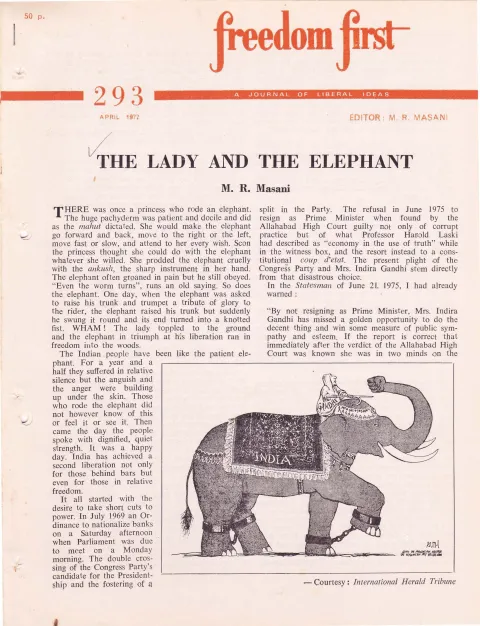
periodical issue
Freedom First
A Journal of Liberal Ideas
By M. R. Masani, S. P. Aiyar, Bernard Levin, Geeta Doctor, Dinshah K. Malegamvala, N. C. Zamindar
Published for Democratic Research Service by J. R. Patel, Associate Editor, Freedom First at 127, M. Gandhi Road, Bombay 400 023 (Phone: 273914) and printed by him at Mohan Mudranalaya, Acme Estate, Sewri (East), Bombay 400 015 · Bombay · 1977
16 pages
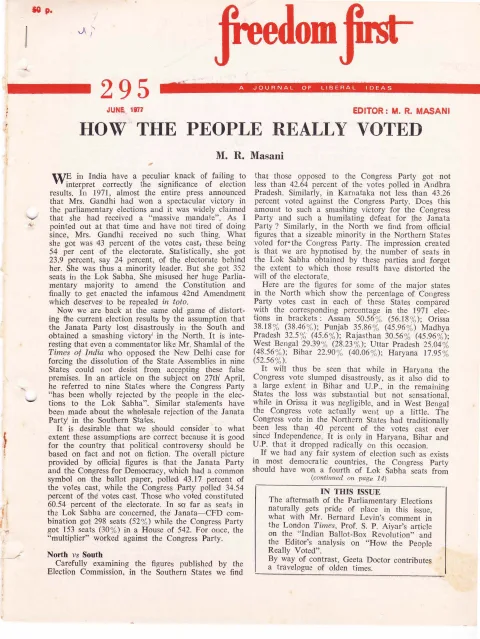
Freedom First
Summary
Freedom First No. 295 (June 1977) is the first post-Emergency, post-election issue of the Bombay classical-liberal monthly edited by M. R. Masani. Its center of gravity is the March 1977 general election that ended Indira Gandhi’s rule and the Emergency: the editor’s lead essay disputes the ‘Janata swept the North, lost the South’ narrative with vote-share arithmetic, S. P. Aiyar’s essay frames the result as an epic ‘ballot-box revolution’ vindicating democracy over dictatorship, and a reprinted Bernard Levin column from The Times mocks Western apologists for the Emergency and salutes JP Narayan’s final appeal to voters. The editor’s ‘Between You & Me and the Lamp Post’ column comments on Idi Amin, the death of Ludwig Erhard, the new Janata government’s early moves on press and broadcast autonomy, and the treatment of Vietnamese refugees. A World News digest reprints wire-service items on Soviet politics, Mozambique refugee camps, and Kissinger’s warning on Zaire; two reader letters press the new government to entrench civil liberties; and Geeta Doctor contributes a travel essay on a drive across the Deccan. The issue closes with a page of aphoristic press quotations (‘With Many Voices’) and the subscription/colophon block.
Key points
-
M. R. Masani’s lead editorial, “How the People Really Voted”, disputes the narrative that Janata “swept the North, lost the South”, using Election Commission data to show Congress’s southern vote share held only modestly, and blames India’s first-past-the-post system for distorting seat-vote relationships.
-
S. P. Aiyar’s “India’s Ballot Box Revolution” frames the 1977 election as ending thirty years of Congress dominance, rejecting the “Divine Right Theory” that a dominant party suits a plural society, while warning that political loyalties remain volatile.
-
Bernard Levin’s reprinted Times column mocks Western commentators who dismissed Indian elections as a “pointless farce” while excusing Chinese authoritarianism, and quotes at length Jayaprakash Narayan’s final pre-election appeal to “defeat the dictators”.
-
Masani’s lamp-post column profiles Ludwig Erhard’s post-war economic liberalism and his 1958 warning that Indian statism would delay its escape from poverty, alongside notice of early Janata moves toward broadcast and educational autonomy.
-
Geeta Doctor’s travel essay recounts a drive across the Deccan from Bombay to Hyderabad and Mysore, visiting a Bahmani-era fort at Naldrug and the Srisailam dam, offered as a deliberate contrast to the issue’s election coverage.
-
A World News digest reports India’s refusal of a Soviet credit offer for the Bokaro steel plant, Soviet-bloc training of Idi Amin’s security forces, and mass detention camps in post-independence Mozambique.
-
Reader letters from Dinshah K. Malegamvala and N. C. Zamindar call for dismantling the Samachar news monopoly and autonomous broadcasting, while warning that Janata’s use of religious campaigners risks repeating the historical “Khilafat mistake”.
Essays
How the People Really Voted
By M. R. Masani
M. R. Masani’s lead editorial disputes the widely-repeated claim that the Janata Party ‘lost disastrously’ in South India while sweeping the North. Using Election Commission figures, he shows the Congress vote share in the southern states (42–43%) was not a landslide, and contrasts this with the more dramatic collapses of the Congress vote in Haryana, Bihar, and Uttar Pradesh. He argues India’s first-past-the-post electoral system (inherited from Britain) has chronically distorted the relationship between vote share and seats won, citing a Citizens for Democracy committee report (on which he served alongside Eric da Costa, V. M. Tarkunde, P. G. Mavalankar, A. G. Noorani, and K. D. Desai) that recommended a mixed, West-German-style proportional system. He closes by urging the new government not to cling to first-past-the-post now that it has benefited from the same distortions that previously entrenched Congress rule, and references the electoral reform committee appointed by Jayaprakash Narayan.
- Disputes the press narrative of a ‘smashing’ Janata victory in the North and a ‘disastrous’ loss in the South using Election Commission vote-share data.
- Shows Congress vote share fell radically only in Haryana, Bihar, and U.P.; elsewhere the decline was more modest.
- Attributes the seat-vote distortion to India’s first-past-the-post system inherited from Britain.
- Cites the Citizens for Democracy Committee on Electoral Reform (chaired under JP Narayan’s initiative) and its 1975 report recommending a mixed West German-style electoral system.
- Warns the new Janata government against clinging to a system that once favoured Congress now that it favours them.
Between You & Me and The Lamp Post (Levin on Amin; Dr. Miracle; Educational Autonomy; Autonomy for AIR and TV; Gherao Debunked; How to Help the Vietnamese)
The editor’s regular miscellany column runs six short items: a wry defence of Bernard Levin’s satirical suggestion that Britain should welcome Idi Amin (so as to depose him more easily); an obituary appreciation of Ludwig Erhard, architect of West Germany’s post-war ‘economic miracle’, recounting his defiance of Allied controls and his 1958 warning that India’s statist policies would delay its own escape from poverty; approving notice of the new Janata government ministers (Pratap Chandra Chunder on education, L. K. Advani on broadcasting autonomy, Ravindra Verma on gheraos, George Fernandes on gheraos) moving to roll back state control; and a piece on Vietnamese refugee testimony about concentration camps under the new communist regime, framed as a test of the Carter administration’s willingness to choose sides against dictatorship.
- Defends Bernard Levin’s Times column urging Britain to admit Idi Amin, on the grounds that it would let Uganda depose him.
- Profiles Ludwig Erhard’s economic liberalism and courage in abolishing wartime controls against Allied orders.
- Notes Erhard’s 1958 warning to India that state controls would delay its escape from poverty.
- Welcomes early Janata government moves toward educational and broadcast autonomy from state control.
- Reports Vietnamese refugee accounts of concentration camps and forced ‘re-education’ under the postwar communist government.
India’s Ballot Box Revolution
By S. P. Aiyar
S. P. Aiyar’s essay reads the 1977 election as an epic, world-historical event: the end of a thirty-year Congress monopoly and a demonstration that democracy is not, as some Western commentators claimed, a luxury unsuited to poor developing countries. He argues that fear of the Emergency’s ‘divine right’ style of one-party rule, more than economic self-interest, drove ordinary illiterate and literate voters alike to reject Mrs. Gandhi despite pre-election inducements. He is cautious about durability, however, warning that political loyalties in India are ‘extremely volatile’ and that the Janata government’s success will be judged on economic performance, family planning policy, and its ability to manage centre-state relations with the South.
- Frames the 1977 election as a ‘ballot-box revolution’ ending thirty years of Congress dominance.
- Rejects the theory that a dominant single party was a rational necessity for a plural society, calling it ‘a subtle variation of a Divine Right Theory’.
- Argues voters rebelled against injustice and threats to their way of life rather than being bought off by pre-election handouts.
- Cites The Economist’s view that India disproved the ‘condescending dogma’ that the poor do not value their political rights.
- Warns that political loyalties are volatile and the new government must deliver on civil liberties, economic performance, and centre-state relations, especially with the South.
One in the Eye & A Salute to the Brave
By Bernard Levin
Reprinted from The Times, Bernard Levin’s column skewers Western fellow-travellers who excuse authoritarianism in China while dismissing Indian elections as a ‘pointless farce’ conducted by illiterate masses who don’t understand what they’re voting for. He recounts Indira Gandhi’s Emergency-era consolidation of power (rewritten constitution, tamed judiciary, controlled press, mass detentions) and her gamble in calling an election she expected to win unopposed, only for the electorate to vote decisively for democracy over ‘false stability’. The piece closes by quoting at length Jayaprakash Narayan’s final appeal to voters before the election, urging them to ‘defeat the dictators’ and warning that 19 months of tyranny would become 19 years of terror if they faltered.
- Satirises Western intellectuals who tolerate Chinese communism’s lack of freedoms while dismissing Indian democracy as meaningless.
- Recounts how Mrs. Gandhi rewrote the constitution, controlled the judiciary and press, and jailed opponents during the Emergency.
- Argues she called the election confident of an overwhelming win, having eliminated serious opposition.
- Credits ordinary Indian voters, including the poor and illiterate, with choosing democracy over stability and propaganda.
- Quotes at length Jayaprakash Narayan’s final pre-election appeal calling on voters to ‘free India, defeat the dictators’.
Driving Across the Deccan
By Geeta Doctor
Geeta Doctor’s travel essay contrasts her grandfather’s ceremonious travels as a colonial-era District Forest Officer with the impersonal, hurried travel of the present day, then narrates a drive from Bombay to Hyderabad, Bangalore, Mysore and the Kerala coast. The bulk of the essay (through the rendered pages) covers a stop at a Bahmani-era fort at Naldrug, the legend of a ‘lascivious king’ turned to stone at Srisailam, and the massive Srisailam dam construction on the Krishna river, which Nehru had called ‘one of the new temples of modern India’. The piece is a travelogue rather than a political or economic argument, offered explicitly ‘by way of contrast’ to the issue’s election coverage.
- Contrasts the leisurely, staged travel of the author’s grandfather’s colonial era with the rushed, package-tour travel of the present.
- Describes a road trip from Bombay through Sholapur, Hyderabad, and toward Bangalore, Mysore, and Kerala.
- Recounts local legend and history of a Bahmani-era fort at Naldrug founded by Hasan Ganju/Bahman Shah.
- Describes the Srisailam dam project on the Krishna river, quoting Nehru’s description of dams as ‘new temples of modern India’.
- Includes the folk legend of a king turned into a boulder by Shiva for lusting after his own daughter.
World News (Russian Aid Refused by India; Soviet Experts Help Amin’s Killers; The Battle Against Hunglish; Djilas’ Cousin Arrested; Japan United Against ‘Soviet Bully’; Mozambique Terror Camps; Soviets Denounce ‘Dr. Zhivago’; Kissinger Warning on Zaire Invasion)
An unsigned digest of wire-service and press clippings under the standing ‘World News’ feature, covering: India’s Janata government declining a Soviet credit offer for the Bokaro steel plant in favour of domestic capacity; reports that Soviet-bloc advisers were training Idi Amin’s Ugandan security forces implicated in killings; the spread of English loanwords (‘Hunglish’) into Hungarian despite official resistance; the arrest of Milovan Djilas’s cousin in Yugoslavia for ‘hostile propaganda’; Japan’s cross-party anger at Soviet fishing-zone demands; mass detention and forced-labour camps for up to 100,000 people in post-independence Mozambique; a Soviet diplomatic protest against U.S. Embassy screenings of Doctor Zhivago; and Henry Kissinger’s first public speech since leaving office, warning that the international community’s passive acceptance of the Katangan invasion of Zaire (aided by Cuban troops and Soviet-supplied arms) risked setting a dangerous precedent.
- India’s new Janata government refused a $450 million Soviet credit offer for the Bokaro steel plant’s rolling mill, opting for self-reliance.
- Ugandan army defectors reported Soviet-bloc and possibly East German advisers training security forces implicated in killings under Idi Amin.
- Reports on the spread of English loanwords (‘Hunglish’) in Hungary despite official linguistic-purity efforts.
- Reports of mass detention and forced labour in Mozambique’s post-independence ‘re-education’ camps, with beatings, rape and murder alleged.
- Kissinger’s post-office speech at Georgetown warning that international passivity toward the Soviet- and Cuban-linked invasion of Zaire could trigger a wider race war in southern Africa.
Letters (Essential First Steps; Elections 1977)
By Dinshah K. Malegamvala; N. C. Zamindar
Two reader letters respond to the election result. Dinshah K. Malegamvala calls for entrenching press freedom and civil liberties, urging the new government to renounce the renamed ‘Samachar’ news monopoly, protect small and regional-language newspapers, make broadcasting autonomous from government control, and restore judicial independence, arguing that no institution, not even the Prime Minister, should stand above the rule of law. N. C. Zamindar reflects on the surprise of the Janata victory, calling it a protest vote against Emergency-era abuses, and worries that the use of religious figures as campaigners by the Janata side risks repeating the ‘Khilafat mistake’ in Indian politics.
- Malegamvala urges dismantling the Samachar news monopoly and restoring press pluralism.
- Calls for AIR, Doordarshan and the Films Division to become autonomous statutory bodies free of government control.
- Insists the rule of law applies to all, quoting ‘no Prime Minister; not even God!’
- Zamindar frames the Janata win as a protest vote against Emergency excesses rather than a positive mandate.
- Zamindar criticises the Janata campaign’s use of religious heads as campaigners, comparing it to the historical ‘Khilafat mistake’.
With Many Voices
The issue’s closing page, ‘With Many Voices’, is a compilation of short aphoristic quotations clipped from the international and Indian press in April-May 1977, on subjects ranging from Cold War rhetoric and gender and politics to Marxism’s fortunes in India and the debasement of the word ‘democracy’. It is followed by the Freedom First subscription form and the publication’s colophon (published for Democratic Research Service by J. R. Patel).
- Compiles brief quoted aphorisms from The Economist, the Observer, the Statesman and other papers on politics, Marxism, and democracy.
- Includes Subramaniam Swamy’s quoted remark that ‘Marxism has failed in India’ and Communists should look elsewhere.
- Includes J. K. Galbraith’s quip that pessimism is seen as a mark of superior intellect.
- Includes Lord Shawcross’s line that no word has been as debased and abused as ‘democracy’.
- Closes the issue with the subscription form and the Democratic Research Service colophon.
Generated by the v1.5 extraction pipeline. Awaiting editorial review.
Metadata and summary are AI-extracted from the source PDF and reviewed for editorial accuracy. The original work is available via the Read PDF tab above (where present); paragraph-level citation inside the PDF is deferred to a future engagement.