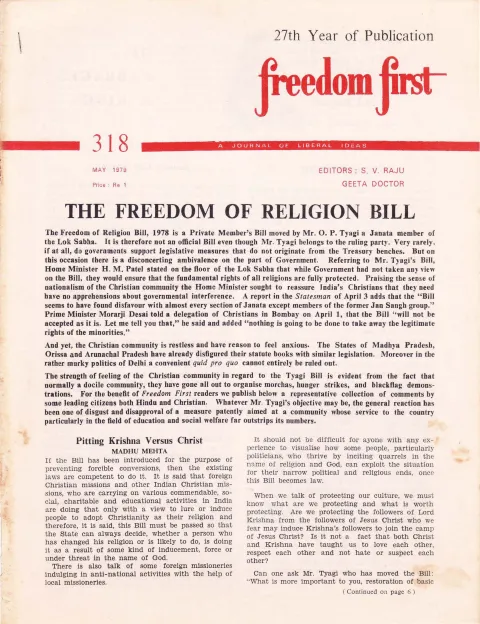
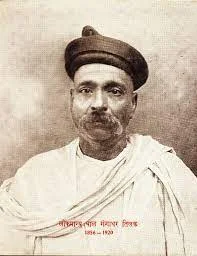
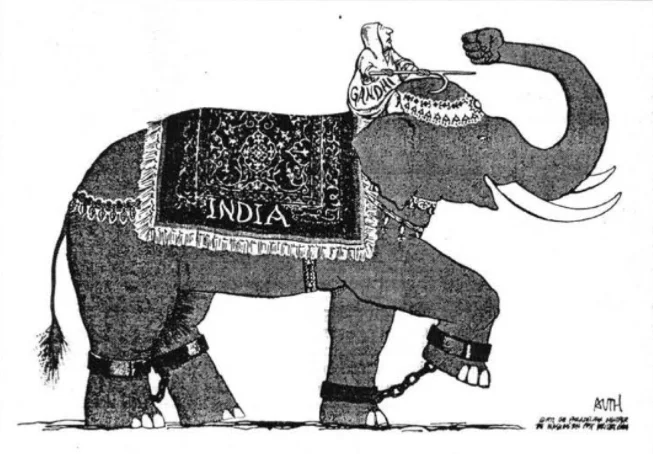
periodical issue
Freedom First
A Journal of Liberal Ideas
Edited by S. V. Raju
Published for the Democratic Research Service by J. R. Patel, Associate Editor, Freedom First at 127, Mahatma Gandhi Road, Bombay 400 023 (Phone: 273914) and printed by him at Commercial Printers & Stationers, 525 S. Bapat Marg, Dadar, Bombay-400 028 · Bombay · 1979
16 pages
Freedom First
Summary
This is the complete March 1979 issue (No. 316, 27th Year of Publication) of Freedom First, the Bombay-based monthly journal of liberal ideas edited by S. V. Raju and Geeta Doctor. The issue’s lead piece is M. R. Masani’s essay ‘Were Rajaji Alive Today…’, which argues that C. Rajagopalachari’s moral and constitutional critique of Indian politics — his insistence on Dharma in public life, his opposition to the erosion of property rights and judicial independence through constitutional amendments, and his call for a decontrolled, low-tax economy — remains unfulfilled by the post-Emergency Janata Government. The unsigned editorial column ‘Of Cabbages & Kings’ skewers the Janata Government’s double standards on foreign policy and human rights, mocks a passenger-frisking controversy involving George Fernandes, criticizes Hindi-imposition policy, and needles Charan Singh’s factional maneuvering. Ian Ball’s ‘Taxation vs Civilisation’ uses Ibn Khaldun’s fourteenth-century Muqaddimah alongside Arthur Laffer, Milton Friedman, and California’s Proposition 13 tax revolt to argue that rising taxation destroys the incentive for enterprise and ultimately civilisation itself. A ‘World News’ digest reprints international clippings on Salvador de Madariaga’s death, a British industrial dispute at Cadbury-Schweppes, a doctor’s strike against treating trade unionists, and Chinese politics around the Panchen Lama. An Amnesty International report calling for India to abolish preventive detention and improve prison conditions is summarized, and two book reviews close out the substantive content: S. P. Aiyar reviews B. R. Nanda’s biography of Gopal Krishna Gokhale, and Mehra Masani reviews a survey-based study, ‘Indian Women Today,’ by Girija Khanna and Mariamma A. Verghese. The issue ends with ‘With Many Voices,’ a page of quotations from the world press, and the statutory Form IV ownership statement.
Key points
-
M. R. Masani’s “Were Rajaji Alive Today…” argues C. Rajagopalachari’s moral and constitutional critique remains unfulfilled by the Janata Government, faulting it for only partially undoing the 42nd Amendment via a diluted 45th Amendment and for leaving the “permit licence quota raj” intact despite implementing Rajaji’s call to prioritise agriculture.
-
Masani recalls Rajaji as “the Great Dissenter”, quoting his line to Nehru, “you have the majority… but logic is with me”, and urges readers to speak truth even against majority opinion.
-
The “Of Cabbages & Kings” column criticises the Janata Government’s inconsistent foreign policy on Iran and China, mocks Communications Minister George Fernandes’s outrage at being frisked at Madras airport, and reports on the “Lest We Forget” exhibition of Emergency-era underground literature inaugurated by M. R. Masani.
-
Ian Ball’s “Taxation vs Civilisation” draws a parallel between California’s Proposition 13 tax revolt and the fourteenth-century Arab historian Ibn Khaldun’s account of how rising taxation destroys enterprise and ultimately civilisation, linking it to Arthur Laffer’s Laffer Curve and Milton Friedman’s tax-reform advocacy.
-
A World News digest carries an obituary of Spanish liberal Salvador de Madariaga, founding President of the Liberal International, alongside reports on British industrial disputes and Chinese politics around the Panchen Lama.
-
An 84-page Amnesty International study, based on a fact-finding mission led by Professor James Fawcett, documents up to 1,000 political prisoners in India, mostly alleged Naxalite sympathisers, some held over six years without trial, and confirms torture allegations during the Emergency, recommending abolition of preventive detention and the death penalty.
-
S. P. Aiyar reviews B. R. Nanda’s biography of Gopal Krishna Gokhale, highlighting British officialdom’s private fear of him as “the most dangerous enemy of British rule in India” and his declining a knighthood to preserve the Servants of India Society’s simplicity.
-
Mehra Masani reviews Indian Women Today by Girija Khanna and Mariamma A. Verghese, a 1,000-woman survey finding majority support for family planning education and women’s employment but majority disapproval of inter-caste marriage and divorce.
Essays
Were Rajaji Alive Today…
By M. R. Masani
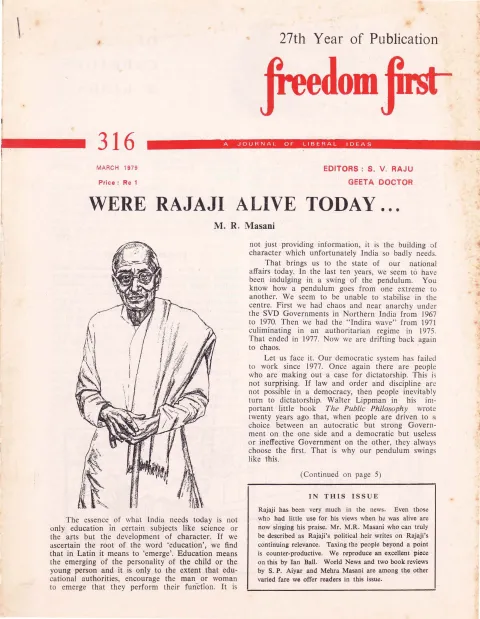
M. R. Masani’s essay imagines how C. Rajagopalachari (Rajaji) would judge India’s post-Emergency political and constitutional condition. Masani opens by diagnosing India’s decade of instability — coalition chaos, the ‘Indira wave,’ the 1975 Emergency, and the return to disorder after 1977 — as a failure of both discipline and democracy together, and calls for a national recovery of ‘character.’ He then argues Rajaji’s core relevance lies first in the moral plane: Rajaji’s idea of Dharma in politics, a religiously-grounded but non-sectarian ethical framework, which Masani contrasts with India’s constitutional self-description as a ‘Socialist Secular Republic.’ Masani devotes extended argument to the erosion of the Constitution via the 24th, 25th, 26th, and especially the 42nd Amendment, which he says destroyed fundamental rights (notably the right to property) and judicial independence by subordinating the President and Supreme Court to Parliament and the Prime Minister; he faults the Janata Government for failing to rescind the 42nd Amendment fully, settling instead for a diluted 45th Amendment (‘half a mouse’). On the economic plane, Masani recounts Rajaji’s demands for abolishing permits, licences, quotas, and the Planning Commission, cutting taxation, and reversing planning priorities to favour agriculture — noting that only the priority reversal has been implemented, while the ‘permit licence quota raj’ remains intact. The essay closes by praising Rajaji as ‘the Great Dissenter,’ recounting an anecdote of Rajaji telling Nehru ‘you have the majority… but logic is with me,’ and urging readers to speak truth even against majority opinion.
- Masani argues India’s post-1977 democracy has failed for lack of both discipline and character, causing a swing back toward authoritarian temptation.
- Rajaji’s concept of Dharma in politics is presented as a non-sectarian ethical demand, contrasted with India’s official ‘Socialist Secular’ constitutional identity.
- The 42nd Amendment is described as having destroyed fundamental rights and judicial independence by making Parliament and the Prime Minister supreme over the Constitution.
- The Janata Government is criticized for only partially undoing the 42nd Amendment via a watered-down 45th Amendment.
- On economics, Rajaji’s programme (abolish permits/licences/quotas, abolish the Planning Commission, cut taxes, prioritize agriculture) is judged mostly unimplemented except for the agriculture-first priority shift.
- Rajaji is held up as a lifelong political dissenter willing to be right against the majority, exemplified in an anecdote about arguing with Nehru.
Of Cabbages & Kings
The unsigned ‘Of Cabbages & Kings’ column, prefaced by a Lewis Carroll epigraph, comments acidly on contemporary political hypocrisies. It contrasts the Janata Government’s ‘internal affair’ non-interference stance on Iran’s revolution with its readiness to criticize other nations’ human-rights records, and accuses Prime Minister Morarji Desai and Foreign Minister Vajpayee of double standards, including a congratulatory message to Ayatollah Khomeini juxtaposed with earlier warmth toward the Shah. A section on ‘Frisking St. George’ mocks Communications Minister George Fernandes’s outrage over being frisked at Madras airport, contrasting it with his own past emergency-era policies. ‘Beware the Peking Duck’ satirizes China’s renaming of Peking to Beijing and questions Vajpayee’s forthcoming China trip. ‘Not Medicine But Aushadh’ criticizes the Prime Minister’s suggestion that English be replaced in medical education. ‘Sniping at Public Schools’ defends elite public schools against criticism from the Citizens for Democracy. ‘Operation Checkmate’ analyzes intra-Janata factional politics involving Charan Singh, the Jan Sangh, and chief ministers in U.P., Bihar, and Himachal Pradesh. The column concludes with ‘Lest We Forget,’ reporting on a Bombay exhibition, ‘Lest We Forget,’ organized by the Indian Committee for Cultural Freedom and inaugurated by M. R. Masani, documenting underground literature circulated during the Emergency, along with excerpted visitor comments both praising and criticizing the exhibition.
- The column criticizes the Janata Government’s inconsistent foreign-policy stances, especially over Iran, Bhutto’s execution, and China versus Vietnam/Cambodia.
- It mocks George Fernandes’s objection to being frisked at Madras airport as hypocritical given his own emergency-era security policies.
- It criticizes the Prime Minister’s suggestion to conduct medical education in regional languages instead of English.
- It defends India’s public schools against attacks by the Citizens for Democracy.
- It analyzes Janata Party factional maneuvering involving Charan Singh and state chief ministers.
- It reports on the ‘Lest We Forget’ exhibition of Emergency-era underground literature, inaugurated by M. R. Masani, including mixed visitor reactions.
Taxation vs Civilisation
By Ian Ball
Ian Ball’s article ‘Taxation vs Civilisation’ draws a parallel between California’s 1978 ‘Proposition 13’ property-tax revolt (and the broader American tax-limitation movement led by figures like Howard Jarvis and economist Arthur Laffer) and the fourteenth-century Arab historian Ibn Khaldun’s account, in his Muqaddimah, of how rising taxation destroys the incentive for productive and cultural activity within a dynasty over time. Ball quotes Ibn Khaldun at length describing how low taxation under a young dynasty encourages enterprise and swells tax revenue, while later rulers’ escalating exactions eventually crush incentive, shrink the tax base, and ‘destroy civilisation.’ The piece concludes (in its continuation) by linking Ibn Khaldun’s argument to modern voices — Laffer’s ‘Laffer Curve,’ Milton Friedman’s television commercials for tax reformers, and Howard Jarvis’s populist rhetoric — arguing that all describe the same phenomenon: taxpayers eventually revolt when taxation exceeds what they perceive as a fair return.
- Draws a direct parallel between California’s Proposition 13 tax revolt and Ibn Khaldun’s 14th-century analysis of taxation’s effect on dynastic decline.
- Extensively quotes Ibn Khaldun’s Muqaddimah on how low taxation early in a dynasty produces growth, while escalating taxation later ‘stifles’ output and ‘civilisation is destroyed.’
- Cites Arthur Laffer’s ‘Laffer Curve’ theory that cutting tax rates can increase total revenue by restoring incentives.
- Connects the historical and economic argument to the contemporary American tax-limitation movement (Howard Jarvis) and Milton Friedman’s public tax-reform advocacy.
Book Review: Gokhale (by B. R. Nanda)
By S. P. Aiyar
No summary was extracted for this article. Listed for completeness.
Book Review: Indian Women Today (by Dr. Girija Khanna and Mariamma A. Verghese)
By Mehra Masani
This is a two-page digest of reprinted international press items under the heading ‘World News.’ Items include an obituary of the Spanish liberal writer and diplomat Salvador de Madariaga (from The Guardian and Liberal International News), reprinted from Liberal International sources, describing his exile, his terms as Spain’s Minister of Justice and Education, and his role as founding President of the Liberal International; a Daily Telegraph report on 300 women workers at the Cadbury-Schweppes factory in Bournville breaking up a lorry-drivers’ picket; a Daily Telegraph report on a British orthopaedic surgeon, Mr. Patrick Chesterman, refusing to treat trade-union-member patients in protest at strikes; and two Daily Telegraph items on Chinese politics — a report on the Panchen Lama’s reported arranged marriage to a Han Chinese woman, and a note (‘Callaghan Gets Protest Bra’) on a British union protest against Prime Minister Callaghan.
- Reprints an obituary of Salvador de Madariaga, the Spanish liberal writer, diplomat, and founding President of the Liberal International (1947).
- Reports on a British industrial dispute in which Cadbury-Schweppes women workers physically broke up a picket line by striking lorry drivers.
- Reports on a British surgeon’s one-day boycott of trade-union-member patients in protest against public-sector strikes.
- Covers Chinese political news, including the Panchen Lama’s reported arranged marriage and his rehabilitation under the Communist Party after ‘re-education’.
- Includes a brief item on British trade unionists presenting Prime Minister Callaghan with a protest bra during a pay dispute.
Essay 5
This unsigned item reports on an 84-page Amnesty International study urging India to abolish preventive detention provisions from its constitution. It summarizes the findings of an AI fact-finding mission (December 1977-January 1978, led by Professor James Fawcett) that documented as many as 1,000 political prisoners, mostly alleged Naxalite sympathizers, some held without trial for over six years, and confirmed allegations of torture of political prisoners during 1970-1977, particularly during the Emergency when habeas corpus was suspended. The report’s 18 recommendations include establishing an independent body to investigate torture complaints, repealing state preventive-detention laws, abolishing the death penalty, aligning prison conditions with UN standards, and ratifying international human-rights covenants.
- Amnesty International’s 84-page report recommends India remove preventive detention provisions from its constitution.
- An AI mission (Dec 1977-Jan 1978, led by Professor James Fawcett) estimated up to 1,000 political prisoners, mostly alleged Naxalite sympathizers, some held over six years without trial.
- AI confirmed allegations of torture of political prisoners during 1970-1977, especially during the 1975-1977 Emergency when habeas corpus was suspended.
- The report makes 18 recommendations, including abolishing the death penalty, repealing preventive detention laws, and ratifying international human rights covenants.
- The report also investigated alleged police killings of political prisoners in West Bengal and Andhra Pradesh.
Essay 6
S. P. Aiyar reviews B. R. Nanda’s 1977 political biography of Gopal Krishna Gokhale, published by Oxford University Press. Aiyar praises the book as surpassing earlier biographies through its use of original documents from India, Britain, and the United States, and its framing of Gokhale within the broader ‘moderate’ politics of the three-and-a-half decades before World War I. The review highlights Nanda’s portrayal of Gokhale’s disciplined, fact-based political method, the British colonial establishment’s mixture of admiration and fear of him (illustrated by quoted correspondence between Lord Hardinge and Fleetwood Wilson describing Gokhale as potentially ‘the most dangerous enemy of British rule in India’), his declining a knighthood to preserve the Servants of India Society’s simplicity, and his role as an ‘interpreter par excellence’ between British rule and Indian aspirations. Aiyar takes issue, however, with Nanda’s argument — following Nehru’s own prejudice against the moderates — that moderate politics became obsolete and unable to answer the needs of Indian nationalism by the time of World War I, noting that Nanda dismisses later liberal critics of Gandhi as ‘arm chair critics’ without full justice to their warnings about the dangers of populism inherent in revolt.
- Aiyar praises Nanda’s biography for its documentary depth and its framing of Gokhale within a broader political history of the moderate era before WWI.
- The review highlights British officialdom’s private fear of Gokhale, quoting Lord Hardinge and Fleetwood Wilson correspondence calling him ‘the most dangerous enemy of British rule in India.’
- Gokhale declined a knighthood offered partly as a scheme to compromise his position in the Servants of India Society and on the Royal Commission on Public Services.
- Aiyar credits Gokhale with widening the vocation of teacher into nation-building and interpreting British rule’s implications for Indians.
- Aiyar criticizes Nanda’s Nehru-influenced dismissal of moderate politics as obsolete and of liberal critics of Gandhi as mere ‘arm chair critics.‘
Essay 7
Mehra Masani reviews ‘Indian Women Today’ by Dr. Girija Khanna and Mariamma A. Verghese (Vikas Publishing House), a survey-based study of 1,000 women across sixteen Indian cities examining attitudes toward marriage, family planning, employment, dowry, divorce, and inter-caste marriage. The review is largely skeptical, arguing the survey confirms rather than adds to what earlier studies already showed (e.g., that housewives favour arranged marriages while working women favour love marriages), while presenting a mix of encouraging findings (majorities favouring family planning information for girls, widow remarriage, and women’s employment) and discouraging ones (majorities disapproving of inter-caste marriage and divorce, most women admiring only politicians and saints rather than social reformers, low readership rates among educated housewives). Masani criticizes the book’s prose as cliché-ridden and its conclusions as stating the obvious, concluding that despite the effort of data collection, the book adds little new to public understanding of Indian women’s status.
- The book surveys 1,000 women across sixteen Indian cities on marriage, family planning, employment, dowry, and related social attitudes.
- Masani argues the findings mostly confirm what earlier studies already established, offering little genuinely new information.
- Encouraging findings include majority support for educating adolescent girls about childbirth/family planning, approval of widow remarriage, and approval of women’s employment.
- Discouraging findings include majority disapproval of inter-caste marriage and divorce, and that most women admire only politicians and saints rather than social reformers.
- Masani criticizes the book’s writing as clichéd and its concluding chapter as merely recapitulating known facts about discrimination against women.
Essay 8
‘With Many Voices’ is the issue’s closing quotations page, prefaced by a Tennyson epigraph, gathering short excerpts from the world press on topics including British public-sector inefficiency (The Economist), Prince Charles’s marriage prospects (The Observer), Air India’s management (Rashmi Mayur in the Indian Express), U.S.-China diplomatic recognition (Senator S.I. Hayakawa), the state of Indian parliamentary politics (Y.B. Chavan), Indira Gandhi’s political role (Rajmohan Gandhi in Himmat), and China’s Vice-Premier Deng Xiaoping on Soviet foreign policy, among others. The page is followed by the statutory Form IV ownership declaration naming J. R. Patel as printer/publisher and the Democratic Research Service, 127 Mahatma Gandhi Road, Bombay, as the entity behind the periodical, alongside editors S. V. Raju and Geeta Doctor.
- A curated page of short press quotations on varied political and social topics from British, American, and Indian sources.
- Includes Deng Xiaoping’s remark on the Soviet Union’s foreign-policy character.
- Includes Rajmohan Gandhi’s assessment of Indira Gandhi’s ambiguous role in creating and possibly reuniting Janata.
- Closes with the Form IV statutory ownership declaration confirming publisher J. R. Patel and the Democratic Research Service as the entity behind Freedom First.
Generated by the v1.5 extraction pipeline. Awaiting editorial review.
Metadata and summary are AI-extracted from the source PDF and reviewed for editorial accuracy. The original work is available via the Read PDF tab above (where present); paragraph-level citation inside the PDF is deferred to a future engagement.