periodical issue
Freedom First
By R. V. Murthy, B. K. Desai, Adam Adil, Hugh Seton-Watson
Edited, printed & published for the Democratic Research Service by V. B. Karnik at The Kanada Press, 109 Parsi Bazar Street, Bombay 1. · Bombay · 1958
12 pages
Freedom First
Summary
This is the March 1958 issue (No. 70) of Freedom First, the monthly journal published in Bombay by the Democratic Research Service under editor V. B. Karnik, in association with the Indian Committee for Cultural Freedom. The issue opens with R. V. Murthy’s analysis of the Chagla Commission’s findings on the Life Insurance Corporation’s Mundhra share-purchase scandal, drawing lessons about state-corporation autonomy and the dangers of further nationalisation. A ‘Notes’ section covers Mao Zedong’s Hundred Flowers Campaign and subsequent purge, French bombing of the Tunisian village of Sakhat Sidi Youssef, the toned-down treatment of Stalin in the new Soviet Encyclopaedia, Henry Cabot Lodge’s diplomatic visit to India, and an obituary for Maulana Abul Kalam Azad. B. K. Desai contributes a piece exposing Congress politicians’ participation in the communist-organised India-China Friendship Association. Adam Adil analyses the political crisis in Indonesia arising from President Sukarno’s inclusion of Communists in the Djuanda cabinet and the resulting regional rebellion. Hugh Seton-Watson (condensed from ‘New Leader’) writes on the ‘Populist mentality’ among Eastern European intellectuals under communism, using Milovan Djilas as a starting point. The issue closes with a Congress for Cultural Freedom declaration on intellectual freedom worldwide, a ‘With Many Voices’ page of quotations from the press, and the statutory ownership statement for the publication. The volume’s argumentative centre is anti-communist and classical-liberal: skeptical of state economic control, alert to communist infiltration of ostensibly independent civic and cultural organisations in India and abroad, and sympathetic to intellectual dissent behind the Iron Curtain.
Key points
-
R. V. Murthy’s “Lessons Of The L.I.C. Episode” reviews the Chagla Commission’s finding that the Life Insurance Corporation’s purchase of Mundhra-controlled shares was rushed through without consulting its Investment Committee, and argues for breaking up state monopolies like the LIC to restore competition and honour C. D. Deshmukh’s earlier assurance against using LIC funds to control private industry.
-
The Notes section recounts Mao’s “Hundred Flowers” campaign followed by a purge of over 100,000 alleged rightists, condemns French bombing of the Tunisian village Sakhat Sidi Youssef, and notes the new Soviet Encyclopaedia cutting Stalin’s coverage from 87 to 5 pages.
-
Further Notes criticise US envoy Henry Cabot Lodge’s warmth toward V. K. Krishna Menon as poor diplomacy, and mourn Maulana Abul Kalam Azad, praising his Al-Hilal journalism and Quran translation.
-
B. K. Desai’s “Tragedy Of India-China Friendship” portrays the India-China Friendship Association as a communist front lent legitimacy by Congress politicians including Krishna Menon, detailing resolutions backing Red China’s UN seat and a cultural-show stand collapse that injured Bombay schoolchildren.
-
Adam Adil’s “Crisis In Indonesia” analyses President Sukarno’s inclusion of Communists in the Djuanda cabinet, the resulting rival Sumatran government under Sjafruddin Prawiranegara, and proposes ending collaboration with Communists, adopting federalism, and equitable revenue distribution.
-
Hugh Seton-Watson’s “Populist Spirit In East Europe” singles out Milovan Djilas as unique among communist officials for criticising the essence of communist power itself, tracing how the new intelligentsia communist regimes educated became the “bitterest critics” driving the 1956 Polish and Hungarian revolutions.
-
The Congress for Cultural Freedom’s Paris declaration expresses solidarity with intellectuals under totalitarianism, naming Tibor Dery, Julius Hay and Djilas among the imprisoned, and links their struggle to Little Rock and the South African Treason Trial.
-
The closing “With Many Voices” column quotes rebel Indonesian premier Sjafruddin Prawiranegara comparing admitting Communists to government to “injecting sickness into one’s body” and closes with the issue’s statutory ownership statement.
Essays
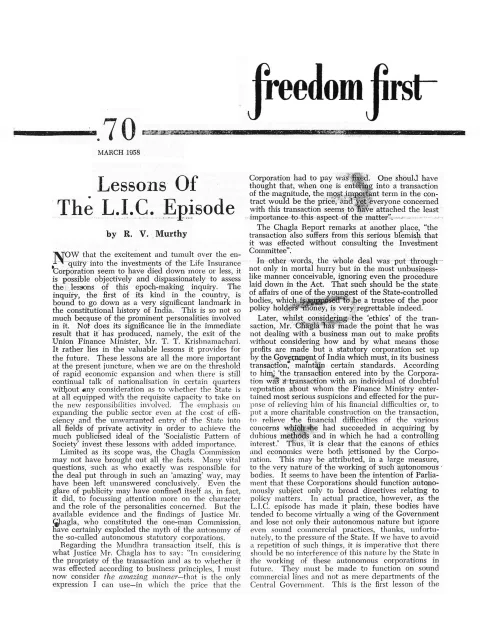
Lessons Of The L.I.C. Episode
By R. V. Murthy
R. V. Murthy reviews the aftermath of the Justice M. C. Chagla Commission’s inquiry into the Life Insurance Corporation’s investments — the ‘Mundhra episode’ that led to the resignation of Union Finance Minister T. T. Krishnamachari. Murthy argues the affair’s significance lies less in its personalities than in the lessons it offers about the limits of autonomy for state-controlled corporations, at a moment when the government was talking of further nationalisation under the ‘Socialistic Pattern of Society.’ He quotes the Chagla Report’s finding that the LIC transaction was rushed through in an ‘amazing manner’ without consulting the Investment Committee, and that it was arguably structured to relieve a businessman of doubtful reputation from his financial difficulties. Murthy draws out several lessons: that autonomous statutory corporations in practice become mere departments of government under state pressure; that funds of the LIC should not be used to acquire controlling interests in private industry (recalling C. D. Deshmukh’s assurance to Parliament to that effect when piloting the nationalisation bill); and that monolithic state monopolies like the LIC should be broken up to encourage competition and efficiency, which would also strengthen India’s still-fragile democracy.
- The Chagla Commission investigated the LIC’s purchase of Mundhra-controlled shares and found the transaction rushed, unbusinesslike, and made without consulting the Investment Committee.
- Chagla’s report suggested the deal may have been structured to relieve Mundhra of financial difficulties tied to concerns he controlled by ‘dubious methods.’
- The episode exploded the ‘myth of the autonomy of the so-called autonomous statutory corporations,’ which in practice function as wings of government under state pressure.
- C. D. Deshmukh, as Finance Minister piloting LIC nationalisation, had assured Parliament the government did not intend to use LIC funds to acquire controlling interests in private industry — an assurance Murthy says must be honoured.
- Murthy argues for demonopolising the LIC and other state-controlled monopolies to restore healthy competition, efficiency, and confidence in government assurances.
- The article situates the LIC affair as a caution against further nationalisation given evident state incapacity to manage new economic responsibilities.
Notes (Tragedy of Hundred Flowers; Another French Folly; Stalin’s Place; Tortuous Business; Maulana Azad)
The ‘Notes’ section is a set of short unsigned editorial comments. ‘Tragedy of Hundred Flowers’ recounts Mao Zedong’s 1956 invitation for open criticism (‘let a hundred flowers bloom’) and the subsequent purge, citing an official report by Public Security Minister Lo Jui-ching that over 100,000 ‘rightists’ and ‘counter-revolutionaries’ were ‘uncovered’ over 27 months, with 17.7 lakh persons investigated, and draws the conclusion that communism can only rule by force, not free consent. ‘Another French Folly’ condemns the French bombing of the Tunisian village of Sakhat Sidi Youssef during the Algerian war, calling French justifications unconvincing given the civilian-only casualties, and calls on the US and UK (who had voiced disapproval) to back Tunisia’s case at the UN Security Council. ‘Stalin’s Place’ notes that the new Soviet Encyclopaedia has drastically reduced its treatment of Stalin (from 87 pages in 1947 to 5 pages), reflecting Khrushchev’s consolidation of a post-Stalin party line. ‘Tortuous Business’ criticises US diplomat Henry Cabot Lodge’s visit to India, particularly his warmth toward Krishna Menon and leftist circles, as diplomatically counterproductive and a wrong signal both to Americans about Menon’s popularity and to Indians about Menon’s standing in America. ‘Maulana Azad’ is an obituary for Maulana Abul Kalam Azad, praising his early anti-imperialist journalism in Al-Hilal, his role bringing Muslims into the nationalist fold, his scholarly translation of the Quran (‘Tarjamanul Quran’), and quotes Nehru’s description of him as of ‘luminous intelligence and towering personality.’
- Mao’s Hundred Flowers Campaign is described as a bait-and-purge: invited criticism was followed by a mass crackdown, with over 100,000 ‘uncovered’ as rightists/counter-revolutionaries per an official report covering June 1955-October 1957.
- The piece concludes communism ‘has to live by the sword rather than by the free consent of free men.’
- French bombing of Sakhat Sidi Youssef in Tunisia (64 killed, 87 wounded, all civilians) is condemned as premeditated aggression tied to French anti-Algerian-rebel operations; Tunisia raised it at the UN Security Council.
- The new Soviet Encyclopaedia cuts Stalin’s coverage from 87 pages (1947 edition) to 5 pages with one photograph, read as Khrushchev recalibrating the official line on Stalin post-20th Party Congress.
- Henry Cabot Lodge’s India visit and warmth toward Krishna Menon is criticised as poor diplomacy that misread and inflated Menon’s domestic and international standing.
- Maulana Azad’s death is mourned as the loss of a scholar-statesman who used journalism (Al-Hilal) to draw Muslims into the nationalist movement and produced a major Quran translation.
Tragedy Of India-China Friendship
By B. K. Desai
B. K. Desai criticises the growing willingness of Congress politicians, including Defence Minister Krishna Menon, to lend their names and prestige to the India-China Friendship Association, which he portrays as a communist front operating a ‘popular front’ strategy under cover of cultural exchange. He describes the Association’s third annual Bombay conference, attended by numerous Congressmen and the Bombay Pradesh Congress Committee leadership, and quotes Association president Pandit Sunderlal’s uncritical praise of China alongside his earlier acknowledgment that India and China ‘were in the same boat’ regardless of China’s communist status. Desai details resolutions passed at the conference (supporting Red China’s UN seat claim, opposing US H-bombs, distributing Chinese communist literature in Indian languages) as evidence of the communist hand behind an ostensibly cultural body. He closes with an account of a cultural show at the conference where stands collapsed, injuring 700 Bombay municipal school children who had allegedly been pressured by a pro-communist Education Officer, Miss Kapila Khandwala, to attend — presented as revealing how communist-sympathetic officials misuse schoolchildren for front-organisation purposes.
- Desai frames the India-China Friendship Association as a communist front using a ‘popular front’ tactic, with genuine or exploited Congress participation lending it legitimacy.
- Defence Minister Krishna Menon inaugurated the conference; senior Bombay Congress figures held official roles in the Reception Committee.
- Association president Pandit Sunderlal is quoted praising China effusively even while conceding China’s communist nature, which Desai reads as ‘slavish Sinophilia.’
- Conference resolutions backed Red China’s UN seat, condemned US H-bombs, and proposed distributing Chinese communist literature via new libraries and regional-language publications in India.
- A cultural show (a Uday Shankar shadow play) at the conference saw a stand collapse, injuring about 100 of 700 Municipal Urdu-school children who attended; Desai attributes their mass attendance to pressure from Education Officer Miss Kapila Khandwala, described as a known pro-Communist sympathiser.
Crisis In Indonesia
By Adam Adil
Adam Adil analyses the political crisis triggered by President Sukarno’s inclusion of Communists in the Djuanda cabinet under his ‘Guided Democracy’ concept, which prompted anti-communist military leaders (Colonels Maludin Simbolon, Ahmed Hussain, and Zulkifli Lubis) backed by the Masjumi Party to proclaim a rival government in Central Sumatra under Sjafruddin Prawiranegara. Adil lays out the case made by Vice-President Mohammad Hatta and Masjumi leaders that admitting Communists (who hold only 39 of 256 parliamentary seats but wield outsized organisational strength, including the largest communist party membership in Asia outside China) risks a ‘Trojan horse’ capture of the state. He surveys regional grievances driving the crisis — Sumatra’s export revenues subsidising an over-populated Java — and the resulting unitary-versus-federal debate splitting Sukarno’s nationalists from Hatta’s and the Masjumi/Nahdatul Ulema’s federalist camp. Adil proposes three steps toward resolution: abandoning ‘Guided Democracy’ collaboration with Communists, adopting a federal structure with regional autonomy, and equitable distribution of national revenues among the islands, especially the underdeveloped ones.
- Sukarno’s ‘Guided Democracy’ cabinet (the Djuanda cabinet) included three Communist nominees despite Communists holding only 39 of 256 parliamentary seats, prompting anti-communist military leaders to proclaim a rival government in Central Sumatra.
- Vice-President Hatta and Masjumi leaders (Dr. Natsir and allies) warn against a Communist ‘Trojan horse’ entering administration, arguing Communists would exploit democratic rights only to destroy democracy.
- The Indonesian Communist Party is described as the largest in Asia outside China, with over half a million members and dominant control of industrial/plantation trade unions.
- Regional economic grievances (Sumatra earning 67% of exports 1952-56 but receiving disproportionately little back, versus Java’s 17% of exports but 73% of imports) fuel the unitary-vs-federal debate.
- Sukarno and nationalist supporters favour a unitary state (originally opposed by the Dutch ‘divide and rule’ framing); Hatta, Masjumi, and Nahdatul Ulema favour a federal structure with regional autonomy.
- Adil’s proposed resolution: end Guided-Democracy collaboration with Communists, adopt federalism with political/economic autonomy for constituent islands, and ensure equitable distribution of national revenue.
Populist Spirit In East Europe
By Hugh Seton-Watson
Hugh Seton-Watson, in a piece condensed from ‘New Leader,’ reflects on Milovan Djilas as an example of a communist official who developed independent conclusions without external compulsion, unlike Tito or Gomulka who reformed policy but never openly criticised the essence of communist power itself. Seton-Watson traces a shared ‘Populist mentality’ among four otherwise disparate groups of interwar and postwar Eastern European educated youth (Russian Narodniks, Serbian Leninists, Romanian Fascists, and Hungarian ‘village explorers’) — a common sense of duty to serve and liberate ‘the people’ despite differing doctrines. He describes how postwar communist regimes tried to co-opt this populist ethic into Stalinist loyalty by expanding education for children of workers and peasants, but the new intelligentsia instead became the regimes’ ‘bitterest critics,’ driving the Polish and Hungarian revolutions of October 1956. He argues that despite Soviet suppression of the Hungarian revolution, Eastern Europe’s intellectuals retain a basic hostility to Soviet rule that neither Khrushchev’s reforms nor propaganda have been able to dissolve, and closes on the view that the free half of Europe remains the crucial symbol of hope against Soviet efforts to extinguish it.
- Djilas is singled out as unique among communist officials for critiquing the essence of communist power itself, not just its bureaucratic excesses, unlike Tito and Gomulka.
- Seton-Watson identifies a common ‘Populist mentality’ across Russian Narodniks, Serbian Leninists, Romanian Iron Guard Fascists, and Hungarian ‘village explorers’ — a shared sense of duty to serve and liberate ‘the people.’
- Postwar communist regimes (1944-48) tried to harness this populist ethic to build a new, larger, loyal intelligentsia drawn from workers’ and peasants’ children, but the strategy backfired: the educated youth became the regimes’ fiercest critics.
- This dynamic drove the Polish and Hungarian revolutions of October 1956, led by the new intelligentsia the regimes themselves had created and educated.
- Seton-Watson argues the Soviet Army could suppress the Hungarian revolution militarily but not the underlying hostility of Hungary’s and Poland’s educated youth to Soviet rule.
- He concludes that a still-free half of Europe remains the crucial symbol sustaining East European intellectuals’ hope, more important to them than American strength or hope of forcible Western liberation.
Congress For Cultural Freedom — A Declaration
This is the text of a declaration issued by the Executive Committee of the Congress for Cultural Freedom, meeting in Paris on 18-19 January 1958, expressing solidarity with intellectuals in totalitarian countries who have shown independence of mind despite repression. The declaration cites the ‘revolt against the lie’ in Budapest inspired by poets, the rebirth of cultural rights in Poland led by young critics, and stirrings of dissent from China and the USSR, while noting the high cost of repression: the imprisonment of Tibor Dery, Julius Hay, and others in Budapest, the jailing of Milovan Djilas in Belgrade, and bans on publications even in Poland. It links this intellectual struggle to other contemporary causes for civil and political rights — racial equality in Little Rock, opposition to arbitrary censorship, the South African Treason Trial defendants — framing all as expressions of a single worldwide struggle waged ‘in the name of free men.’
- The declaration was adopted by the CCF Executive Committee at its Paris meeting of 18-19 January 1958.
- It expresses solidarity with intellectuals under totalitarianism who have asserted independence despite repression, citing Budapest, Poland, and stirrings from China and the USSR.
- It records the human cost of this dissent: Tibor Dery and Julius Hay imprisoned in Budapest; Milovan Djilas jailed in Belgrade; publications banned even in Poland.
- It draws an explicit parallel between East European intellectual dissent and other global struggles — racial equality in Little Rock, the South African Treason Trial, and anti-censorship campaigns — as facets of one struggle for free men everywhere.
With Many Voices
‘With Many Voices’ is a compilation of short quotations drawn from contemporary newspapers and public figures, epigraphed with lines from Tennyson. It juxtaposes remarks from A. M. Rosenthal (New York Times) on India’s moral climate despite corruption; rebel Indonesian Premier Sjafruddin Prawiranegara comparing admitting Communists into government to ‘injecting sickness into one’s body’; Sir Halford Reddish warning against dependence on the welfare state; Swarajya on the press’s shifting convictions; V. K. Krishna Menon on Congress-PSP relations in Kerala; P. R. Lele (Blitz) on Congress leaders’ belief there is no alternative to Congress; a satirical note about Krishna Menon’s prime-ministerial ambitions; Khrushchev on drunkenness; E. M. S. Namboodiripad on Communist-Sarvodaya cooperation in villages; and M. P. Govinda Menon’s hope that the Kerala Communist Party might become a ‘Sarvodaya Communist Party.’ The page is followed by the statutory Statement About Ownership of Freedom First, naming V. B. Karnik as printer, publisher, and editor, with the Democratic Research Service as owner, dated 1 March 1958.
- The page compiles short quotations from Indian and international press and public figures on contemporary political topics (corruption, communism, welfare-state dependency, Kerala politics).
- Rebel Indonesian premier Sjafruddin Prawiranegara is quoted comparing admitting Communists into government to ‘injecting sickness into one’s body,’ echoing the magazine’s Indonesia coverage elsewhere in the issue.
- E. M. S. Namboodiripad and M. P. Govinda Menon comments reflect ongoing debate about Communist-Sarvodaya cooperation in Kerala.
- The issue closes with the statutory ownership statement: V. B. Karnik is listed as printer, publisher, and editor of Freedom First, published monthly in Bombay for owner Democratic Research Service, dated 1 March 1958.
Generated by the v1.5 extraction pipeline. Awaiting editorial review.
Metadata and summary are AI-extracted from the source PDF and reviewed for editorial accuracy. The original work is available via the Read PDF tab above (where present); paragraph-level citation inside the PDF is deferred to a future engagement.