speech
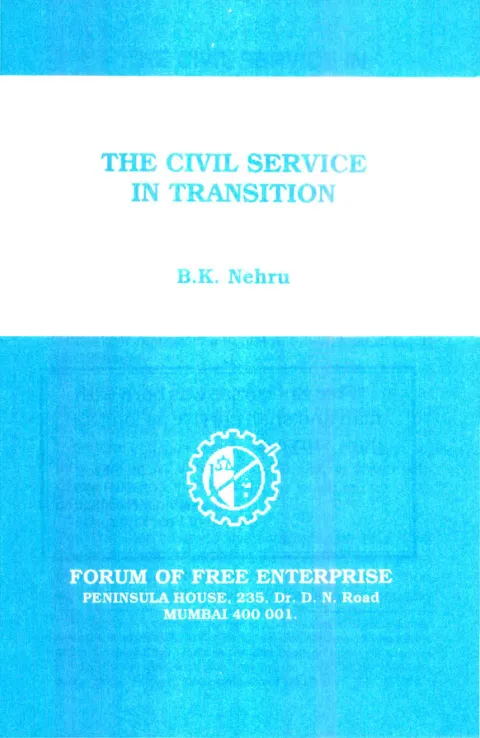
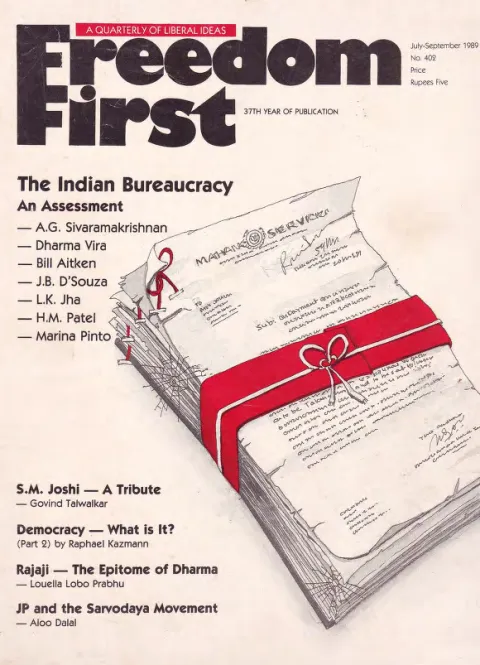
The Civil Service in Transition
By BK Nehru
FORUM OF FREE ENTERPRISE PENINSULA HOUSE, 235, Dr. D. N. Road MUMBAI 400 001. · Mumbai
24 pages
The Civil Service in Transition
By B.K. Nehru
Summary
B. K. Nehru’s lecture traces the rise and decay of India’s higher civil services from their Bourbon-Napoleonic and Haileybury origins to their political subordination in the late 1990s. He defends the All-India Services settlement that Sardar Vallabhbhai Patel forced through an unwilling Constituent Assembly, and argues that it has since been hollowed out by ministerial interference, transfers used as a weapon, and pervasive corruption rooted in the licence-permit-quota raj.
Nehru opens with an institutional history — the Bourbon and Napoleonic prefectoral system, Lord Wellesley’s College of Fort William, the East India College at Haileybury, the opening of the ICS examination in 1853, and the parallel Indian examination introduced in 1922 — before turning autobiographical. Recalling his own 1934 selection, he describes a Viva Voce in which he was asked how he could serve the British Government when half his family was in jail, and his answer that he wanted “to see for himself” whether being in the ICS would help his people. He then evokes the guru-chela district apprenticeship under a Deputy Commissioner, in which the new recruit was drilled in incorruptibility, “no fear or favour”, a contempt for sifarish, and the conviction that he was a servant, not a ruler, of the people.
Four anecdotes mark the collapse of that ethos. Under the British an Accountant General, Ganga Ram Kaula, ordered that an over-priced carpet be recovered from a Finance Member’s salary and was later knighted; under Jawaharlal Nehru, the income-tax chairman Arun Roy refused even T. T. Krishnamachari access to a citizen’s returns and survived; in the present day a young IAS officer is told that ministers will tolerate only “category A” (unquestioning) or at most “category B” officers, never “category C” who insist on law; and an Assistant Commissioner who tries to charge a cabinet minister customs duty on luxury imports is transferred from Delhi to Chennai within a week. Nehru blames a deeper rot: Nehruvian nationalisation and the licence-permit-quota raj created arbitrary discretion that corrupted ministers first and then seeped into the services; deflated ICS salaries and absurdly high income-tax rates put temptation in everyone’s path; and Lok Sabha election finance, now Rs. 1.3 crore a seat, has welded politicians to the underworld.
For Nehru, the constitutional ideas of democracy, equality, secularism, human rights and the Rule of Law remain foreign imports onto a millennia-old “Raja and Praja” template, which is why elected representatives treat the laws they pass as binding on everyone but themselves. The civil servant who insists otherwise is at “continuous war” with the politician, and the Indian Police Service, recast as the Chief Minister’s private army, has fared worse than the IAS. The rendered pages close by noting that the Administrative Reforms Commission under Morarji Desai, the Sarkaria Commission, and the Dharma Vira Commission have all gathered dust, and that the R. Venkataraman commission on constitutional amendments has just been announced; the text breaks off before the lecture’s conclusion.
Key points
-
Modern civil services, with codified recruitment, duties, salaries and tenure, are functionally tied to democracy and the Rule of Law; their genealogy runs from the Bourbon prefects through Napoleon to Haileybury, the 1853 open ICS examination, and the 1922 parallel Indian examination.
-
Pre-Independence ICS training was a guru-chela apprenticeship under a Deputy Commissioner in which moral formation — incorruptibility, refusal of sifarish, the duty to serve rather than rule — was treated as inseparable from technical competence.
-
Four case studies — the Ganga Ram Kaula carpet affair under the British, Arun Roy’s refusal of T. T. Krishnamachari’s demand for a citizen’s tax returns under Nehru, the IAS officer asked which ‘category’ (A/B/C) he belongs to, and an Assistant Commissioner transferred for charging a minister customs duty — mark the long decline of ministerial restraint.
-
Sardar Vallabhbhai Patel is presented as the sole leader to grasp that good laws do not enforce themselves; his All-India Services articles were forced through against the wishes of Chief Ministers who wanted pliable officials, and Jawaharlal Nehru only came round to the ICS view after long experience of office.
-
The licence-permit-quota raj, born of nationalisation and tight industrial control, created the arbitrary discretion that corrupted ministers first and the services after them; deflated ICS salaries and absurdly high direct taxes made the temptation worse.
-
Lok Sabha election finance — Nehru cites Rs. 1.3 crore per seat — has welded the political class to underworld money and produced the now-routine nexus of politician, criminal, corrupt businessman and compromised civil servant.
-
Democracy, equality, secularism, human rights and the Rule of Law are characterised as foreign-origin ideas grafted onto an unbroken Raja-Praja tradition; the elected Ruler is therefore widely assumed to be above the law he passes, and the upright civil servant is in ‘continuous war’ with him.
-
The Indian Police Service has been more thoroughly captured than the IAS, behaving as the Chief Minister’s ‘private army’; commission reports from Morarji Desai’s Administrative Reforms Commission to the Sarkaria and Dharma Vira commissions have been left to gather dust.
Generated by the v1.5 extraction pipeline. Awaiting editorial review.
Metadata and summary are AI-extracted from the source PDF and reviewed for editorial accuracy. The original work is available via the Read PDF tab above (where present); paragraph-level citation inside the PDF is deferred to a future engagement.