periodical issue
Freedom First
Edited by Raman Desai and printed at Inland Printers, 55 Gamdevi Road, Bombay 7 and published for the Democratic Research Service by B. K. Desai at 127 Mahatma Gandhi Road, Bombay 1. · Bombay · 1963
12 pages
Freedom First
Summary
Freedom First No. 130 (March 1963) is a monthly issue of the Bombay-based classical-liberal periodical, published in the immediate aftermath of the 1962 Sino-Indian border war. The issue is dominated by defence and foreign-policy anxiety: contributors press for a formal air-defence pact with Western powers, criticize the government’s handling of the Sino-Indian conflict and the Colombo proposals, argue for the ‘de-militarisation’ of Tibet, and dissect India’s diplomatic humiliation at the Third Afro-Asian People’s Solidarity Conference in Moshi. Domestic politics also features, with a piece on Indonesia’s Sukarno and the proposed Malaysia federation, a defence of the Defence of India Act and the state of emergency by MP Dr. L. M. Singhvi, and a sharply critical history of the Communist Party of India’s shifting, Moscow-aligned positions on Indian nationalism. The issue closes with a book review of a Nigerian ex-communist’s memoir of six years under East German communist tutelage, a cartoon page (‘You Said It’ by Laxman), and the recurring ‘With Many Voices’ page of press quotations on the Sino-Indian dispute, alongside the masthead and subscription details.
Key points
-
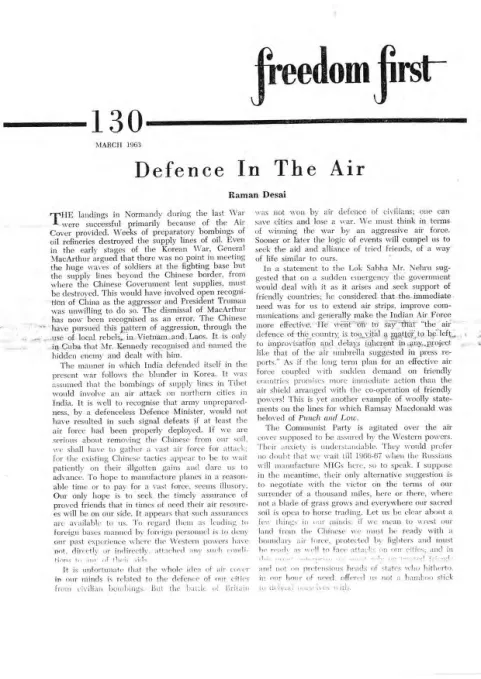
Raman Desai’s “Defence In The Air” argues India’s air defence has been dangerously neglected, invoking Normandy and Korea to insist wars are won by offensive air power, and calls for alliance with ‘tried friends’ rather than boundary concessions to China.
-
A short piece on “The Peacock” reflects on India’s national emblem, paired with James McAuley’s reprinted poem “Innocent By Definition” satirising morally evasive political rhetoric.
-
S. Sharangpani’s account of the Third Afro-Asian Solidarity Conference at Moshi describes how the Indian delegation was outmanoeuvred into a resolution favourable to China, with delegation leader Chaman Lal admitting “we were double-crossed.”
-
An “As Others See Us” reprint from the American National Review argues China’s consolidation of Tibet lets it squeeze Bhutan, Sikkim and Nepal, criticises V. K. Krishna Menon’s pro-Communist influence, and still urges continued Western military aid to India.
-
Adam Adil’s “Dr. Sukarno And Malaysia” condemns Indonesian President Sukarno’s opposition to the proposed Malaysian Federation as ‘neo Afro-Asian imperialism’ serving Soviet and Chinese interests, and argues India should support Malaysia as a check on Communism in Southeast Asia.
-
M. A. Venkata Rao’s “De-Militarisation Of Tibet” traces treaty history including the 1914 McMahon Line to argue India’s 1950-51 acquiescence in China’s absorption of Tibet was a moral and strategic error, and calls for Tibet’s de-militarisation backed by a Western defence pact.
-
Dr. L. M. Singhvi, M.P., in “Emergency And Government,” defends the constitutional propriety of the Defence of India Act, citing Constituent Assembly debates, while calling for parliamentary vigilance against abuse of emergency powers.
-
M. Devadas Kini’s “Reluctant Nationalists?” traces the CPI’s shifting, Moscow-aligned positions on the Sino-Indian dispute from 1930 to 1962, concluding that “a genuine communist cannot be a genuine nationalist.”
-
The issue closes with a review of Aderogba Ajao’s memoir “Six Years Under Communism” on forced detention in East Germany, a Laxman cartoon, and a “With Many Voices” column quoting C. Rajagopalachari comparing debate over Western alignment to “discussing vegetarianism in a Chinese restaurant.”
Essays
Defence In The Air
By Raman Desai
Raman Desai’s opening piece argues that India’s air defence has been dangerously neglected. Drawing on the Normandy landings and the Korean War, he contends that wars are won by aggressive, offensively-postured air forces rather than passive civilian air-cover, and criticizes Nehru’s Lok Sabha statement on air strips and communications as woolly and reactive. He dismisses Communist Party anxieties about Western-supplied air cover as a delaying tactic that suits Soviet interests, and calls for India to secure firm alliances with ‘tried friends’ rather than negotiate boundary concessions with China.
- Uses Normandy and the Korean War as historical analogies for the necessity of air power over passive defence
- Criticizes Nehru’s Lok Sabha statement on air strips as an inadequate, ad hoc response
- Accuses the Communist Party of India of stalling on Western air cover to buy time for Soviet MIG deliveries
- Argues India must seek ‘the aid and alliance of tried friends’ rather than negotiate away territory
- Frames the debate as one between fighting for a boundary versus surrendering ‘a thousand miles’ through horse-trading
The Peacock
By R. K. D.
A short unsigned piece on ‘The Peacock’ reflects on India’s choice of the peacock as its national emblem for wildlife conservation, contrasting it with the peacock’s historic association with Mughal and British imperial pageantry, and closing with a wry note about swearing ‘on the peacock’ never to swallow one’s pride. It is followed by James McAuley’s poem ‘Innocent by Definition’ (reprinted from Quadrant, Sydney, Summer 1963), a satire on morally evasive, consensus-seeking political rhetoric.
- Reflects on the peacock as India’s wildlife emblem and its older association with imperial pageantry
- Notes the male peacock’s greater ‘glamour’ compared to the female, taken as apt for the emblem
- McAuley’s poem satirizes ‘quagmire’ political language that avoids moral judgment
- The poem is reprinted courtesy of Quadrant (Sydney), Summer 1963 issue
Innocent By Definition
By James McAuley
No summary was extracted for this article. Listed for completeness.
Double-cross At Moshi
By S. Sharangpani
S. Sharangpani’s ‘Double-cross At Moshi’ recounts how the Indian delegation to the Third Afro-Asian People’s Solidarity Conference in Moshi, Tanganyika, was diplomatically outmanoeuvred. Despite triumphalist Indian press coverage during the conference, the final resolution on the Sino-Indian conflict dropped the phrase ‘without reservation,’ effectively endorsing China’s position and upholding the Colombo proposals without condemning Chinese aggression. The Indian delegation’s own leader, Chaman Lal, admitted ‘we were double-crossed,’ while the piece criticizes both the delegation’s poor judgment (it was led by ‘fellow-travellers’ and ‘crypto-communists’) and the government’s complicity in sending it.
- The Indian delegation to the Moshi Afro-Asian Solidarity Conference claimed victory prematurely, only to discover the final resolution favoured China
- The word ‘without reservation’ was dropped from the resolution with the Indian delegation’s own consent
- Delegation leader Chaman Lal publicly admitted the Indian side had been ‘double-crossed’
- The delegation is characterized as ideologically unsuited (fellow-travellers and crypto-communists) to represent India’s case against China
- The Soviet delegate at the conference praised the Colombo proposals while avoiding criticism of China
- The piece implicates the Nehru government and the Indian High Commission in Tanganyika in the failed diplomatic effort
As Others See Us: Indian Dilemma
An unsigned ‘As Others See Us’ reprint titled ‘Indian Dilemma’ (from National Review, New York, presumably late 1962) argues that China’s consolidation of Tibet lets it squeeze Bhutan, Sikkim, and Nepal while threatening the Indian subcontinent and Southeast Asia. It criticizes Krishna Menon as a pro-Communist, neutralist influence on Nehru, questions the competence of India’s armed forces, and urges continued Western military aid to India despite the risks and ‘subtle traps’ of unrestricted support to Nehru’s government.
- Frames China’s Tibet consolidation as part of a strategic vise on Bhutan, Sikkim, and Nepal
- Portrays Krishna Menon as pro-Communist and largely responsible, with Nehru, for India’s military unpreparedness
- Questions whether India’s government is competent enough to usefully deploy Western military aid
- Still recommends the West extend aid to India despite doubts, citing the shared interest in resisting Chinese expansion
- Notes India’s continued deployment of best troops against Pakistan in Kashmir rather than solely against China
Dr. Sukarno And Malayasia
By MA Venkata Rao
Adam Adil’s ‘Dr. Sukarno And Malayasia’ [sic] welcomes the proposed merger of Malaya, Singapore, Brunei, Sarawak, and North Borneo into a Malaysian Federation, and condemns Indonesian President Sukarno’s opposition to it as a form of ‘neo Afro-Asian imperialism’ sustained by Soviet and Chinese Communist backing. The essay argues Sukarno is using the Malaysia issue to distract from Indonesia’s economic collapse and dependence on Russian loans, and concludes that India, as a victim of Chinese aggression, has every interest in supporting Malaysia as a check on Communist influence in Southeast Asia.
- Frames Indonesian opposition to the Malaysian Federation as ‘neo Afro-Asian imperialism’
- Portrays Sukarno as diverting attention from Indonesia’s economic and political instability via the Malaysia issue
- Notes Indonesia’s large unpaid debt (over $1,000 million) to the Soviet Union as a source of political leverage over Sukarno
- Argues Tunku Abdul Rehman is a consistent friend of India who has condemned Chinese aggression and started a fund to help India
- Concludes Malaysia’s formation would be a check on Chinese Communist influence in Southeast Asia, benefiting India
De-Militarisation Of Tibet
By M. A. Venkata Rao
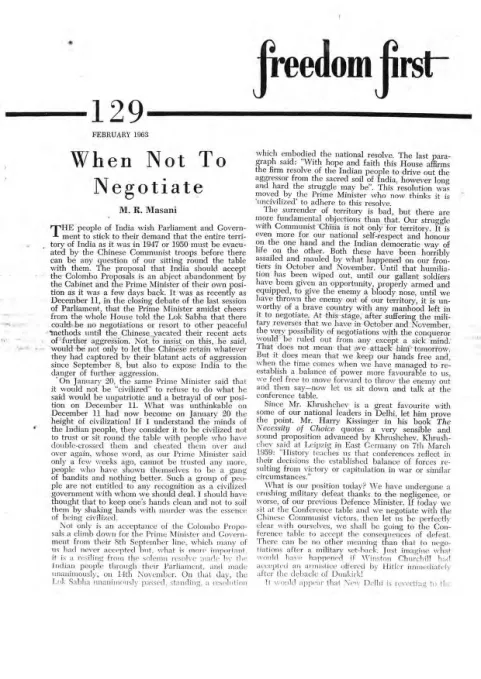
M. A. Venkata Rao’s ‘De-Militarisation Of Tibet’ criticizes Nehru’s acceptance of the Colombo proposals as a reversal of Parliament’s solemn resolution against negotiating with China until it withdrew from Indian soil. The essay reviews the nineteenth- and early twentieth-century treaty history establishing Tibet’s autonomous status (including the 1914 McMahon Line agreement) and argues that India’s 1950-51 acquiescence in China’s absorption of Tibet was a moral and strategic error. It calls for the de-militarisation of Tibet as the minimum security requirement for India, backed by adequate Indian military preparation and a defence pact with Western powers (and possibly Russia).
- Criticizes Nehru for accepting the Colombo proposals in apparent contradiction of Parliament’s resolution
- Traces treaty history (including the 1914 McMahon Line) establishing Tibet’s historic autonomous status vis-a-vis China, Russia, and India
- Argues India’s tacit acceptance of the Chinese absorption of Tibet in 1950-51 was ‘a crime against nationalism, democracy and humanity’
- Describes Tibet’s transformation into ‘a vast military base’ with airfields, railways, and depots threatening India, West Asia, and Southeast Asia
- Proposes de-militarisation of Tibet as the minimum security demand, backed by a Western defence pact akin to the Eisenhower doctrine
- Suggests Russia could also be invited to join a joint security scheme given her own border disputes with China
Emergency And Government
By Dr. L. M. Singhvi, M. P.
Dr. L. M. Singhvi, M.P., defends the constitutional propriety of the Defence of India Act and the state of emergency in ‘Emergency And Government,’ arguing that emergency powers function within, not outside, the framework of the Constitution. He cites debates from the Constituent Assembly (H. V. Kamath, Mahavir Tyagi, T. T. Krishnamachari) on balancing civil liberties against security needs, references the Soviet Constitution’s own martial-law provisions for comparison, and calls on Parliament to remain vigilant that emergency powers are not abused, quoting Shakespeare’s Measure for Measure on the need for the executive to be ‘as holy as severe.’
- Argues the Defence of India dispensation operates within, and does not abrogate, the Constitution
- Cites Constituent Assembly debate (H. V. Kamath’s warning about Article 48 of the Weimar Constitution enabling authoritarianism)
- Cites Mahavir Tyagi and T. T. Krishnamachari on democracy’s need to adjust to security demands while remaining answerable to the people
- Rebuts Communist MP Hiren Mukerjee’s citation of Lord Atkins on wartime law, arguing Mukerjee misapplied a dissenting opinion
- Calls for parliamentary oversight (e.g., a committee) to ensure Defence of India Act powers are not abused
- Closes with a warning, quoting Measure for Measure, that the executive wielding ‘almost Draconian powers’ must be ‘as holy as severe’
Reluctant Nationalists?
By M. Devadas Kini
M. Devadas Kini’s ‘Reluctant Nationalists?’ traces the Communist Party of India’s shifting and evasive positions on the Sino-Indian border dispute and argues that genuine communism is fundamentally incompatible with genuine nationalism. Citing CPI resolutions and statutes from 1930 to 1962, the essay shows the party moved from denying Chinese ‘aggression’ (calling it mere ‘incursion’) to belatedly recognizing it only after ten days, and traces a longer history of the CPI treating Comintern/Moscow directives as binding, opposing Gandhi and Subhas Bose, and supporting Pakistan’s creation on ‘self-determination’ grounds despite claiming Indian nationalism.
- Shows CPI initially refused to call the Chinese crossing of the McMahon Line ‘aggression,’ preferring ‘incursion’
- CPI recognized the 20 October 1962 attack as aggression only after roughly ten days, following the declared national emergency
- Cites the 1930 Draft Platform of Action and 1934 CPI statutes describing the party as bound to the ‘Communist international’ and Comintern decisions
- Notes the CPI’s wartime record: opposing the ‘imperialist war’ before the Nazi invasion of the USSR, then supporting the ‘people’s war’ after, and informing on Congress activity to the British
- The CPI’s 1958 Amritsar constitution names ‘the great October Revolution’ and ‘Marxism-Leninism’ as its guiding inspiration, not Indian nationalism
- Concludes that a ‘genuine communist cannot be a genuine nationalist’ and calls for vigilance against CPI infiltration of Congress and creation of a ‘Yenan’ in NEFA
Six Years Under Communism
An unsigned book review (signed ‘V.B.K.’) covers ‘Six Years Under Communism’ by Aderogba Ajao (George Allen & Unwin, 21 sh.), the memoir of a Nigerian student lured to East Germany under the guise of technical training and forcibly held there for six years by Communist Party handlers. The review situates the book within a broader pattern of Communist recruitment of young Africans and Asians for ideological training, and quotes Ajao’s warnings about Communist exploitation of anti-colonial and pan-African sentiment. It is followed by an advertisement for the book ‘Tibet Fights for Freedom’ (Orient Longmans, Rs. 15).
- Reviews Aderogba Ajao’s memoir of six years’ forced detention and communist indoctrination in East Germany
- Frames the book as part of a broader pattern of Communist recruitment of young Africans and Asians, with training shifting emphasis from Asia to Africa
- Quotes Ajao’s warning that Communists exploit anti-colonial and anti-imperialist sentiment while practising their own imperialism (citing the Baltic States, Hungary, Tibet)
- Notes Ajao’s warning that ‘if Stalin is dead, Lenin, in a sense, is not’ — communism’s drive for power persists
- Accompanied by an advertisement for ‘Tibet Fights for Freedom’ (Orient Longmans, Rs. 15)
You Said It (cartoon)
By Laxman
The back-cover feature ‘With Many Voices’ compiles quotations from the international and Indian press (February 4-22, 1963) on the Sino-Indian dispute, Sino-Soviet relations, and Nehru’s diplomacy, drawn from sources including Swarajya, the Hindu, Time, Opinion, Indian Express, and Hindustan Times. Quoted figures include C. Rajagopalachari, Khrushchev, Nehru, De Gaulle, Nyerere, and Diem, on themes ranging from the unreliability of the Indian state as an ‘ally’ to Soviet-Chinese rivalry for influence over India. The page also carries the subscription coupon and the masthead crediting Raman Desai as editor and B. K. Desai as publisher for the Democratic Research Service.
- Compiles press quotations from February 1963 on the Sino-Indian dispute and Sino-Soviet dynamics
- Quotes C. Rajagopalachari comparing debate over Western alignment to ‘discussing vegetarianism in a Chinese restaurant’
- Quotes Khrushchev’s remarks on Sino-Soviet solidarity (‘when the last spadeful of earth is thrown on the grave of capitalism, we will do it together with China’)
- Includes a Soviet Communist Party letter regretting the loss of Nehru’s trust over the Chinese aggression
- Carries the masthead: edited by Raman Desai, printed at Inland Printers (Bombay), published for the Democratic Research Service by B. K. Desai
Generated by the v1.5 extraction pipeline. Awaiting editorial review.
Metadata and summary are AI-extracted from the source PDF and reviewed for editorial accuracy. The original work is available via the Read PDF tab above (where present); paragraph-level citation inside the PDF is deferred to a future engagement.