periodical issue
Freedom First
A Journal of Liberal Ideas
By NISSIM EZEKIEL, K. S. VENKATESWARAN, J. G. TIWARI, C. RAJU, HOMAI MOOS, MEHRA MASANI, HAVOVI ANKLESARIA, ELIZABETH REUBEN, M. A. RANE, VASANTHA SURYA
Published for the Democratic Research Service by J. R. Patel, Associate Editor, Freedom First, at 127, Mahatma Gandhi Road, Bombay 400 023 (Phone: 273914) and printed by him at The Bombay Chronicle Press, Bombay 400 001. · Bombay · 1981
16 pages
Freedom First
Summary
Issue 339 of Freedom First (March 1981) opens with editor Nissim Ezekiel’s column questioning the moral coherence of non-alignment in light of the Delhi Conference, Afghanistan, and Kampuchea. K. S. Venkateswaran summarises Amnesty International’s 1979-80 annual report, with attention to the Indian scene and the National Security Act, while J. G. Tiwari analyses a Soviet propaganda document on Pakistan, Iran, and the Islamic world. C. Raju’s essay ‘Dilemmas of Liberty’ argues that concentration of economic power, whether in the state or in monopolistic private hands, is the central threat to liberty, citing Milton Friedman. Homai Moos reports on the international Child-to-Child Programme for children’s health and welfare. A substantial ‘World of Books’ section reviews works on H. M. Patel, Ved Mehta’s Mamaji, an anthology on contemporary Indian English verse, and a Jaico volume on women in the Third World’s industrialising economies. The issue closes with M. A. Rane’s tribute to the late M. C. Chagla, delivered at a Bombay condolence meeting, and a short item contrasting British and Soviet foreign aid to India.
Key points
-
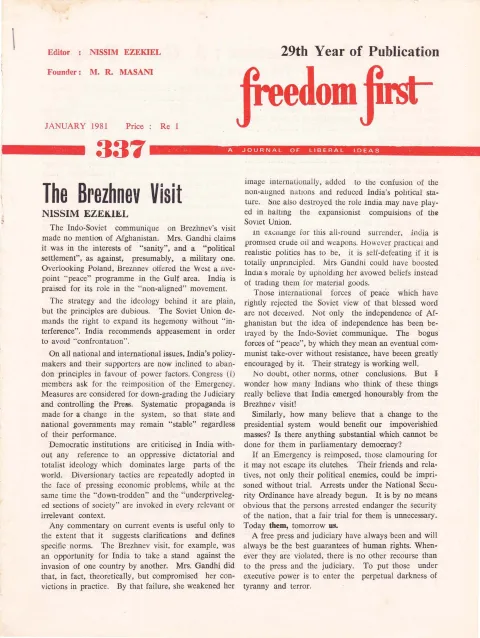
Nissim Ezekiel’s editorial questions the moral coherence of non-alignment, criticising India’s muted response to the Vietnamese occupation of Kampuchea and the Soviet occupation of Afghanistan despite its claimed moral leadership.
-
K. S. Venkateswaran summarises Amnesty International’s 1979-80 annual report, including its aide-memoire to Mrs Gandhi’s government criticising misuse of preventive detention and prison conditions at Tihar Jail.
-
J. G. Tiwari analyses a Soviet pamphlet, The Truth About Afghanistan, showing it frames Pakistan’s military as complicit in suppressing “liberation struggle” and condemns Iran and Khomeini for anti-Soviet rhetoric.
-
C. Raju’s “Dilemmas Of Liberty” argues that concentration of economic power, in the state or in monopolistic private hands, is liberty’s central threat, citing Milton Friedman’s Capitalism and Freedom.
-
Homai Moos describes the London-founded Child-to-Child Programme’s Indian chapters, which train older children to assist younger ones’ health and welfare, with its 1981 focus on handicapped children.
-
The World of Books reviews the H. M. Patel commemoration volume, Ved Mehta’s family memoir Mamaji, an anthology of contemporary Indian English verse, and a study of women’s labour exploitation across Japan, Malaysia and India.
-
M. A. Rane’s tribute to the late M. C. Chagla recalls his defiance of MISA-era restrictions during the Emergency, his presidency of Citizens for Democracy after JP’s death, and his lifelong rationalism, including a cremation without religious rites.
Essays
Alignments of the non-aligned
By NISSIM EZEKIEL
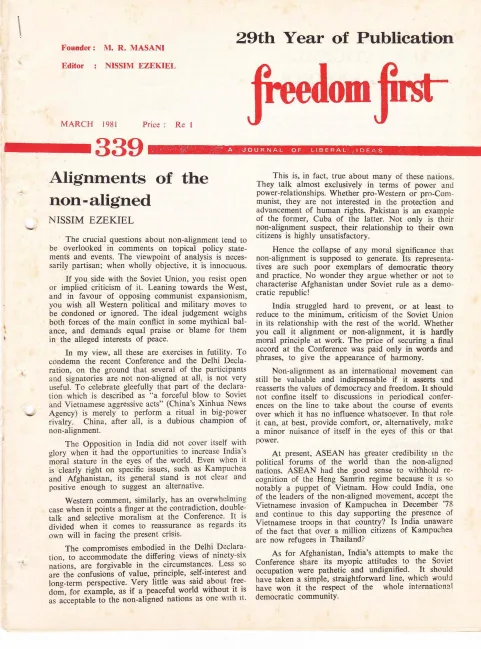
In this editorial, Nissim Ezekiel argues that partisan judgements about non-alignment are exercises in futility, and that the Delhi Declaration’s compromises among ninety-six nations said very little about freedom. He criticises both pro-Soviet and pro-Western non-aligned states for inconsistency, singles out India’s muted response to the Vietnamese occupation of Kampuchea and the Soviet occupation of Afghanistan, and concludes that non-alignment retains value only if it consistently asserts democratic and free values rather than functioning as a forum for power politics.
- Partisan analysis of non-alignment, whether pro-Soviet or pro-Western, is dismissed as an exercise in futility.
- The Delhi Declaration’s compromises among ninety-six nations said little about freedom as a value.
- India is criticised for a weak, unclear stance on Kampuchea and Afghanistan despite claiming moral leadership of the non-aligned movement.
- ASEAN is credited with greater credibility than the non-aligned bloc for refusing to recognise the Heng Samrin regime.
- Non-alignment is said to retain value only if it consistently asserts democracy and freedom rather than serving as a forum for power politics.
Amnesty International Annual Report
By K. S. VENKATESWARAN
K. S. Venkateswaran summarises Amnesty International’s 408-page annual report covering May 1979 to April 1980, noting the growing scale of imprisonment, torture, and extra-judicial killing worldwide and Amnesty’s observation that the most flagrant violations occur in totalitarian states. He details criticism levelled at Iran (unfair trials and executions under the Islamic Revolutionary Tribunals), Poland (police brutality against dissidents such as Edmund Zadrozynski), and the Soviet Union (persecution of Helsinki monitors including Andrei Sakharov and Edward Arutunyan), before turning to ‘The Indian Scene’, where Amnesty’s aide-memoire to Mrs Gandhi criticised the misuse of preventive detention law, police brutality, and prison conditions at Tihar Jail, and recalled the Supreme Court’s ruling in Sunil Batra’s Case.
- Amnesty’s 1979-80 report covers over a hundred countries and 12 months of human rights findings.
- Amnesty avoids formally ranking regimes but Venkateswaran notes the worst violations recur in totalitarian and mostly leftist states.
- Iran is criticised for unfair trials, executions, and flogging under the Islamic Revolutionary Tribunals.
- Poland is criticised for police brutality against dissidents including a named retired metal worker.
- The Soviet Union is criticised for persistent persecution of Helsinki monitors, including Andrei Sakharov and Edward Arutunyan.
- An Amnesty aide-memoire to Indira Gandhi’s government criticised misuse of preventive detention (the National Security Act), police brutality, and conditions in Tihar Jail, citing the Supreme Court ruling in Sunil Batra’s Case.
Soviet Designs On Pak, Iran And The Islamic World
By J. G. TIWARI
J. G. Tiwari analyses a Soviet-published pamphlet, The Truth About Afghanistan, arguing it reveals Moscow’s strategic thinking on Pakistan, Iran, and the wider Islamic world. He shows the document frames Pakistan’s General Staff as a tool of ‘liberation-struggle’ suppression, implies Pakistan’s independence is at risk if it continues opposing Soviet actions in Afghanistan, and floats redrawing the Pak-Afghan border over the Pushtun issue. Tiwari also details the document’s condemnation of Iran for supporting Afghan rebels and criticising the USSR, and its portrayal of Ayatollah Khomeini as a reactionary obstructing a ‘progressive’ revolution, closing on the ironic Soviet rehabilitation of Zafar Peshavari, the communist who led the failed 1921 Gilan Soviet Republic in northern Iran.
- The analysis is based on a Novosti (Soviet) publication titled The Truth About Afghanistan.
- The document frames Pakistan’s military as complicit in suppressing ‘liberation struggle’ in the region and warns Pakistan’s independence is at risk if it opposes Soviet actions.
- Soviet backing for Pushtun and Baluchi irredentism against Pakistan is highlighted as a means of destabilising the Pak-Afghan border.
- Iran and Ayatollah Khomeini are condemned in the document for anti-Soviet rhetoric and support for Afghan rebels, despite Khomeini’s own anti-communist credentials domestically.
- The document rehabilitates Zafar Peshavari, leader of the 1921 Soviet-backed Gilan Soviet Republic in Iran, as a heroic precedent.
Dilemmas Of Liberty
By C. RAJU
C. Raju argues that liberty and good government can coexist only through careful, discriminating restraint on the concentration of power, whether wielded by a dictator, an unaccountable electorate, or an overweening state. He contends that competitive private enterprise is a bulwark of liberty and that its erosion in favour of public enterprise concentrates dangerous power in the state, invoking Milton Friedman’s Capitalism and Freedom on the link between economic and political freedom. Raju further criticises India’s electoral politics for producing corruption and short-termism, the passivity of the Indian electorate toward inequality, and the growing power of both corporations and organised labour to raise costs at the consumer’s expense, concluding that the balance between liberty and state power is increasingly endangered.
- Liberty requires eliminating concentrations of power, whether in the hands of a dictator, the state, or unaccountable elites.
- Competitive private enterprise is framed as a bulwark of liberty against creeping state and public-sector power.
- Milton Friedman’s Capitalism and Freedom is cited approvingly on the link between economic and political freedom.
- Indian electoral politics is criticised for producing corruption, sub-committees, and short-term slogans like ‘Garibi Hatao’ rather than sustained reform.
- Both corporate monopolies and organised labour are described as increasingly able to raise costs at the expense of the consumer.
- The essay warns that the balance between liberty and state power may be endangered by self-generating inflation and the government’s role as broker.
Child-To-Child Programme
By HOMAI MOOS
Homai Moos, a member of the international committee of the Child-to-Child Programme, describes this London-founded initiative that trains older children to assist in the health, welfare, and development of younger children in their communities. She outlines its Indian chapters (Hyderabad, Bombay, Delhi, Chandigarh, Madras, and others), its patron Mrs Roda Mistry, its six broad strategies for child-to-child help, and international examples from Chile, Guatemala, India, Kuwait, and Papua New Guinea, noting that 1981’s focus is the handicapped child in the International Year of Disabled Persons.
- The Child-to-Child Programme originated at the Institute of Education and Child Health, University of London, and trains older children to help younger ones with health and welfare.
- India’s national headquarters is at Niloufer Hospital, Hyderabad, with a Western Region base in Bombay and chapters in several other cities.
- Mrs Roda Mistry, Member of the Rajya Sabha, is the Programme’s patron in India.
- Six broad strategies are outlined: eating well, improving health, providing safe environments, simple research, stimulating younger children, and helping handicapped children.
- 1981, the International Year of Disabled Persons, sees the Programme’s Indian focus shift toward handicapped children.
The World Of Books: H. M. Patel 75th Birthday Commemoration Volume (review)
By MEHRA MASANI
The ‘World of Books’ section carries four reviews. Mehra Masani reviews the H. M. Patel 75th Birthday Commemoration Volume, finding most tributes dull but valuing the account of Patel’s role in the 1947 Partition Secretariat and his forced retirement following the Mundhra LIC scandal, praising his post-retirement rural development work at Vallabh Vidyanagar. Havovi Anklesaria reviews Ved Mehta’s Mamaji (sequel to Daddyji), describing it as a family chronicle centred on Mehta’s father, criticising its flat, cameo-like treatment of characters including the arranged child-marriage of the author’s aunt. Elizabeth Reuben reviews Contemporary Indian English Verse: An Evaluation, a twenty-essay anthology, finding the first half stronger and noting misprints and thin analysis undermine some individual essays despite a valuable closing piece by Vrinda Nabar on Keki Daruwalla. Vasantha Surya reviews Women in the Third World (ed. Laeeq Futehally), surveying essays on the exploitation of women workers under industrialisation in Japan, Malaysia, and India, and contrasting these with the relatively better status of women in Sri Lanka, Kerala, Java, and Sudan.
- Mehra Masani reviews the H. M. Patel commemoration volume, highlighting Patel’s role in 1947 Partition negotiations and his forced ICS retirement over the Mundhra/LIC scandal under T. T. Krishnamachari.
- Havovi Anklesaria reviews Ved Mehta’s Mamaji, a family memoir sequel to Daddyji, criticising its flat narrative style despite its vivid detail.
- Elizabeth Reuben reviews an anthology of twenty essays on contemporary Indian English poetry, praising Vrinda Nabar’s closing essay on Keki Daruwalla as the collection’s strongest.
- Vasantha Surya reviews Women in the Third World, which documents how industrialisation in Japan, Malaysia, and India has intensified the exploitation of female labour.
- Surya’s review contrasts this exploitation with the comparatively stronger status of women in Sri Lanka, Kerala, Java, and Sudan due to differing cultural and religious traditions.
The World Of Books: Mamaji by Ved Mehta (review)
By HAVOVI ANKLESARIA
M. A. Rane’s speech at a Bombay condolence meeting pays tribute to M. C. Chagla, recalling his frequent public addresses for Citizens For Democracy and allied civil liberties organisations, his defiance of MISA-era restrictions during the Emergency to address banned meetings, and his role as All India President of Citizens for Democracy after Jayaprakash Narayan’s death. Rane recounts Chagla’s opposition to the Emergency and to the 42nd Amendment, his founding role in the Rationalist Association of India alongside contemporaries such as Sir Raghunath Paranjpe and D. R. Karve, his professed rationalism and secular humanism, and his wish for a non-religious cremation, closing with the claim that Chagla will have ‘an abiding place’ in the coming rise of secular humanism.
- Chagla addressed public meetings for Citizens For Democracy from 1974 until shortly before his death, including a defiant appearance ten days after a hospital operation in November 1980.
- He was unanimously elected All India President of Citizens for Democracy after Jayaprakash Narayan’s death and defied MISA restrictions to speak at banned meetings during the Emergency.
- He was among the founders of the Rationalist Association of India in the early 1930s, alongside figures such as Sir Raghunath Paranjpe and D. R. Karve.
- Chagla’s cremation was conducted without religious rites at his own request, which Rane frames as consistent with his rationalist convictions.
- Rane frames Chagla as belonging to ‘the age of enlightenment’ and predicts a rise of secular humanism in his mould by the end of the century.
Generated by the v1.5 extraction pipeline. Awaiting editorial review.
Metadata and summary are AI-extracted from the source PDF and reviewed for editorial accuracy. The original work is available via the Read PDF tab above (where present); paragraph-level citation inside the PDF is deferred to a future engagement.