pamphlet
The Cult of State Capitalism in India
By C. H. Bhabha
FORUM OF FREE ENTERPRISE, 235, DR. DADABHAI NAOROJI ROAD, BOMBAY-1 · Bombay · 1957
9 pages
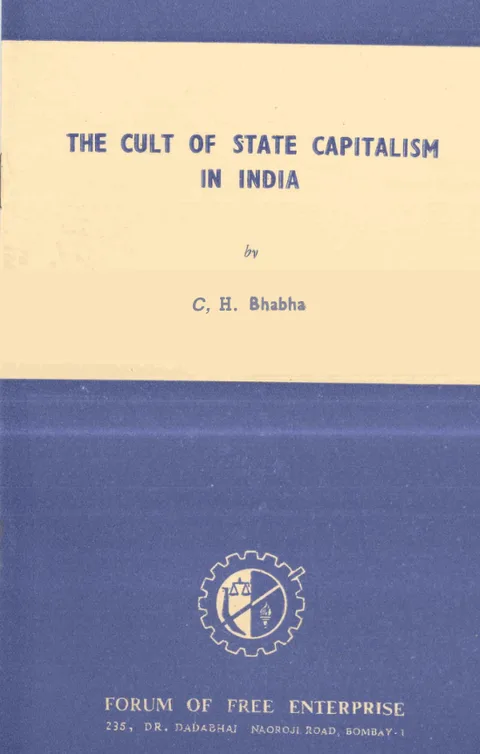
The Cult of State Capitalism in India
By C. H. Bhabha
Summary
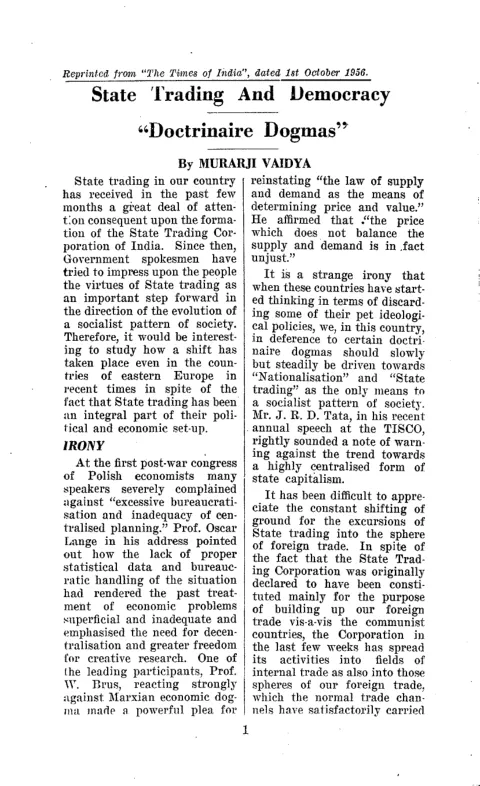
C. H. Bhabha’s pamphlet, published by the Forum of Free Enterprise, is a sustained polemic against what he calls the “cult of State Capitalism” in post-independence India. Bhabha argues that political slogans demonising capital and capitalists, paired with the Nehru-era doctrine of a “mixed economy”, have in practice drifted toward a totalitarian experiment in state capitalism. He treats the 1948 industrial policy resolution and its 1956 revision as the formal milestones in this drift, and points to the establishment of the State Trading Corporation and the nationalisation of life insurance as concrete instances of a “violent shift” in the role of the state.
The central evidentiary section reviews the First Five-Year Plan, conceding that overall industrial production rose by about 35% between 1951 and 1955 (with tables for cotton textiles, jute, steel, cement, machine tools, diesel engines, sewing machines, soda ash, caustic soda and superphosphates), but insisting that the direct contribution of state enterprise was negligible. Bhabha singles out the Sindhri Fertiliser Factory, Chittaranjan Loco Works, Hindustan Aircraft, Hindustan Telephones and Hindustan Shipyard as cases that, examined honestly, would expose the burden public ventures place on the nation. He warns that state enterprises shielded from competition foster complacency, that organising them as private joint-stock companies still leaves shareholders without effective control, and that the ordinary basis of contract and freedom of association is being trampled.
Bhabha then turns the comparative lens outward. In the United States, he argues, roughly 100 billion dollars of federal investment in business by the mid-1950s produced a backlash; the Eisenhower administration’s “get out of business” campaign and divestments by the Defence Department exemplify a counter-doctrine he labels “people’s capitalism” or “democratic capitalism”, citing General Motors’ 639,000 stockholders and 1.5 million holders of AT&T stock. He quotes Soviet economist Eugene Varga’s failed search for evidence against this trend, the heavy losses of French nationalised railways and coal mines, and the conversion of ex-Finance Minister John Matthai away from nationalisation in his Lok Sabha speech, alongside Winthrop Aldridge’s warning that “Government planning means the destruction of individual initiative”.
The pamphlet closes by invoking Jefferson on the danger of concentrating “all cares and powers into one body” and by quoting Nehru approvingly on producing material goods “not at the expense of the spirit of man”. Bhabha urges that India’s State Capitalism be deeply thought out and provided with proper safeguards rather than pursued through painful or inhuman ways.
Key points
-
Frames Indian “mixed economy” rhetoric as a drift toward totalitarian state capitalism, with the 1948 industrial policy resolution as the first turning point and the 1956 revision deepening it.
-
Treats the State Trading Corporation and the nationalisation of life insurance as emblematic of a “violent shift” in the role of the state.
-
Concedes that overall industrial production rose ~35% over the First Plan (1951-1956) but argues the direct contribution of state enterprise was negligible and credit belongs to private initiative.
-
Names Sindhri Fertiliser Factory, Chittaranjan Loco Works, Hindustan Aircraft, Hindustan Telephones and Hindustan Shipyard as state ventures whose true costs are obscured by official accounting.
-
Warns that state enterprises insulated from competition breed complacency, while joint-stock organisation does not give shareholders genuine control.
-
Holds up American “people’s capitalism” — wide stock ownership in firms like General Motors and AT&T, plus the Eisenhower “get out of business” campaign — as a contrary global trend.
-
Cites ex-Finance Minister John Matthai’s Lok Sabha recantation and Winthrop Aldridge of the Chase National Bank as authorities against nationalisation.
-
Closes with Jefferson on concentrated power destroying liberty, and asks that India’s State Capitalism be deeply thought out and not pursued through painful or inhuman ways.
Generated by the v1.5 extraction pipeline. Awaiting editorial review.
Metadata and summary are AI-extracted from the source PDF and reviewed for editorial accuracy. The original work is available via the Read PDF tab above (where present); paragraph-level citation inside the PDF is deferred to a future engagement.