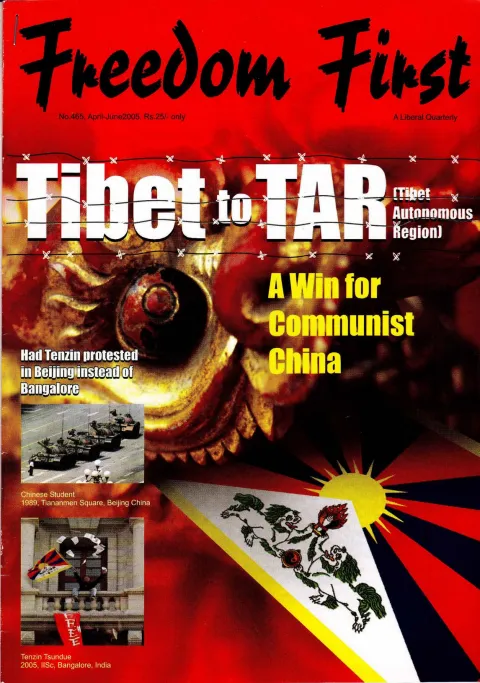
periodical issue
Freedom First
A Liberal Quarterly
Publishers: Indian Committee for Cultural Freedom (ICCF), 3rd Floor, Army & Navy Building, 148, Mahatma Gandhi Road, Mumbai 400 001. Published by J. R. Patel for the Indian Committee for Cultural Freedom (ICCF) and printed by him at Kaiser-E-Hind Private Ltd., Plot No.A-191, Road No.16A, MIDC, Wagle Industrial Estate, Thane (W) - 400604. · Mumbai · 2005
32 pages
Freedom First
Summary
Freedom First No.466 (July-September 2005) is the 53rd-year quarterly of the Indian Committee for Cultural Freedom, edited by S. V. Raju. The editor’s note explains the issue’s delay: unprecedented Mumbai flooding destroyed the editor’s papers and computer, forcing reconstruction of the contents and abandonment of a planned cover feature on India-Pakistan rapprochement. The issue opens with tributes to two recently deceased Liberals, C. R. Irani (Statesman editor and press-freedom champion) and Dr. Fredie Mehta (Tata economist), followed by the regular ‘With Many Voices’ page of quoted commentary and ‘Of Cabbages and Kings’ editorial notes on the national flag code, judicial activism, and rule of law. The rendered pages cover a Minoo Masani birth-centenary reprint of his 1957 parliamentary Minute of Dissent on the Wealth Tax Bill; Eustace D’Souza’s analysis of China’s expanding military strength and its implications for India; a press release on Chinese diplomatic pressure against a Tibet-related talk in Mumbai; Dr. R. Srinivasan’s profile of the 19th-century Maharashtrian rationalist Gopal Ganesh Agarkar; Ashok Karnik’s commentary on the L. K. Advani-Jinnah controversy within the BJP; and tributes to the late novelist Shama Futehally by Humera Ahmed and her mother Laeeq Futehally. The volume’s throughline is classical-liberal commentary on economic policy, civil liberties, national security vis-a-vis China, secular rationalism, and remembrance of departed Liberals.
Key points
-
Freedom First No. 466 (July-Sept 2005) was delayed after Mumbai’s unprecedented flooding destroyed the editor’s papers and computer, forcing abandonment of a planned cover feature on India-Pakistan rapprochement.
-
S. V. Raju’s tribute to C. R. Irani, the late Statesman editor, credits him with preserving the paper’s independence during the Emergency and recounts his history in the Swatantra Party at Minoo Masani’s invitation.
-
A reprint marking Minoo Masani’s birth centenary, his 1957 Minute of Dissent on the Wealth Tax Bill, argues extending the tax to joint-stock companies would harm small investors, citing Reserve Bank survey data showing most Bombay shareholders were middle- or lower-income.
-
Major General Eustace D’Souza surveys China’s expanding military modernisation, including a “Web Army” monitoring Indian missions and the militarisation of Tibet via the Gormu-Lhasa railway, and recommends India strengthen border forces and regional diplomacy.
-
A press release by Aspi B. Mistry describes Chinese diplomatic pressure to cancel a Mumbai talk by the Dalai Lama’s translator, recalling a similar 2004 episode that forced a Tibet retrospective out of the Asian Film Festival.
-
Dr. R. Srinivasan profiles 19th-century rationalist Gopal Ganesh Agarkar as the most sceptical of Indian liberals on religion’s role in public life, reviewing Aravind Ganachari’s biography on the centenary of Agarkar’s death.
-
Ashok Karnik examines the controversy over L. K. Advani’s praise for Jinnah’s 1947 speech, surveying competing theories for the remark and the resulting RSS-BJP disarray.
-
Tributes by Humera Ahmed and Laeeq Futehally remember novelist Shama Futehally, situating her fiction’s sensitivity to privileged women confronting a harsher world.
Essays
Essay 1
A tribute marking the death of C. R. Irani (1930-2005), Chairman and Editor-in-Chief of The Statesman, written by editor S. V. Raju. It credits Irani with rescuing The Statesman from political capture in the mid-1960s and defending press freedom during the Emergency alongside Ramnath Goenka, A. D. Gorwala, Minoo Masani, and Soli Sorabjee. It recounts Irani’s entry into the Swatantra Party in the early 1960s at Minoo Masani’s invitation, his later resignation from party membership on becoming Managing Director of The Statesman in 1968, and his enduring personal and institutional ties to Masani and Freedom First.
- C. R. Irani died on July 23, 2005; obituary written by S. V. Raju.
- Irani preserved The Statesman’s independence from political capture in the mid-sixties and from Indira Gandhi’s government during the Emergency.
- He received Freedom House’s Freedom Award, the Commonwealth Press Union’s Astor Award, and was made Knight Commander of the Order of Isabella Catholica.
- Irani joined the Swatantra Party in the early 1960s after Rajaji referred him to Minoo Masani; he later became national Joint Secretary.
- He resigned party membership in 1968 on becoming Managing Director of The Statesman, with the concurrence of Rajaji and Masani.
- He persuaded Masani to write a fortnightly column in The Statesman supporting Freedom First, and was a member of the Indian Liberal Group and Patron of the Indian Committee for Cultural Freedom.
Many Voices
The ‘With Many Voices’ page (unsigned, compiling quoted commentary from the press) and ‘Of Cabbages and Kings’ (signed SVR) editorial notes. Topics include a cabinet rule restricting display of the Tricolour to above the waist, judicial activism and PILs as a check on poor governance (illustrated by a Mumbai school toilet case and a Bandh-related PIL against the Shiv Sena and BJP), hazards faced by judges in Indian courtrooms, Chinese diplomatic pressure against a Tibet-focused talk in Mumbai, and obituary notes for Dr. Fredie Mehta of the Tata Group.
- ‘With Many Voices’ compiles press quotations on secularism, the judiciary, China, and Indian politics from commentators including Tavleen Singh, Kuldip Nayar, and Supreme Court Chief Justice R. C. Lahoti.
- ‘Of Cabbages and Kings’ criticizes a cabinet amendment restricting display of the national flag to above the waist as a triumph of form over substance.
- It praises judicial activism via PILs as a check on poor governance, citing a Mumbai school lacking adequate toilets and a successful PIL against an illegal 2003 Bandh called by the Shiv Sena and BJP.
- It notes physical hazards faced by Indian judges (a ceiling fan collapse in a Kolkata courtroom) as a commentary on poor court infrastructure.
- A press note (‘Antics of the Ugly Chinese’) criticizes repeated Chinese diplomatic interference against Tibet-related events in Mumbai, comparing the conduct to Graham Greene’s ‘The Ugly American’.
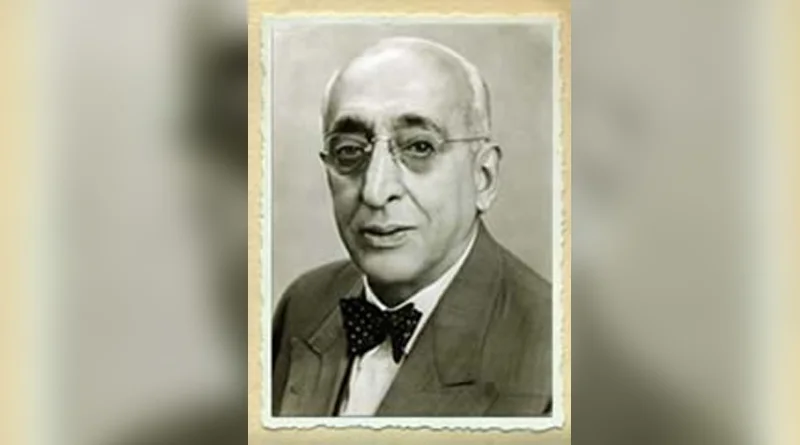
- An obituary for Dr. Fredie Mehta (1928-2005), Tata Group economist and Patron of the Indian Committee for Cultural Freedom, quotes Jerry Rao’s tribute and notes Mehta’s admiration for but independence from B. R. Shenoy’s views on deficit financing.
Of Cabbages and Kings
No summary was extracted for this article. Listed for completeness.
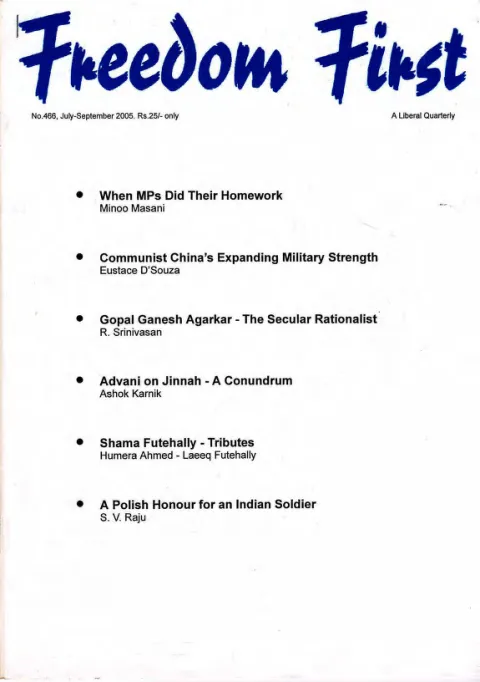
When MPs Did Their Homework
By Minoo Masani
A reprint marking Minoo Masani’s birth centenary: his Minute of Dissent, filed August 14, 1957, as a member of the Select Committee of Parliament on the Wealth Tax Bill. Masani argues that extending Wealth Tax to joint-stock companies is bad in principle, would retard capital formation, and effectively imposes double taxation or falls on small investors who are otherwise exempt. He presents Reserve Bank survey data showing that the great majority of shareholders in Bombay City are middle- or lower-income individuals, and gives the Associated Cement Companies shareholding distribution as an illustrative case, showing 92% of capital held by a wide cross-section of small investors. He also objects to discriminatory features of the Bill regarding rural versus urban home ownership, pensions versus provident-fund benefits, and a tools/instruments exemption limit unfair to professionals.
- Minoo Masani was elected to the second Lok Sabha in 1957 as an independent from Ranchi and served on the Select Committees on the Wealth Tax and Expenditure Bills.
- He dissents from extending Wealth Tax to joint-stock companies, arguing it is beyond the tax’s stated purpose of personal taxation.
- He cites a 1955 Reserve Bank of India survey showing 59.5% of Bombay City shareholders had monthly incomes below Rs.666, and over 73% of shares were held by those earning below Rs.2,500/month.
- Using Associated Cement Companies as an example, he shows 92% of its capital was held by individuals and families across a wide social spectrum, not concentrated wealth.
- He argues the Bill creates double taxation or captures small investors otherwise exempt, and discriminates between urban and rural home owners and between pensioners and provident-fund recipients.
- He objects to a Rs.10,000 exemption limit on professional tools/instruments as unfairly restrictive to surgeons, engineers, and others.
- The reprint is followed by a quoted C. Rajagopalachari passage (Swarajya, November 16, 1957) on distinguishing the general from the particular in reading old scriptures.
Communist China’s Expanding Military Strength
By Eustace D’Souza
Major General (Retd.) Eustace D’Souza surveys China’s expanding military modernization and its implications for India. He describes rising Chinese defence spending, a ‘Web Army’ monitoring internet traffic related to Indian missions, sharp Chinese diplomatic criticism of Indian officials over the 1962 border war and over Indian-Taiwanese naval contacts, and warming US, Russian, and Chinese economic and military ties that leave India needing to balance its own position. The essay catalogues specific modernization details — submarines, missile destroyers, satellites, an airborne army, fighter upgrades — and discusses the militarization of Tibet, including the Gormu-Lhasa-Shigatse railway and Han labour demographic shifts, before recommending India strengthen border forces, diplomatic engagement with regional neighbours, nuclear deterrence, and intelligence collation via the Tibetan and other diasporas to avoid ‘another 1962’.
- China’s defence budget and modernization programme are expanding, according to retired officers and a Chennai strategic-studies professor cited in the piece.
- A Chinese Consul General publicly and sharply criticized India’s Defence Minister Pranab Mukherjee for calling the 1962 border conflict an invasion of Arunachal Pradesh.
- A ‘Web Army’ in China is reported to be monitoring internet traffic from Indian missions abroad amid criticism of India-Taiwan naval interactions.
- The US, Russia, and China are each separately cultivating military and economic ties with China, complicating India’s strategic position; the US is said to be turning to India as a counterbalance.
- China is modernizing submarines, missile destroyers, satellites, an airborne army, and fighter aircraft, and is investing in Tibet’s militarization, including a railway built partly for military purposes and Han labour resettlement.
- The essay recommends India strengthen border-area forces, nuclear deterrence, intelligence gathering via its diasporas, and diplomatic ties with Nepal, Bangladesh, Sri Lanka, Myanmar, Japan, and others to avoid repeating 1962.
Communist China’s Expanding Military Strength
By Eustace D’Souza
A press release, issued in the first person by Aspi B. Mistry (Secretary, Dharma Rain Education Society, Mumbai), describing a phone call from the Chinese Deputy Consul-General in Mumbai, Mr. Song, demanding cancellation of a public talk on Tibetan Buddhism by the Venerable Geshe Lhakdor-la, the Dalai Lama’s official translator. The writer refuses, citing India’s democratic right to hold such meetings, recounts a similar 2004 episode in which Chinese pressure forced the Asian Film Festival in Mumbai to drop a Tibet retrospective, and calls on Indians to protest the ‘diplomatic license’ Chinese officials appear to assume in India.
- The Chinese Deputy Consul-General in Mumbai, Mr. Song, phoned to demand cancellation of a September 27, 2005 talk by Geshe Lhakdor-la on ‘Combining Head and Heart: Wisdom and Compassion in Tibetan Buddhism’.
- Song argued the speaker’s ties to the Dalai Lama made the event political interference in China’s internal affairs; the writer refused, citing India’s democratic rights.
- The press release recalls a 2004 episode where similar Chinese pressure forced the Asian Film Festival in Mumbai to withdraw a Tibet retrospective section.
- The release calls on ‘all freedom loving individuals and organizations’ to protest what it calls extra-territorial Chinese diplomatic interference in India.
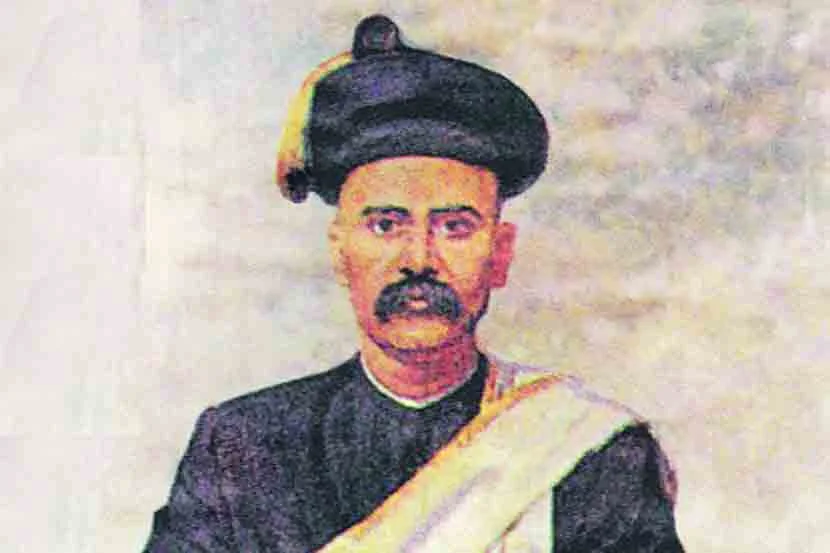
Gopal Ganesh Agarkar - The Secular Rationalist
By Dr. R. Srinivasan
Dr. R. Srinivasan profiles Gopal Ganesh Agarkar (d. 1895), the 19th-century Maharashtrian secular rationalist, on the centenary of his death, framed around a review of Aravind Ganachari’s biography. The essay traces the Maharashtrian liberal tradition from the 1840s, contrasts Western liberalism’s suspicion of religion with the Indian liberal intelligentsia’s general theism and gradualism, and situates Agarkar as a disciple of Mill and Spencer who emphasized individuality, rationality, science, and a sceptical, near-total-separationist attitude to religion in public life — more radical than contemporaries like Ranade. It covers Agarkar’s views on social reform, his conflicts and continuities with Phule’s championing of the socially deprived, his newspaper commentary on Ilbert Bill-era politics and famine, and closes with an assessment of his enduring but historically under-recognized relevance outside Maharashtra.
- Gopal Ganesh Agarkar (d. 1895) is presented as the quintessential Maharashtrian Liberal, profiled via Aravind Ganachari’s 2005 biography ‘Gopal Ganesh Agarkar, the Secular Rationalist’.
- Unlike Western liberalism’s suspicion of religious domination in public life, the Indian liberal intelligentsia of Agarkar’s era remained largely deist or theist and reformed gradually rather than radically.
- Agarkar, a disciple of Mill and Spencer, centered his thought on individuality and viewed evolution and rationality as implying that social arrangements must be periodically reassessed and reformed.
- He advocated women’s education, widow remarriage, and birth control, and worked alongside Gokhale in laying the parameters of a rational social policy.
- Agarkar was among the most sceptical Indian liberals about religion, favouring near-total separation of religion from public life, in contrast to reformers who sought sanction for reform within scripture.
- As a newspaperman he took nationalist positions on the Ilbert Bill, Ripon’s local-government reforms, Indianization of services, and documented the ill effects of British rule including famine deaths.
- The essay judges Agarkar’s relevance as having grown given the ‘negation’ of secularism and pluralist ideals in the two decades preceding the piece, and credits Ganachari’s biography as the first full-length English study of Agarkar in a century.
Advani on Jinnah - A Conundrum
By Ashok Karnik
Ashok Karnik examines the controversy sparked by L. K. Advani’s remarks praising aspects of M. A. Jinnah’s 1947 Constituent Assembly speech during a Pakistan visit, and the ensuing backlash from the RSS and BJP hardliners. He surveys several competing theories for why Advani made the statement — naivete about its impact, a calculated bid to reposition as a liberal international statesman, or overreach in effectively certifying Jinnah as ‘secular’ — and narrates the political fallout, including RSS demands for Advani’s resignation, the Madanlal Khurana affair, and Vajpayee’s shifting interventions, concluding that the episode reflects deepening disarray within the BJP and public indifference to its internal battles.
- Advani’s praise of Jinnah’s August 11, 1947 Constituent Assembly speech, made during a Pakistan visit, triggered RSS and BJP hardliner condemnation.
- Advani had already angered VHP/Bajrang Dal factions by earlier calling the day of the Babri Masjid’s demolition ‘the saddest day of his life’.
- The essay lists competing theories for Advani’s motive: naivete about domestic impact, a diplomatic gesture praising only the acceptable parts of Jinnah’s record, or a deliberate bid for international liberal statesman status.
- K. S. Sudarshan and Sangh Parivar figures used the episode to press for Advani’s exit and generational change in BJP leadership.
- A compromise resolution was eventually drafted, with Advani emerging ‘the victor on points’ but the RSS-BJP battle continuing.
- The essay connects the episode to wider BJP turmoil, including the Madanlal Khurana affair and the Tehelka-tape controversy involving Bangaru Laxman, concluding that ‘the common man has stopped to care which way the BJP goes’.
Shama Futehally - Tributes
By Humera Ahmed - Laeeq Futehally
Two tributes to novelist and short-story writer Shama Futehally (d. December 2, 2004), by her friend Humera Ahmed and her mother Laeeq Futehally. Ahmed recounts Futehally’s literary career — short-story collections, the novels ‘Tara Lane’ (1993) and ‘Reaching Bombay Central’ (2001), and a translation of Meera’s bhajans — situating her fiction’s sensitivity to the compromises faced by privileged, protected women confronting a harsher outside world, and quotes from Futehally’s own review of Ahmed’s short-story collection. Laeeq Futehally’s tribute as a mother describes her daughter’s varied body of work including translations of Sufi poetry, an unfinished play on the Taj Mahal, and an unfinished novel based on the Upahar fire tragedy, emphasizing how Shama wrote in the margins of a busy domestic life as wife, mother, and teacher.
- Shama Futehally, daughter of Laeeq and Zafar Futehally, died December 2, 2004; both parents and the Futehally family were associated with the Indian Committee for Cultural Freedom and its journal Quest.
- Humera Ahmed situates Futehally’s novels ‘Tara Lane’ (1993, Ravi Dayal) and ‘Reaching Bombay Central’ (2001, Viking) as depicting privileged, protected upper-class Muslim women confronting caste and communal tensions in the outside world.
- Futehally also translated Meera’s bhajans from Hindi (‘In the Dark Of The Heart: Songs of Meera’, 1994, HarperCollins) and Sufi poetry from Urdu.
- Ahmed quotes Amita Malik’s praise that Futehally ‘has the gift of making the ordinary extraordinary,’ and Futehally’s own review of Ahmed’s collection ‘Check Mate and Other Stories’.
- Laeeq Futehally’s tribute as mother describes an unfinished play on the Taj Mahal (expected to be produced by the National School of Drama) and an unfinished novel based on the Upahar cinema fire tragedy in New Delhi.
- Both tributes emphasize that Futehally wrote in stolen moments — waiting rooms, buses, trains — while balancing roles as wife, mother, and teacher, without neglecting any of them.
Generated by the v1.5 extraction pipeline. Awaiting editorial review.
Metadata and summary are AI-extracted from the source PDF and reviewed for editorial accuracy. The original work is available via the Read PDF tab above (where present); paragraph-level citation inside the PDF is deferred to a future engagement.