speech
Union Budget 1990-91 Will Not Solve Economic Problems
By HP Ranina
Published by M. R. PAI for the Forum of Free Enterprise. "Piramal Mansion", 235 Dr. D. N. Road, Bombay - 400 001. · Bombay · 1990
20 pages
Part of The Union Budget
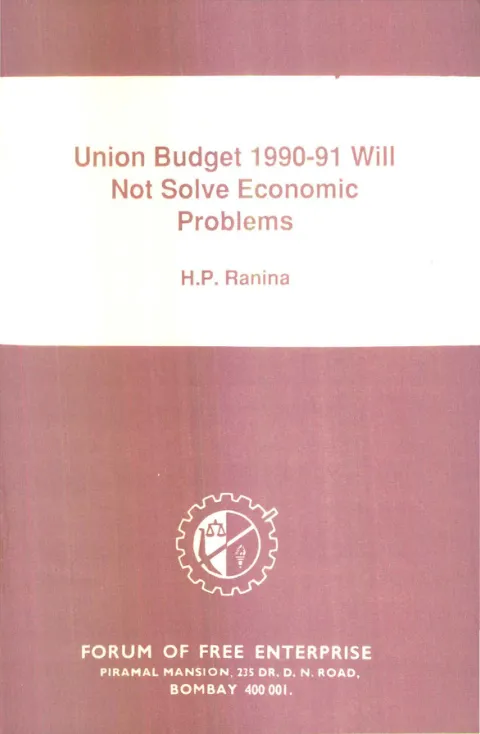
Union Budget 1990-91 Will Not Solve Economic Problems
By HP Ranina
Summary
H. P. Ranina, a tax expert writing under the auspices of the Forum of Free Enterprise, dissects Finance Minister Madhu Dandavate’s first budget of the decade, presented on 19th March 1990. Ranina credits Dandavate with restricting the budgetary deficit to Rs.7,206 crores, accepting the desirability of a stable Income Tax Law, abolishing the Gold Control Act, and acknowledging that public expenditure leakages are a chief source of black money. But these concessions, he argues, are overshadowed by a budget that loads industry with roughly Rs.800 crores of extra direct tax not through higher rates but through the withdrawal of long-standing concessions — the Investment Allowance, the Investment Deposit Scheme, and incentives for new units in backward and rural areas — pushing effective income-tax for such units from 16.2% to 43.2%.
The pamphlet works through almost every limb of the Finance Bill. Ranina objects that section 88’s savings rebate offers virtually no fresh incentive over the old section 80-C; that the Equity Linked Savings Scheme merely replaces section 80-CC; that export incentives are weak apart from a customs cut on capital goods; and that the retrospective taxation of cash compensatory assistance, drawback of duty and import entitlement licences will reopen settled assessments and overturn court decisions in favour of exporters. He attacks the proposal to shift the gift-tax burden from donor to donee as administratively unworkable and likely to drive transactions underground, and pleads for a charitable-trust exemption.
On the macro-economic side, Ranina warns that 49% allocation to the rural sector will not lift agricultural output, that the Employment Guarantee Scheme will not touch the educated unemployment crisis (12 million unemployed and roughly 100 million underemployed), and that writing off farmers’ loans without linking relief to performance squanders an opportunity to raise rural productivity. He criticises hikes in railway freight, petrol and diesel prices — noting India already has the world’s highest petrol price — and the continuing growth of non-plan expenditure, with interest payments alone absorbing Rs.20,850 crores and defence Rs.15,750 crores against total plan outlay of Rs.30,192 crores. His verdict is that the budget is politically seductive but will not solve inflation, declining industrial growth, or rising poverty.
Key points
-
Frames Dandavate as ‘the first Finance Minister in India who has learned the art of raising taxes with cheer’ — politically deft but economically inadequate.
-
Calculates an Rs.800 crore additional burden on the corporate sector achieved by withdrawing tax concessions rather than raising headline rates, lifting effective tax on new rural/backward-area units from 16.2% to 43.2%.
-
Welcomes the abolition of the Gold Control Act and the acknowledgement that public-expenditure leakages generate much of the country’s black money.
-
Argues new savings provisions (section 88, Equity Linked Savings Scheme) merely repackage existing reliefs and offer ‘virtually no additional incentive for saving’.
-
Attacks retrospective taxation of cash compensatory support, duty drawback and import entitlement licences, which will reopen completed assessments and override court rulings favourable to exporters.
-
Rejects shifting gift-tax from donor to donee as unworkable and pleads for an exemption for charitable and religious trusts.
-
Warns that the Employment Guarantee Scheme, confined to drought-prone areas, will not address 12 million unemployed and at least 100 million underemployed.
-
Condemns retrograde indirect-tax measures — railway freight, petrol and diesel hikes, excise on ice-cream and refrigerators — noting India has ‘the dubious distinction of having the highest price of petrol in the world’.
-
Highlights structural failure to control non-plan expenditure, with interest at Rs.20,850 crores and defence at Rs.15,750 crores against a Rs.30,192 crore plan outlay.
Generated by the v1.5 extraction pipeline. Awaiting editorial review.
Metadata and summary are AI-extracted from the source PDF and reviewed for editorial accuracy. The original work is available via the Read PDF tab above (where present); paragraph-level citation inside the PDF is deferred to a future engagement.