speech
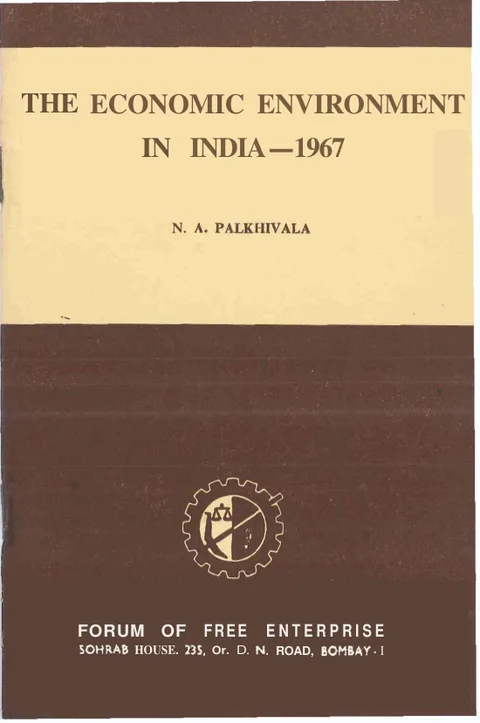
The Economic Environment in India—1967
Published by M. R PAI for the Forum of Free Enterprise, "Sohrab House", 235, Dr. Dadabhai Naoroji Road, Bombay 1, and printed by S. B. Phansikar at Parmanand Co-operative Printing & Publishing Society Ltd., Ambekar Road, Wadala, Bombay 31. · Bombay · 1967
9 pages
The Economic Environment in India—1967
By N. A. PALKHIVALA
Summary
Adapted from a talk delivered at Ahmedabad on 12 January 1967, N. A. Palkhivala’s pamphlet diagnoses what he calls India’s self-inflicted economic distress and lays the blame squarely at the door of government policy. Drawing on a Committee on Economic Development study of Latin America, he argues that the dominant variable behind a nation’s economic fate is not natural endowment or population but the policy pursued by its rulers — and on six tests (monetary stability, fiscal policy, export policy, climate for free enterprise, balance between agriculture and industry, and openness to foreign capital) India serves “as a warning, and not an example, to the rest of mankind.”
Palkhivala marshals statistics relentlessly. He documents 28 percent and 25 percent rises in the wholesale price index and food prices over a decade, a real-national-income decline of 4.7 percent in 1965–66, mounting foreign debt of Rs. 2,629 crores by the end of the third Plan and deficit financing crossing Rs. 1,150 crores. He attacks marginal income-tax rates as high as 82.2 percent on earned income and 89.4 percent on unearned income, with corporate rates above 54 percent on aggregate, calling the system a “special confiscatory rate of tax on two foreign exploiters” applied also to Indian companies. The collapse of the capital market — share values down 42 percent during the third Plan, public participation in new issues dropping from 94 percent to 17 percent — is read as a verdict on Government fiscal policy delivered by the investing public itself.
The second half of the booklet treats climate for enterprise, agricultural–industrial imbalance, and foreign capital. Palkhivala protests the “materialistic faith” of the planners who treat steel plants as temples while neglecting agriculture, criticises a licensing regime run from Delhi by “pen-and-pencil armies and permit-licence armouries,” and points out that public-sector enterprises with Rs. 2,000 crore investment yielded only 1.7 percent on capital employed against 19 percent in the private sector. He closes with seven suggestions — recognising that plans are for human beings, prioritising price stability, freeing the economy from licensing, dropping deficit financing as a habit, fixing the public sector, cutting taxation to revive savings, and pursuing exports with imagination. He invokes Bacon’s “Knowledge is power,” warning that “the State faces its greatest crisis when knowledge is possessed by some and power by others.”
Key points
-
Argues that economic policy, not natural endowment, is the decisive determinant of national prosperity — illustrated by Burma and Indonesia as cautionary cases alongside India.
-
Identifies six facets of governmental policy (monetary stability, fiscal policy, export policy, climate for free enterprise, agricultural-industrial balance, foreign capital) on which India fails.
-
Documents monetary instability: 28% wholesale price rise over ten years, real national income falling 4.7% in 1965-66, and Rs. 2,629 crores of foreign debt at end of third Plan.
-
Attacks confiscatory direct taxation — marginal rates of 82.2% on earned and 89.4% on unearned income, and corporate rates above 54% — with comparative data showing India taxes honest enterprise more heavily than any other country.
-
Treats the post-devaluation export collapse as evidence that the Government took the right diagnosis but “did not take the follow-up measures” needed.
-
Criticises the licensing raj run from Delhi as the principal obstacle to competition and price stability, and condemns the “materialistic faith” that builds steel plants while neglecting agriculture.
-
Cites public-sector enterprises earning only 1.7% on capital employed against 19% in the private sector as a verdict on state capitalism.
-
Closes with seven suggestions and Bacon’s dictum — the State’s gravest crisis is when knowledge is held by some and power by others.
Generated by the v1.5 extraction pipeline. Awaiting editorial review.
Metadata and summary are AI-extracted from the source PDF and reviewed for editorial accuracy. The original work is available via the Read PDF tab above (where present); paragraph-level citation inside the PDF is deferred to a future engagement.