
periodical issue
Quest
A Quarterly of Inquiry, Criticism and Ideas
By Asaf A. Fyzee, Michael Polanyi, A. B. Shah, Raj Krishna, Mihir Sinha, Keshab D. Bhatt, RAJENDRA AvASTHI, P. C. Mathur, Basudha Chakravarty, D. P. Singhal, Upendra Nath Ashk
Printed and published by MISS SHEELA SINGH for the Indian Committee for Cultural Freedom, Army and Navy Building, 148 Mahatma Gandhi Rd., Bombay 1, at Inland Printers, Victoria Mills Buildings, 55 Gamdevi Road, Bombay 7. · Bombay · 1964
118 pages
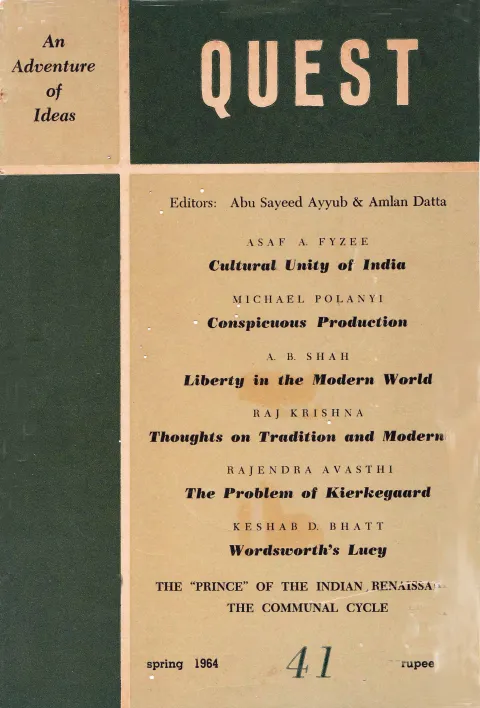
QUEST
Summary
Quest No. 41 (April-June 1964), the Bombay quarterly sponsored by the Indian Committee for Cultural Freedom and edited by Abu Sayeed Ayyub and Amlan Datta, is an unusually unified number: nearly every item in it attacks some form of intellectual self-deception. Asaf A. Fyzee opens by dismantling the official pieties about Indian cultural unity and arguing that unity can only rest on a frank recognition of religious difference; the editors append a line inviting further contributions, and A. B. Shah’s Harold Laski Institute lecture, Raj Krishna’s seminar paper on tradition and modernity, and Basudha Chakravarty’s essay on the 1964 Hindu-Muslim riots all take up adjacent ground. The economic centre of the issue is Michael Polanyi’s ‘Conspicuous Production’, which argues that Soviet planning is a camouflaged market whose statistical triumphs are bought with real economic loss, and which corrects both Mises and Hayek in passing; Shah’s lecture performs the same operation on Laski, whom he treats as a sincere libertarian who did ‘immense harm to the cause of liberty’. Against this political matter sit four pieces of pure scholarship and imagination: Mihir Sinha’s family history of the Tagores of Jorasanko, Keshab D. Bhatt’s argument that Wordsworth’s Lucy was Dorothy, Rajendra Avasthi’s exposition of Kierkegaard’s three stages, and Upendranath Ashk’s Hindi story of an ascetic undone by desire, translated by Jai Ratan. P. C. Mathur’s field assessment of Panchayat Raj in Rajasthan and D. P. Singhal’s angry review-article on Percival Spear’s India close the argumentative section.
The issue’s centre of gravity is anti-communist liberalism of the Congress-for-Cultural-Freedom kind, and its eight book-reviews, gathered under the head ‘BOOKS’, mostly reinforce it: Crozier on decolonisation, Khera on public-sector management, Noorani on India’s China policy, Karan Singh on Aurobindo, Osborn on overpopulation, Slonin on the Russian theatre, Khosla’s judge’s notebook and Wain’s literary essays. Two things a reader should know are not disclosed in print. Shah’s article twice cites, as authority, ‘A New Look at Communism, edited by A. B. Shah and Nissim Ezekiel, Indian Committee for Cultural Freedom, Bombay, 1963’ — a book co-edited by this issue’s own Reviews Editor and published by the journal’s own sponsor. And Raj Krishna’s article is openly derived from a seminar organised by the Congress for Cultural Freedom, the parent body of Quest’s sponsor, a relationship the issue never names. A third item, on printed p.107, is an ICCF advertisement for ‘A National University’, a volume edited by Shah containing a paper by co-editor Amlan Datta. K. K. Sinha’s employment by the ICCF, by contrast, IS disclosed, in the ‘Our Reviewers’ note.
Essays
Cultural Unity of India
By Asaf A. Fyzee
Fyzee sets out to demolish what he regards as a national slogan. Against Rawlinson and Humayun Kabir, who find ‘a remarkable unity of spirit informing Indian culture throughout the ages’, he argues that such statements are true only if ‘Indian culture’ means Hindu culture; taken as a claim about all the peoples and religions of India they are historically indefensible. He substitutes a five-part account: there have been periods of unity (Akbar, the decade before 1947) and periods of murderous disunity (1947-48); present unity is potential, not actual; the slogan itself is self-deception and should be abandoned; and real unity must be built on patriotism plus a genuine conception of tolerance. He then separates ‘culture’ from ‘civilization’ via Tylor, Eliot, Clive Bell and Will Durant, and describes Indian culture as a composite of ancient Hindu, medieval Islamic and modern Western elements, none of which can be surrendered without loss.
The second half is a sustained argument against religious syncretism. Quoting Radhakrishnan on the difference between mystical and prophetic religion, and reproducing several pages of Amaury de Riencourt on Alberuni’s testimony to eleventh-century Hindu xenophobia, Fyzee insists that ‘antagonistic religions must mean antagonistic cultures’ and that the honest goal is peaceful co-existence, not fusion. He closes with six practical prescriptions — teach patriotism through the country’s variety, allow complete political freedom even within a family, allow the widest possible linguistic freedom (defending Anglo-Indians whose mother tongue is English and Urdu-speaking Muslims against the charge of being ‘de-Indianized’), build a welfare state, fight untouchability and caste, and stop repeating that all religions are one. He offers Switzerland, England and the United States as models of cultural unity achieved without uniformity.
- Treats the claim of Indian cultural unity as a slogan that is defensible only if ‘Indian’ is silently narrowed to ‘Hindu’.
- Distinguishes ‘culture’ (ethnic, neutral, total) from ‘civilization’ (a higher developed state), following Tylor, Eliot, Clive Bell and Will Durant.
- Describes Indian culture as an irreducible composite of ancient Hindu, medieval Islamic and modern Western elements.
- Rejects syncretism: mystical and prophetic religions cannot be reconciled, so peaceful co-existence, not fusion, is the realistic aim.
- Defends linguistic minorities explicitly, including Indians whose mother tongue is English and Muslims who use Urdu.
- Reproduces, in order to criticise, Saiyidain’s catalogue of communal stereotypes about Muslims, Hindus, Sikhs and Christians.
Conspicuous Production
By Michael Polanyi
Polanyi’s lecture is a correction of the Western critique of Soviet planning as much as of Soviet planning itself. He recounts the 1920 debate: Ludwig von Mises argued that without a market resources cannot be allocated economically and therefore that public ownership must stop industrial production altogether. Polanyi accepts the principle but says the argument was inadequate and the conclusion too strong — Soviet state industry demonstrably worked by the mid-1930s. F. H. Knight’s 1936 rebuttal, amplified by Hayek’s Road to Serfdom, then swung the Western position to the opposite error, treating central direction as economically feasible but politically tyrannical; Polanyi calls the resulting confusion ‘disastrous’, since it both hid the real reason central direction fails and offered underdeveloped countries a false bargain of wealth for liberty.
His own principle is administrative rather than economic: wherever a very large number of units achieve a joint advantage by mutually adjusting to each other, that adjustment cannot be replaced by deliberate planning. He illustrates it with a sack of potatoes settled by a good shaking, and with a football team directed by a captain over radio. From this he predicted in 1948 that Soviet enterprises could be financed centrally but could not run day to day without a market — so he denied the Soviet government’s own account of itself. The puzzle he then sets himself is why a camouflaged, distorted market should be more productive than a normal one. His answer is that Soviet conditions replicate a chronic sellers’ market, which reduces variety, slows innovation and makes distribution erratic; these three failures cut the cost of producing any given parcel of goods and so raise physical output, while lowering the actual economic value of what is produced. Planners are satisfied because they measure the physical product. Polanyi names the resulting system ‘Conspicuous Production’.
- Corrects Mises: his 1920 impossibility argument was inadequate and its conclusion about public ownership was refuted by Soviet industry by about 1935.
- Argues that the Knight-Hayek reply produced a ‘disastrous confusion’ that obscured both why planning fails and why Soviet communism suppresses liberty.
- Offers a general administrative principle: mutual adjustment among very many units cannot be replaced by deliberate planning — illustrated by potatoes in a sack and a radio-directed football team.
- Concedes the reverse case: investment allocation among nationalised industries involves few enough adjustments to be centrally handled, so a capital market can be replaced by rival pressure groups.
- Explains apparently high Soviet productivity as a sellers’-market artefact: reduced variety, slower innovation and erratic distribution cut costs and inflate physical output while destroying economic value.
- Notes as evidence of camouflaged market relations: money accounting since the second Five Year Plan, official applause for over-fulfilment of plans, pervasive black markets, and plans in fact written from the bottom up.
Liberty in the Modern World
By A. B. Shah
Shah’s Ninth Annual Lecture at the Harold Laski Institute is a critical obituary for Laski’s political thought. He begins from Laski’s own introduction to the Pelican Liberty in the Modern State and its account of the 1930s ‘raucous voices’, then argues that the wheel has come full circle: fascism was destroyed but communism extended its sway over some 800 million people, so that by 1962 the prospects for liberty were worse over a vaster area of mankind than ever before. He separates two kinds of dictatorship. The non-communist ones — Salazar, Franco, the Latin American variety — are personal, economically weak and territorially contained, but precisely because they are personal they are susceptible to communist blandishment, and Burma shows how such a regime drifts communist-wards. Communist dictatorship, by contrast, has ‘all the requisites of permanence and continued, inherent expansionism’.
Shah then asks how Laski failed to see this, given that in 1923 he had described Lenin and Mussolini alike as establishing ‘a government not of laws but of men’. The answer, he argues, is that from the early 1930s Laski accepted the Marxian theory of the state, identified all power with economic power and the impulse to power with the desire for profits, and so could not recognise the threat implicit in concentrated power of any kind. He was, like many Western intellectuals, ‘a dupe of communist propaganda’, and he was so because he wanted a centre of hope against fascism. Shah’s central analytic claim is that Laski slipped from the negative to the positive concept of liberty. He restates the classical negative formulation via Mill and Isaiah Berlin, insists that it entails an active umpire state rather than laissez faire, but warns that the state is a Leviathan and that what is safe in England may stifle liberty in a less developed society. Tracing the positive concept back through Hegel, Rousseau, Spinoza to Plato, he identifies its core assumption — that men may be forced to be free — and quotes Charles I from the scaffold to show how old the doctrine is that liberty means good government rather than a share in it. A final section argues that liberty in the new Afro-Asian states faces a second enemy in indigenous authoritarian culture, and that India is ‘the sole major exception’ because of a century-old democratic tradition and an abortive nineteenth-century renaissance. Even there he is not confident: he cites the 1957 mob that prevented Professor N. R. Phatak from lecturing on 1857, and Nehru’s entering the Mangeshi temple in 1963 without insisting on the Harijans’ right to enter with him.
- Argues the threat to liberty was greater in 1962 than in the 1930s, because communist dictatorship is permanent and expansionist where fascist and personal dictatorships were not.
- Explains Laski’s failure as the consequence of accepting the Marxian theory of the state and identifying all power with economic power.
- Locates the decisive error in the unconscious slip from the negative to the positive concept of liberty, and traces the positive concept to Plato via Hegel, Rousseau and Spinoza.
- Insists the negative concept requires an active, umpire state — citing Mill on protective and enabling legislation — and is not laissez faire.
- Holds India to be the sole major Afro-Asian exception, while naming two Indian failures of liberty: the 1957 mob against N. R. Phatak’s lectures, and Nehru’s silence at the Mangeshi temple in 1963.
- Cites, without disclosing the connection, a 1963 Indian Committee for Cultural Freedom volume he co-edited with Quest’s own Reviews Editor Nissim Ezekiel.
Some Thoughts on Tradition and Modernity
By Raj Krishna
Raj Krishna’s seminar remarks advance four connected propositions against the fashionable Indian demand for a ‘synthesis’ of tradition and modernity. First, modernity is pluralism: as societies modernise, knowledge, experience and valuation differentiate, and any attempt to lay down one logically coherent synthetic model for all fields of activity is utopian and antithetical to modernity itself — the Christian and communist ‘syntheses’ are his two negative examples. Second, change in an inherited social structure cannot be ordained except in a few directions, because industrialisation arrives as a bundle of six mutually accelerating processes (monetisation, mechanisation, specialisation, urbanisation, large-scale production and organisation, and operational rationality) and no traditional society has effectively resisted it for long. Social reformers should therefore stop asking society to reform before industrialising and welcome industrialisation as one of their reforming agents.
Third, the product of the process is broadly homogeneous: he catalogues the big cities, the systems of administration and finance, and ‘the blue jean boys and the blue jean girls at bars, fountains and street corners’ as evidence. Fourth — and this is his conciliatory move — industrialisation is indifferent to whatever tradition does not obstruct it, so customs, art-forms and religious practice can continue and evolve, provided the society is pluralistic. What must be guarded against is not industrialisation but ‘the excesses of planning’, and specifically the proposal for a social perspective plan alongside the economic one. He then turns to whether Indian tradition is hospitable to scientific method, finds that the later Nyaya schools distinguished forms of inference rigorously, and argues that the Indian mind later shifted its interest away from the physical world under an excessive emphasis on the illusoriness of the world — quoting Kabir’s Sahib tera hai ghat mahi. Two inherited obstacles remain: a teleological devaluing of curiosity about this world, and a procedural deficiency in empiricism, aggravated by the tradition of presenting ‘the truth by intuition’. He ends by refusing to identify modernisation with industrialisation, locating the heart of modernity in the Western universities, defending mass culture against elite disgust at the ‘yankification’ of Europe, and suggesting via Northrop that the East’s exploration of concepts by intuition can continue undisturbed within a modern industrial life.
- Defines modernity as cultural and valuational pluralism, and treats any all-embracing synthesis — Christian, communist or Indian — as anti-modern.
- Argues industrialisation is a bundle of six self-accelerating processes that no traditional society has long resisted, so social reform need not precede it.
- Holds that industrialisation is indifferent to whatever tradition does not obstruct it, which is why cultural plurality can survive it.
- Opposes the proposal for a social perspective plan parallel to the economic plan as neither practicable nor desirable.
- Identifies two inherited obstacles to Indian science: a teleological devaluing of curiosity about the physical world, and a procedural deficiency in empirical verification.
- Separates modernisation from industrialisation, locating modernity in the Western universities’ engagement with truth rather than in jazz, dress or hairstyle.
Dwarkanath Tagore, the “Prince” of the Indian Renaissance
By Mihir Sinha
Sinha writes a family history in order to rescue a reputation from the shadow of a descendant. His opening complaint is archival: in a tropical country the raw materials of history decay fast, and the historian’s nightmare is not conflicting data but no data at all — which is why India has come to revere mythology and folk-lore. The Tagore papers survive, and they show that ‘the family of the Tagores would have been famous in the pages of our history even if the poet had never been born’. He traces the line from King Adisur’s importation of five Kanauj Brahmins in the tenth century, through Bhattanarayan and the Kushari family’s peculiar loss of caste after Purushottam’s marriage, to Panchanan’s move to Gobindopur, Jayram’s windfall from the Fort William compensation, and the undignified quarrel between the brothers Nilmoni and Darpanarayan that split the family into the Jorasanko and Pathuriaghata branches — the first supplying Bengal’s middle class with idealistic leadership, the second entrenched in ‘wealthy reaction’.
The centre of the article is Dwarkanath (1794-1846), adopted by Ram Lochan, educated in the vernacular, Arabic, Persian and some English, and decisively influenced by Rammohan Roy. Sinha follows him through law, revenue service as Sheristadar and then Dewan to the Suddar Board of Customs, Salt and Opium, and then into business: the Union Bank of 1829 — ‘perhaps the first joint stock bank floated by Indians’ — and Carr, Tagore and Co. of 1834, the first Indian partnership on the European model, with its indigo factories, silk kuthi, Ranigunj coal mines and Ramnagar sugar factory. He assesses him as neither better nor worse than his contemporaries as a zemindar, whose political thinking was coloured by his landowning interest, but whose judgment that collaboration with Britain’s advanced economy was the quickest way out of stagnation ‘cannot be challenged’. Dwarkanath’s public record includes the anti-Suttee agitation, a vagrancy law and work-houses, the Calcutta sanitary committee that sponsored the Fever Hospital of Pataldanga, the reorganisation of Hindu College with H. H. Wilson and David Hare, the Calcutta Medical College and the overcoming of Hindu prejudice against dissection, the liberalisation of press regulations and the Landholders’ Society. He was the first Indian justice of the peace. The article closes on the two European journeys, the family story that he sought the Dewanship of Bengal, Bihar and Orissa, his death in England in 1846, and the ascetic reaction of his son Debendranath, whose Brahmoism split the household between Nos. 5 and 6 Dwarkanath Tagore Lane.
- Frames the article as an act of historical rescue: the Tagores would be famous without Rabindranath, who was ‘nonetheless a product of his environment’.
- Traces the family from tenth-century Kanauj Brahmins through the Kushari caste anomaly to the Jorasanko/Pathuriaghata split caused by the Nilmoni-Darpanarayan quarrel.
- Credits Dwarkanath with the Union Bank (1829) and Carr, Tagore and Co. (1834), the first Indian partnership enterprise on the European model.
- Records his public work: anti-Suttee agitation, vagrancy law and work-houses, Calcutta sanitation, Hindu College, the Medical College and the prejudice against dissection, press liberalisation, the Landholders’ Society.
- Judges him a practical man rather than an intellectual, whose politics were coloured by landed interest but whose collaborationist economic judgment was sound.
- Reads Debendranath’s Brahmoism as an almost symbolic act of atonement for his spendthrift father’s worldly ambition.
Wordsworth’s Lucy
By Keshab D. Bhatt
Bhatt sets out to identify Lucy, 164 years after the poems were composed. He first disposes of the school that holds Lucy never existed: Wordsworth’s inventive genius was the weakest part of his poetic fabric, his best poetry rests on personal experience, and the Lucy poems are too intense and too tender to have been invented. He then narrows the field of ‘maidenly influences’ to three — Annette Vallon, discovered by Harper and Legouis in 1916; Dorothy Wordsworth; and Mary Hutchinson — dismissing Mary of Esthwaitewater and other calf-loves as too shadowy. An analysis of the five poems follows: each records a personal experience described with objective reality; each communicates a tenderness ‘almost spiritual in its depth’; the love is conspicuously sexless; and four of the five conclude on the elegiac note that Lucy is dead. Lucy was an English girl of the untrodden ways, a kindred spirit in the love of Nature, taught ‘to lean her ear in many a secret place’.
He then argues by elimination and chronology. Annette could have inspired the poems as an experience of love, but Wordsworth’s desertion of her and Caroline in December 1792, and the remorse that followed, make it improbable in the extreme that she inspired verse so tender. Mary’s ‘low domestic voltage’ lacked the intensity to stimulate his poetic sensibilities. Dorothy, separated from him in childhood and reunited with ‘more than friendly ardour’, supplied the three idyllic years of Racedon and Alfoxden — the ‘three years she grew in sun and shower’ — and the Alfoxden Journal became a store-house for his poetry. The Grasmere Journal, by contrast, is charged with a new and dangerous emotion, and Bhatt reads Wordsworth’s decision at Goslar, where four of the five poems were composed, as a symbolic killing of Lucy. His clinching evidence is the Grasmere Journal entry of 10 April 1802: as Dorothy read the letter announcing the marriage to Mary, Wordsworth was riding back composing ‘Among all lovely things my Love had been’, a poem he told Coleridge recorded an incident ‘between Dorothy and me’. Lucy, Bhatt concludes, is Dorothy — and by marrying, Wordsworth cut off the mainspring of his emotional life and ‘assassinated the poet in himself’.
- Rejects the fictional-Lucy thesis on the ground that Wordsworth’s invention was weak and the Lucy poems are inventionless.
- Reduces the candidates to Annette Vallon, Dorothy Wordsworth and Mary Hutchinson, and eliminates the first two on grounds of remorse and of insufficient emotional intensity respectively.
- Reads the sexlessness and the elegiac closes of four of the five poems as evidence of an emotion recollected and spiritualised rather than erotic.
- Treats the Goslar winter of 1798-99, where four of the five poems were written, as the moment Wordsworth symbolically killed Lucy.
- Takes the Grasmere Journal entry of 10 April 1802 and Wordsworth’s April 16 letter to Coleridge as clinching the identification with Dorothy.
- Concludes that the marriage stabilised the man but destroyed the poet.
The Problem of Kierkegaard
By Rajendra Avasthi
Avasthi gives a systematic exposition of Kierkegaard’s stages on life’s way, beginning from the biography: the imagination, dialectic and religious melancholy inherited from a father whose confession of sexual fall and blasphemy became ‘the great earthquake’ for the son. Kierkegaard’s purpose, on this account, was single — to bring man into a religious relationship with God — and his problem was to seek not a contemplated truth but ‘a truth which is truth for me’. The vital condition of personality is inwardness, and inwardness is a struggle of qualitative leaps and crises. An individual passes between stages not by transformation but by a leap, a free decision.
The aesthetic stage is expounded through its three moods — sensual immediacy, doubt and despair — figured by Don Juan, Faust and the Wandering Jew; it is a meaningless life whose core is a pleasure that breeds melancholy, and whose refuge is the bitter laughter Kierkegaard calls irony. Irony is the intermediary sphere between aesthetic and ethical: the ironist sees the ethical as a possibility but has not entered it. Despair, the cause of aesthetic tension, is also its remedy, provided it is chosen — ‘one can doubt without choosing to, but one cannot despair without choosing.’ Choice then becomes the centre of the ethical mode: what matters is not choosing the right but the energy and pathos with which one chooses, and the ethicist chooses himself in relation to his environment, so that ‘the ethical is the universal’. The ethical stage has a natural ordination to religiousness, since the ethicist acknowledges unconditional obligation but lacks the power to perform the moral act; ethics fails to expose original sin. Humour stands between ethical and religious as irony stood between aesthetic and ethical, resting the God-idea alongside other things without religious passion. The transition to the religious is made by infinite resignation and faith — Abraham sacrificing Isaac, Abraham regaining Isaac. Guilt at the extreme point of ethics becomes sin when placed before God; faith is the human condition in which the eternal in man is most fully realised; and the Incarnation brings eternity into time, so that the individual gains contemporaneity with Christ. The problem Avasthi leaves us with is Kierkegaard’s own: man cannot be a Christian but can only attempt to become one, especially inside a Christendom that lives under the illusion of already being Christian.
- Grounds the whole system in Kierkegaard’s inheritance from his father: imagination, dialectic and religious melancholy, and ‘the great earthquake’ of the paternal confession.
- Expounds the aesthetic stage through Don Juan (sensual immediacy), Faust (doubt) and the Wandering Jew (silent despair).
- Places irony between the aesthetic and ethical spheres and humour between the ethical and religious, both as contemplative half-measures.
- Makes chosen despair the hinge: the self that emerges from despair knows itself as related primarily to eternity in time.
- Argues ethics destroys itself at its extreme point, where guilt placed before God becomes sin and opens the religious mode.
- Insists the stages are not a temporal hierarchy and the third is not a synthesis of the first two — a point made explicitly in the notes.
Problems and Prospects of Panchayat Raj
By P. C. Mathur
Mathur assesses India’s shift from Community Development to Democratic Decentralisation, working largely from Rajasthan, the pioneering state, and from the official Rajasthan Evaluation Report. His premise is that the Community Development Programme failed in its primary objective because the people’s participation that was its motive power dried up, as the Balwantrai Mehta Committee found. Democratic Decentralisation is only ‘a general response to a specific challenge’, and it may fail either because the inherited problems persist or because the response is inadequate. Early Rajasthan evidence is unpromising: the Gram Sabha remains largely ineffective, the Panchas display little activity, Panchayats and cooperative societies work as rival institutions, and the associate organisations have not been attempted in earnest. He treats these as failures of Panchayat Raj institutions to generate enthusiasm rather than of Panchayat Raj as such.
His sharpest specific argument concerns statistics. Under Community Development, officials inflated returns to demonstrate efficiency; now that collection has passed to Panchayats and Panchayat Samitis, elected non-officials dependent on votes have an even stronger incentive to collude with officials in producing inflated figures. He then analyses the change-over as three shifts — a re-alignment of driving forces, a re-adjustment of working relations, and a re-orientation of programmes and priorities — and works through each. The training of some four million elected non-officials, most of whom hold office for three to five years and many of whom will not be re-elected, is a stupendous and partly wasted expense. The much-feared official/non-official tug-of-war has not materialised, but smooth adjustment is not the same as satisfactory action, and he documents the opposite danger: extension officers going slack, District Level Officers treating Panchayat Raj as not their business. A third problem is the ‘officialisation’ of the non-officials and the concentration of V.I.P. treatment and administrative powers in the Chairmen — in Rajasthan the Samitis tried to shift all ten of the Vikas Adhikari’s administrative powers to the Pradhan and the Government allowed only two. On politicisation he sets Jayaprakash Narayan’s school, which sees party politics as an alien corruption, against the view that partyless democracy is a myth and that politics converts kinship factions into clear-cut power factions. He closes by noting that Paul Appleby’s dogmatic denial of any link between decentralisation and democracy has been answered by India’s ‘Decentralised Democracy’, and that P. K. Chaudhuri’s pre-inauguration fears of rigid state control were belied in practice — the Rajasthan government has used its considerable powers judiciously.
- Argues Democratic Decentralisation may inherit rather than cure the Community Development Programme’s failures, and in one respect intensify them.
- Predicts that elected non-officials dependent on votes will inflate developmental statistics more, not less, than the officials did.
- Quantifies the training problem: nearly 4 million elected non-officials, short terms of 3-5 years, and heavy non-re-election wastage.
- Reports the feared official/non-official conflict did not materialise, but documents official apathy at block and district level instead.
- Documents the ‘officialisation’ of non-officials: Rajasthan Samitis sought to move all ten of the Vikas Adhikari’s administrative powers to the Pradhan; the Government conceded two.
- Finds the pessimistic predictions of excessive state control (P. K. Chaudhuri, 1959) belied by the actual working of the Rajasthan Act.
The Communal Cycle
By Basudha Chakravarty
Chakravarty writes in the immediate aftermath of the early-1964 attacks on the Hindu minority in East Pakistan and the Muslim minority in West Bengal. His analytic starting point is a symmetry: the majority community in either country is impervious to communalism in itself to exactly the extent that it is alive to communalism in the other, and it regards its own minority as less than loyal. He then attacks the standard exculpation. ‘This theory of repercussions is a mild form of putting what should more frankly be described as retribution or retaliation’ — and the facts do not fit it. Jabalpur did not fit it. The attempts on the lives of the sick poet Nazrul Islam and of Ali Akbar Khan cannot be explained as resentment at what was done to co-religionists elsewhere. And if repercussions were real, counter-repercussions would have deterred the rioters. Better, he says, to be frank and call it naked antipathy.
He next rejects the proposed solutions. The school that assimilates Hindu-Muslim differences to historic racial conflict and the Arab-Jewish clash ends in exchange of population; but the Greco-Turkish compulsory exchange has been universally rejected as harmful and the Greco-Bulgarian voluntary one proved possible only under coercion. India’s present minorities were created by the 1947 partition and were, for centuries before it, constituents of the same people; exchanging them would be India’s confession of failure to integrate her minorities and to establish herself as a secular state. He then draws a careful and unflattering comparison of the two societies’ responses. In East Pakistan the press called the riots riots, denounced them in banner headlines, and students, journalists, litterateurs and democratic parties organised peace processions and committees at the height of the violence, while the government suppressed news; in West Bengal the press wrote of ‘disturbances’, and peace marches came only after the riots had ended and then under governmental auspices — but the West Bengal and Union governments acted with resolute decision where the East Pakistan government did not. He explains the asymmetry structurally: Pakistan’s Hindu minority is no competitor and attracts no direct animosity, whereas the Indian Muslims’ constitutional equality, numbers and political potential create a fear complex even in the far more numerous majority, aggravated by resentment over the Pakistan movement and by the exemption of minority personal law from reform measures. Hence in India it is the secular state, not the people, that is trusted to protect the minority. He closes on the need to reject the alibi of the ‘unassimilated fringe’, on ruthless suppression of violence pending a re-examination of human and cultural values, and on the fear that the generation born around independence is being infected.
- Identifies a structural symmetry: each majority community sees communalism only in the other country, and treats its own minority as disloyal.
- Demolishes the ‘theory of repercussions’ as a euphemism for retaliation, citing Jabalpur and the attacks on Nazrul Islam and Ali Akbar Khan as cases it cannot explain.
- Rejects exchange of population on historical and humanitarian grounds, invoking the Greco-Turkish and Greco-Bulgarian conventions.
- Rates the East Pakistani press and public as having resisted the riots more promptly than West Bengal’s, while rating the Indian governments’ action as more resolute.
- Explains the asymmetry by the Indian Muslim minority’s constitutional equality, numbers and political potential, which generate a fear complex in the majority.
- Notes the aggravating effect of exempting minority personal law from reform measures like the Hindu Code and the Religious Endowments Act.
Imagery in Indian History
By D. P. Singhal
Singhal’s review-article treats Percival Spear’s India - a Modern History as a case study in historical imagery. He opens with Frederick the Great sending for ‘my liar’ and with Macaulay on the technique by which a historian who does not assert what is absolutely false can still ‘make a saint of Laud or a tyrant of Henry the Fourth’ — a little exaggeration, a little suppression, a judicious use of epithets, scepticism on one side and credulity on the other. He observes that specialists tend to ignore such books rather than protest, because disputation lends academic lustre to pamphleteering and because their replies stay in academic journals.
The substance of the charge is that Spear, who edited and revised Vincent Smith’s Oxford History, reproduces Smith’s bias in a form remodelled for the post-imperial relationship: his Indian lacks vigour and vitality and his integrity and competence are uncertain, while his Englishman remains the stern, just and benevolent patriarch — Lytton, who passed the Vernacular Press Act, failed to avert a famine and launched the Second Afghan War, is ‘brilliant but wayward’. Singhal accuses Spear of diluting India’s achievements with brief and casual references while dwelling at length on racial diversity, territorial disunity and decadent institutions; of denying Hinduism its assimilative character and Indian history its continuity; of neglecting the rejuvenating influence of Islam and mentioning Kabir casually as a weaver-poet; of applying caste analysis so crudely that he calls attention to Tagore’s Brahman birth while ignoring the family’s invidious position among Brahmans, and calls Nehru a Brahman when it suits and a Westernised man when it does not. He charges Spear with drawing European comparisons only when they suit him — emphasising sati and caste while making no reference to the burning of heretics, witch-hunting, slavery or public hangings in Europe — and with omitting British excesses: Clive’s forgery, mass executions in Kabul, public hangings in Burma, the permanent gallows after the Mutiny, the blowing up of 65 prisoners at Maler Kotla in 1872, the asphyxiated Moplah prisoners. On Amritsar he says Spear’s narrative conveys neither the brutality nor the consequences, and elsewhere dismisses Gandhi’s phrase ‘the satanic government’ as said ‘with a twinkle in his eye’. Above all, Singhal argues, Spear traces Indian backwardness to India’s past rather than to British policy, and in order to acquit the British of divisive measures finds continuous Hindu-Muslim tension — against which Singhal sets Elphinstone’s 1859 ‘Divide et impera’ minute, Minto on the 1906 Muslim demonstration, Coatman’s proposal of a separate Muslim state, and Hamilton’s 1902 letter recommending the Aga Khan to Curzon. He ends with Edward Thompson on the sterility of British thinking about India, and a final note listing factual errors, including Spear’s statement that the India Council survived the 1935 Act and his calling the Cabinet Mission the Cripps Mission.
- Frames the review with Macaulay’s account of how a historian creates an image without asserting anything absolutely false.
- Places Spear in a line from Vincent Smith and Edward Thompson’s ‘half-devil and half-child’ Indian, but remodelled for the post-imperial relationship.
- Charges Spear with diluting Indian achievements, denying Hinduism its assimilative character and Indian history its continuity.
- Attacks the crude use of caste analysis, citing Spear’s treatment of Tagore’s Brahman birth and his inconsistent characterisations of Nehru.
- Documents asymmetrical comparison: sati and caste emphasised, European heretic-burning, witch-hunting, slavery and public hangings unmentioned, British excesses in India omitted.
- Counters Spear’s account of Hindu-Muslim tension with Elphinstone’s ‘Divide et impera’ minute, Minto’s 1906 remark, Coatman’s separate-state proposal and Hamilton’s 1902 letter on the Aga Khan.
- Lists factual errors in a closing note, including the India Council’s survival of the 1935 Act and ‘the 1964 Cabinet Mission’ called the Cripps Mission.
The Sapling and the Rock
By Upendranath Ashk
Ashk’s story, translated from the Hindi by Jai Ratan, follows Shanker, a poor graduate whose ambitions have curdled into a wish for renunciation. Benighted near Gagrait on his way to the Chintapurni Fair, he is taken in by a school teacher who runs an ashram, a village school and a dispensary in the valley, and who listens to his confession with such sympathy that Shanker adopts him as a mentor and calls him Bhai Saheb. The teacher’s doctrine is that life is meaningless without an aim, that the highest aim is to merge one’s soul with the Supreme Soul, and that one should be in the world but not of it ‘like the mountains: it has its roots in the earth, but its peaks shine with transcendent glory’. Shanker dreams that night of becoming a rock on which the rains of temptation and the winds of desire beat in vain — and then of the rock hurtling down the mountain into the bubbling cauldron of the sea.
The cauldron turns out to be his own desire and the mountain Bhabi, the teacher’s wife. Ashk builds the story from small, precise domestic detail: Bhabi’s weak heart and fits, her ruined digestion from the dry chapatis her husband prescribes, her memories of her father’s death and her uncle’s usurpation, her cousin Manohar, her observation that she was a gay child until marriage dried up the source of her laughter. Bhai Saheb’s discipline requires that a householder treat his wife as a sister after the second child, and he instructs Shanker to keep his eyes down before women and see every woman as his mother. Shanker obeys to the letter and repeatedly fails: massaging her temples his hand slips to her cheek; pinning her arms to force medicine down her throat he leaves sweating; pressing her heart in the dark he finds himself leaning over her as Bhai Saheb walks in. The climax comes when Bhabi lies down beside him as he reads, her blouse open, and he bends to kiss her — and stops, because the dry lines on her lips have ‘become hard as nails, drenched in blood’, trying to pierce through the rock. He flees into the night. At dawn, sitting on a rock above the valley, he finds that a windblown seed has lodged in a fold of the rock and sprouted a sapling which the rock, ‘harsh, cruel and inhospitable’, will not give an inch of space, so that its tender leaves have turned yellow; and behind that rock and that withering sapling he sees the silhouette of another rock and another sapling, also yellowing.
- Sets a poor graduate’s failed worldly ambition, fed by a volume of Ramakrishna’s sermons, against his inability to actually renounce.
- Makes the teacher’s doctrine of the rock the story’s controlling image and then turns it against him.
- Builds the wife’s suffering out of household detail — dry chapatis, fits, headaches, a dead father, a usurping uncle — rather than statement.
- Uses Bhai Saheb’s instruction to keep the eyes lowered before women as the measure of Shanker’s repeated, involuntary failures.
- Resolves on a double image: a sapling withering in a rock’s fold, behind which stands another rock and another yellowing sapling — the teacher’s own marriage.
- Translated from the Hindi by Jai Ratan, whose credit appears at the end of the story but not on the contents page.
Essays on Literature and Ideas
By V. Y. Kantak
Kantak reviews John Wain’s Essays on Literature and Ideas favourably but with reservations about its unevenness — some casual reviewing and one or two extra-literary themes are included, which he decides is an advantage because it lets the reader place Wain’s literary opinions in the wider context of his thinking. What he admires is the charm and freshness of a poet’s use of language and the refreshing approach to entrenched intellectual positions, which he illustrates from Wain’s own preface on criticism as ‘the adventure of a man’s soul among books’. The piece de resistance is the opening essay on the conflict of forms, which Kantak summarises approvingly: the poet who finds inherited moulds unsuitable must live again the primary act of creating a form, like Adam naming the animals, and an inquiry into the rise and decline of literary forms leads both outward to society and inward to the individual writer. He follows Wain’s condensed surveys of drama moving between ritual and realism, of poetry re-establishing its roots in magic and incantation after Freud and Eliot, and of the novel’s exhaustion.
He dissents on two points. Wain’s account of the novel’s collapse, from documentary underpinning kicked away to a score of minor forms, is fascinating but not convincing — Kantak thinks Wain takes insufficient note of the novel’s changing form and purpose, though he accepts the corollary that journalism and its ‘plethoric diet of documentary’ are the main danger to English letters. And he objects at some length to the final essay, ‘A Visit to India’, first published in Encounter. It is not deviation from fact that bothers him — ‘what he describes is very much there, don’t we know it, the filth, the beggary, the cockroaches, the superstition, the vulgarity, the Babu English and all’ — but the tone: one looks in a poet for a breath of sympathy or for perceptiveness beyond the first report of the revolted senses, and finds instead a witty account of a refined Westerner’s holiday jaunt not very different from Beverley Nichols. He concedes the report is candid and that Wain has the grace to say he is bewildered, but wishes the irony had been left out. Kantak’s other praise goes to the essays on Hopkins — the best short account of what made Hopkins descend on modern poetry ‘like a new Evangel’ — and on Orwell, and to the polemic against R. P. Blackmur and the New Criticism’s jargon.
- Praises Wain’s poet’s ear and his willingness to challenge entrenched intellectual positions, while noting the volume’s unevenness.
- Singles out the opening essay on the conflict of literary forms as the book’s centrepiece, with its Adam-naming-the-animals account of formal invention.
- Dissents from Wain’s thesis that the novel has reached exhaustion, while accepting his indictment of journalism’s ‘plethoric diet of documentary’.
- Objects to ‘A Visit to India’ on grounds of tone rather than accuracy, comparing it unfavourably to what one expects of a poet.
- Rates the Hopkins essay the best short account of Hopkins’s impact on modern poetry, and endorses Wain’s attack on Blackmur and New Critical jargon.
The Morning After
By P. Kodanda Rao
Kodanda Rao reviews Brian Crozier’s The Morning After under the heading ‘Colony Into Nation’. He credits Crozier with vivid and commendably impartial description of the European colonies that recently attained ‘independence’ and of what followed, and notes his opening difficulty: independence means different things to the Presidents of Tunisia and Guinea, as democracy does in London and Peking. Crozier’s own absolute definition — a country is independent if it runs its own army and civil service, pays its way and controls its foreign policy — leads him to concede that no country is independent, that even the super-powers are circumscribed, and finally to abandon the attempt to define the term. Kodanda Rao observes that this leaves Crozier unable to distinguish the new states from the older sovereign ones at all, since the quantum of independence has never been uniform in history.
The review’s strongest passage is a comparison Crozier’s framework cannot accommodate: India and the Congo. Britain early acknowledged self-government as her goal for India and prepared her for it, if less rapidly than Indian leaders wished, so India inherited efficient Civil and Defence Services, while Belgium never dreamt of such a goal and left a Congo with barely a dozen locally educated people. ‘There is thus no parallelism between India and the Congo. Each is unique’ — and no parallelism between India, Pakistan, Burma and Ceylon either. Kodanda Rao then turns Crozier’s own liberalism against him. Crozier laments that the new states lean towards socialism and Russian communism rather than Western liberalism, yet admits that in their independence struggles they received sympathy only from Western socialist parties and from Communist Russia and China — India owed her independence to Attlee’s Labour government, not to Churchill, who denied that the Atlantic Charter applied to India. Crozier’s comparison of India with Communist China favours India for parliamentary democracy, rule of law and individual freedom, but he concedes he is only comparing ‘the bad, with China, the worst’, and insists socialism and democracy cannot co-exist while democracy and economic development can. Kodanda Rao notes with three exclamation marks where this ends: parliamentary government is best but ‘too much of a luxury for the undeveloped countries’, which should prefer an authoritarian government, with sympathetic references to Indonesia’s guided democracy, Pakistan’s basic democracy and the constitutions of Stalin’s Russia, Salazar’s Portugal and Franco’s Spain — before falling back on the proposition that institutions matter less than the men who run them. His verdict: treating the ‘morning after’ states as one species and their former rulers as another is ‘more interesting than valid, more descriptive than illuminating and profitable’.
- Shows Crozier’s absolute definition of independence collapsing into the admission that no country is independent, leaving new and old states undistinguished.
- Uses the India/Congo contrast to argue that no parallelism exists between decolonised states, nor between India, Pakistan, Burma and Ceylon.
- Turns Crozier’s liberalism against him: the new states leaned socialist because only socialists and communists supported their independence struggles.
- Records Crozier’s concession that his favourable verdict on India only compares ‘the bad’ with ‘the worst’.
- Flags with evident distaste Crozier’s conclusion that undeveloped countries should prefer authoritarian government, and his sympathetic notice of Stalin’s, Salazar’s and Franco’s constitutions.
- Concludes the book’s species-level treatment of post-independence states is more descriptive than illuminating.
Government in Business
By Frances Blank
Blank reviews S. S. Khera’s Government in Business, an almost exhaustive account of higher management in Indian public undertakings, published as its author is about to retire from the I.C.S. The review’s device is that the book reads as if written three years after retirement, when in fact its value lies in the passages that could only come from current experience — ‘Too many top bosses sit at headquarters asking far too many questions. Too many people watch other people doing things, instead of doing things themselves.’ She admires Khera’s insistence on human values rather than humanitarian principles in staff and labour relations, his refusal to accept the Auditor General’s ‘pedestrian accounting’ as a test of management while accepting full accountability for resources, and above all his perception that a state enterprise’s duty does not end with efficient production but extends to sale at a profit.
Her criticism is that Khera’s own responsibilities apparently never included the export drive, so he never had to confront markets in which the customer cannot be kept ignorant of alternatives by import restrictions — in which case, she suggests, he would have seen to it that ‘the Indian made biscuits which are as good as any imported from abroad’ were actually sold abroad at a profit, or amended his finding. The review then closes with an extended and rather savage joke: a future historian raking over the debris of our libraries will find, alongside Khera’s appreciation of marketing, passages of jejune theorising — notably the claim that a ten-million-ton steel plant faces ‘only one single test … are they producing 10 million tons or not?’ — and will wonder, after the manner of the Homeric scholars, whether the book is the work of two writers, a genuine Khera and a pseudo-Khera. Finding the assertion that Oxford and Cambridge were the centre of resistance to scientific and technological education, and knowing that the Cavendish Laboratory opened in 1874, he will date the pseudo-Khera to not later than 1873 and conclude that an admirable book of 1963 survives only in a text disfigured by interpolations from ‘an unidentified and unregretted scribe round about 1873’.
- Locates the book’s value in its pragmatism, which could only come from current rather than recollected administrative experience.
- Endorses Khera on human values in labour relations, on accountability for resources, and on the duty of state enterprises to sell at a profit.
- Faults him for never having faced export markets, where customers cannot be kept ignorant of alternatives by import restrictions.
- Skewers the passage treating ten million tons of steel as the single test of a steel plant, with no question of type or price.
- Ends with a sustained Homeric-scholarship parody positing a ‘genuine Khera’ of 1963 and a ‘pseudo-Khera’ datable to 1873.
Our Credulity and Negligence
By K. K. Sinha
K. K. Sinha reviews A. G. Noorani’s Our Credulity and Negligence, sponsored by Indians For Victory, under the heading ‘Post-Mortem’. He expected familiar ground and found instead a lucidly written, fully documented analysis of Indian policy towards China from 1950 to 1963 that ‘reads like a novel that cannot be put aside without finishing’; the phrase of the title, he notes, was first formulated by President Radhakrishnan on returning from NEFA after the defeat. He credits the book with provoking fundamental questions that ‘don’t leave you even while you go to sleep’.
The review is far harsher than the book. Sinha’s judgment is that Nehru, as captain of the ship and director of India’s policy, ‘was a complete flop and yet he pretended that he knew better than others’, was fooled by the Chinese at practically every turn, and was so contradictory and so prone to appeasement that nobody could identify the nation’s fixed points of reference; in no other country could such a person have remained Prime Minister so long. He assigns the maximum blame to Nehru while holding V. K. Krishna Menon to have been his dominating intellectual guide, and holds the other ministers to be at least abettors since none resigned. He then diagnoses the credulity: Nehru’s frame of reference is a Marxist outlook, he prides himself as a revolutionary, and he believed in a myth of Asianism in which an independent-minded agrarian-communist China and India could build an Asian force to balance the West. The negligence he attributes to a Gandhian tradition that attaches little importance to force and strategy and believes only ideas move men, leaving Nehru with no understanding of communist method and relative ethics. Sinha’s conclusion goes further than Noorani’s: no real improvement is possible ‘without our disclaiming the leadership of Mr. Nehru, as not only a failure but ruinous’ — adding that the author has studiously kept away from such strongly worded conclusions, though the implications are clear. He closes by noting two printing mistakes in the book.
- Praises Noorani’s book as lucid, fully documented and unputdownable, and notes that ‘credulity and negligence’ was Radhakrishnan’s phrase.
- Judges Nehru a complete failure as director of India’s China policy and asks how such a person remained Prime Minister so long.
- Assigns maximum blame to Nehru while naming V. K. Krishna Menon his dominating intellectual guide, and holds the silent cabinet to be abettors.
- Attributes the credulity to a Marxist frame of reference and a myth of Asianism, and the negligence to a Gandhian indifference to force and strategy.
- Draws the political conclusion Noorani avoided — that Nehru’s leadership must be disclaimed as ruinous — while saying so explicitly.
- The ‘Our Reviewers’ note on p.104 discloses that the reviewer works for the Indian Committee for Cultural Freedom, the journal’s own sponsor.
Prophet of Indian Journalism
By Mahesh Desai
Mahesh Desai reviews Karan Singh’s Prophet of Indian Nationalism, a study of Aurobindo Ghosh’s political thought from 1893 to 1910, under the heading ‘Stormy Petrel’. His opening move is to attack the title and the premise behind it. Indian nationalism is unquestionably rooted deep in the past, he concedes, but that is not its sole strength and justification, and ‘when it is made to strut forth on the crutches of the past Indian nationalism has a distinctly hobbled look’; a book that shows so little awareness of this inadequacy is hard to feel enthusiasm for, and if the author means only to present the thought of one outstanding pre-Gandhian nationalist, he should have been more considerate in his choice of title.
On Aurobindo himself Desai is generous. He was the stormy petrel of Indian politics in the first decade of the century, fighting with Tilak for a radical recasting of a Congress politics grown moribund under the Moderates; it was he who lifted the concept of Mother India out of Bankim Chatterji’s writing and charged it with an intensely felt emotion that infected the national movement at the time of Curzon’s partition of Bengal; in the short period of his active participation he became the symbol and leader of young India in revolt, far outshining the lawyer-orators of the Congress platform. The complaint is that Karan Singh’s book says all this and yet fails to bring the personality into focus, which surprises Desai because the quotations cover every aspect of the thought and its development is traced with detailed regard for source and sequence. He attributes the anaemia, the repetitiveness and the thinness of the author’s own contribution to the book’s origin as a doctoral thesis, and argues that a study in depth of Aurobindo would need a perspective of contemporary political thought and a critical appraisal of the sources of modern nationalism. The failure is the technique’s, not the subject’s — and the price, he adds, is ‘quite princely’.
- Opens by rejecting the premise that Indian nationalism’s justification lies in its rootedness in the past.
- Objects to the book’s title as unearned by a study confined to one pre-Gandhian nationalist’s thought, 1893-1910.
- Credits Aurobindo with lifting Mother India out of Bankim Chatterji and charging it with the emotion that fuelled the anti-partition movement.
- Finds the personality never comes into focus despite comprehensive quotation and careful tracing of sources and sequence.
- Blames the book’s anaemia and repetitiveness on its origin as a doctoral thesis, and calls its price princely.
- Note for cataloguers: Quest’s own contents page misprints the book’s title as ‘Prophet of Indian Journalism’.
Our Crowded Planet
By Suma Chitnis
Chitnis reviews Our Crowded Planet, a collection of essays sponsored by the Conservation Foundation and edited by Fairfield Osborn, under the heading ‘Worse than Atomic War?’. She opens from the book’s own premise that overpopulation, though less acute than atomic warfare, is graver because it springs from our own nature, and describes the five-section structure — biological, economic and political implications, the world’s demographic danger spots, and then the religious, ethical and moral issues, which she calls an unusual and welcome addition. Her complaints about coverage are specific: nothing on the feasibility of harnessing other planets’ resources, which in an era of orbital flight deserved a frank appraisal rather than being left to the comic strip; nothing on recent progress in the oral contraceptive; and, apart from a few suggestions such as Julian Huxley’s proposal for a joint declaration by developed and underdeveloped countries, no positive path emerging from the essays at all. She also objects sharply to repetition — the fact that three billion people will double to six within forty years is vital, but ‘it is annoying to have it repeated over a dozen times’ — and notes that the contributors are not to blame for a failure of co-ordination.
Her sharpest passage is national. Finding the jurist Chagla ‘embarrassingly vague and inadequate’ as spokesman for a country that contributed so much to making the problem difficult, she supplies the statistics herself. The Congress government has kept a 1935 promise; family planning has figured in all three Five-Year Plans at Rs. 65 lakhs, Rs. 40 crores and Rs. 27 crores; administrative bodies, committees, clinics, trained volunteers, free contraceptives, sterilisations, films, pamphlets, exhibitions, seminars, demographic centres, surveys and state awards have all been deployed, with help from the U.N., W.H.O. and Ford Foundation. And yet the population has jumped from 351 million in 1951 to 438 million in 1961, and the rate of increase has risen from 1.9% to 2.15% — lower than Vietnam’s 5.4% or Singapore’s 4.6%, but far above Japan’s or France’s 0.9% and the U.K.’s 0.5%, and still rising. Per capita income of $69.30 against $900-$1400 in Western Europe and $2,300 in the U.S. is expected to reach only $80.85 by the end of the Third Plan, far below the $200-$300 considered reasonable; the Nutrition Advisory Committee’s balanced diet costs Rs. 35 per capita a month, which barely 20% of the population can afford. Her conclusion is that however ‘striking’ India’s efforts, they are simply not enough, and that unlike Japan and the West, where birth control came from the people, India must plant alien attitudes that need time to root — time she says India does not have.
- Welcomes the book’s inclusion of religious, ethical and moral sections alongside the biological, economic and political ones.
- Faults it for omitting the feasibility of extra-planetary resources and recent progress in the oral contraceptive, and for yielding no positive path.
- Objects that the three-billion-to-six statistic is repeated more than a dozen times, a failure of editorial co-ordination rather than of the contributors.
- Calls India’s own spokesman, the jurist Chagla, embarrassingly vague, and supplies the demographic and economic record herself.
- Marshals the figures: population 351m (1951) to 438m (1961); growth rate 1.9% to 2.15%; per capita income $69.30 rising only to $80.85; a balanced diet affordable by barely 20%.
- Argues India’s problem differs from Japan’s and the West’s because birth-control attitudes must be planted rather than arising from the people, and time is short.
Russian Theatre
By Roshan Alkazi
Alkazi reviews Marc Slonin’s Russian Theatre under the heading ‘Theatres of the Tsar and the Soviets’. She finds the opening thin: the origins of pagan folk-lore and ritual are lightly touched upon and prove disappointingly cursory, as do the few pages on the mummers and merrymen of the Middle Ages and the Morality and Puppet plays — precisely the periods in which the indigenous roots of the Russian theatre lie. What she recommends to Indian readers is the account of foreign influence, which offers a comparison with India’s own situation: just as the Russian theatre was rejuvenated from outside, India is now imbibing as much as it can from the West to create a live theatre tradition. She traces the sequence Slonin describes — Tsar Alexey inviting the Germans to stage Esther in the second half of the seventeenth century, showmanship and splendour, the first subsidised theatrical school, Pyotr I moving the stage from palace to a State Theatre on Red Square with the propaganda value of theatre already understood, then the Italians with commedia dell’arte, opera and ballet, then the French with Racine, Corneille and Moliere, until in 1749 a Russian poet’s tragedy ‘Chorev’ was produced by Russian cadets and the merchant’s son Volkov started an amateur Russian group.
Her main interest is in what the book reveals about the relation between theatre and state. She notes that unlike India there was no completely dormant period, but there was an almost complete break in traditional forms; and she follows the passage from pseudo-French classical tragedy to the Romantic drama of Pushkin and Lermontov, the enormous success of Shakespeare, Gogol’s ‘Inspector General’ as the first truly realistic comedy, and fifty years later the Moscow Art Theatre and its belief in ‘truth in representation of life’. The pre-1917 era of the great director-producers, with almost unlimited control over actors, budget and repertory, gives way in the chapter ‘From Innovators to Conservatives’ to the problems of transfer from private to state ownership, in which ‘the whole purpose of theatre slowly shifted from being an art form to becoming a tool for propaganda’. From 1917 to 1930 any eccentric proposal could find followers and material support because the state had no settled policy; then Meyerhold’s struggle against socialist realism ended in his denunciation of the regime — ‘This has nothing to do with art, and without art there is no theatre’ — his arrest three days later, and his disappearance into an Arctic camp. Between his extermination in 1938 and the end of the Stalin era in 1953 there was a long dull period of uniformity, and Alkazi ends by quoting Slonin’s hopeful close about an irrevocable march forward.
- Faults the book’s treatment of the indigenous roots — pagan ritual, mummers, Morality and Puppet plays — as disappointingly cursory.
- Recommends the chapters on foreign influence specifically for their bearing on India’s own borrowing from the West to build a live theatre.
- Traces the German, Italian and French layers from Tsar Alexey’s Esther to the 1749 production of ‘Chorev’ by Russian cadets.
- Identifies the book’s real interest as the relation between theatre and state patronage, from crown and aristocracy to the 1905 ferment and the director-producers.
- Records the shift after nationalisation from art form to propaganda tool, and Meyerhold’s denunciation, arrest and disappearance into an Arctic camp.
- Marks 1938 to 1953 as a long dull period of uniformity, and closes on the author’s hopeful verdict.
The Murder of Mahatma and other Cases
By Ashok H. Desai
Ashok H. Desai reviews G. D. Khosla’s The Murder of the Mahatma and Other Cases from a Judge’s Notebook under the heading ‘Criminal Cases’, opening with a general complaint about the genre: legal autobiography is a difficult art, lawyers suffer even more than laymen from thinking the universe revolves round their own forensic efforts, advocacy is given such importance that the intricacies of the legal process are disregarded, and the Indian style adds a solemn assurance that the autobiographer was an honest lawyer, ‘suggesting delicately that this distinguishes him from others of the tribe’. It is a measure of Khosla’s success, he says, that he does not intrude on the narration.
Khosla was a District Judge in the Punjab and became Chief Justice at Chandigarh, and Desai quotes his description of the District of Jhang — where ‘the incidence of crime among these people was high, and their main recreation was breaking each other’s heads and pursuing vendettas which, in some cases, had begun several generations ago’ — while noting drily that these worthies preferred murder by the blow direct, and that the Punjab’s ingenuity in method compares unfavourably with the Babu who murdered a zamindar by scratching him with a plague-infected needle or the Poona doctor with his untraceable drug. What the offenders excel at is the alibi: Desai’s favourite case is the village feud in which two expected assailants prepared unimpeachable alibis, were falsely identified by the surviving victims, and so cast enough doubt on the testimony that all the accused were acquitted. He also relates the case of Amrik Singh, who shot his reluctant wife Jaipal Kaur, his father-in-law and two others, attempted suicide, escaped from prison, and years later was identified by fingerprints rather than by his wife, who could not recognise him. The title case, the Godse and Apte appeal, he calls historical but unexciting, heard in the incongruous ballroom of the Viceroy’s summer lodge at Simla; its poignancy lies in Godse’s eloquent self-defence and Khosla’s observation that a jury drawn from that day’s audience would have acquitted him by an overwhelming majority — which Desai takes to be ‘a strong ground for the abolition of the Jury system’. He closes by noting that Godse admitted his act and pleaded Gandhi’s tolerance and gentleness as provocations.
- Opens with a general indictment of legal autobiography and credits Khosla with keeping himself out of the narration.
- Quotes Khosla’s description of Jhang district, where vendettas ran across generations, and compares Punjabi directness unfavourably with more ingenious murders elsewhere.
- Rates the alibi cases highest, especially the village feud in which two false identifications destroyed the prosecution’s whole case.
- Relates the Amrik Singh case, resolved by fingerprints after his own wife failed to identify him.
- Reads Khosla’s remark that the Simla courtroom audience would have acquitted Godse as an argument for abolishing the jury system.
- Records without comment that Godse admitted the killing and pleaded Gandhi’s tolerance and gentleness as provocations.
Essay 20
An unlisted single-line editorial note, set across the foot of the last page of Asaf A. Fyzee’s article and signed ‘Editors’. It solicits further contributions on the question of Indian cultural unity, and is the only place in the issue where the editors speak in their own voice. It converts what is printed as a single article into an open invitation to debate, and is worth recording because it establishes editorial intent: the editors evidently regarded Fyzee’s attack on the unity slogan as the opening of a controversy rather than a settled position of the journal.
- The only editorial voice in the issue apart from the masthead and the standing business notices.
- Frames Fyzee’s article as the opening of a debate rather than a finished statement.
- Set at the foot of printed p.15, immediately below the end of the article, and unlisted on the contents page.
Essay 21
An unlisted filler quotation, set in a ruled box across the foot of the last page of Raj Krishna’s article and credited ‘RILKE’S LETTERS’. It argues that no one takes possession of the unutterable powers of existence without at some point affirming, and even jubilating at, the terribleness of life; whoever does not merely walks at the edge, and when the decision finally comes will have been neither one of the living nor one of the dead. Rilke then identifies the essential meaning of his two books as showing the identity of terribleness and bliss as two faces of the same divine head — indeed of a single face that merely looks one way or the other depending on the distance or mood from which it is perceived. The placement is not random: it faces Raj Krishna’s closing plea that the East’s exploration of trans-rational realms of consciousness can continue inside a modern industrial life, and it prefigures Avasthi’s Kierkegaard article later in the number.
- An unlisted boxed filler, credited to Rilke’s letters, on affirming the terribleness of life.
- Asserts the identity of terribleness and bliss as two aspects of one divine face.
- Placed at the end of Raj Krishna’s article on tradition and modernity and thematically continuous with Avasthi’s Kierkegaard piece.
- No Quest contributor’s byline attaches to it; it carries no contents-page entry.
Essay 22
An unlisted four-line filler quotation credited ‘GOETHE’, set in italic verse at the foot of the last page of Keshab D. Bhatt’s Wordsworth article. It states that until one has possessed dying and rebirth one is only a sullen guest on the gloomy earth — a compressed statement of the transformation-through-loss theme that Bhatt’s article has just developed at length in Wordsworth’s case, and that Avasthi takes up as Kierkegaard’s leap on the following pages. Like the Rilke filler on printed p.37, it carries no contents-page entry and no Quest contributor’s byline, and it is set as a display item rather than as advertising.
- An unlisted four-line verse filler credited to Goethe, printed in italics at the foot of printed p.53.
- States that possessing dying and rebirth is the condition of being more than a sullen guest on earth.
- Sits immediately after Bhatt’s account of Wordsworth’s symbolic killing of Lucy and immediately before Avasthi’s Kierkegaard article.
- One of only two non-advertising unlisted display items in the issue.
Essay 23
An unlisted block headed ‘OUR REVIEWERS’, printed at the foot of printed p.104 immediately below the end of the last book-review, carrying one-line biographies of all eight reviewers in the order of their reviews. It records that V. Y. Kantak teaches English at Baroda University; that P. Kodanda Rao’s own book on the life of Sastri was reviewed in the last issue of Quest; that Frances Blank was born in Darjeeling and is a keen student of economics; that K. K. Sinha is a Calcutta journalist who works for the Indian Committee for Cultural Freedom; that Mahesh Desai is a Trade Union Leader who works in Jharia and Bombay; that Suma Chitnis teaches Sociology at Bombay University; that Roshan Alkazi is well known in the theatre world as a producer who works with children; and that Ashok Desai is a Bombay barrister. The block is the issue’s only disclosure of an institutional relationship: it is here, and nowhere else, that a reader learns a reviewer is employed by the journal’s own sponsor. It is also the only place where Ashok H. Desai’s middle initial is dropped.
- Eight one-line reviewer biographies, unlisted on the contents page, at the foot of printed p.104.
- Discloses that K. K. Sinha, who reviews Noorani on the China policy, works for the Indian Committee for Cultural Freedom — the journal’s sponsor.
- Notes that P. Kodanda Rao, himself a reviewer here, had a book of his own reviewed in the previous number.
- Frances Blank’s birth in Darjeeling is the only place of origin recorded for any reviewer.
- Prints ‘ASHOK DESAI’ where the contents page and the review signature give ‘Ashok H. Desai’.
Essay 24
An unlisted full page headed ‘OUR CONTRIBUTORS’ on printed p.105, carrying biographical notes for all eleven bylined authors of the issue’s articles, current-politics piece, review-article and short story, in contents-page order. The notes are substantive rather than formulaic: Fyzee’s records a principalship of Law College Bombay, an ambassadorship, UPSC membership and visiting professorships at McGill (1958-59) and Cambridge (1962-63), with two book titles; Polanyi’s records F.R.S., a Merton College fellowship and the Gifford Lectures published as Personal Knowledge; Shah’s records his closeness to ‘the late M. N. Roy and his Radical Humanist movement’ and a career as professor of mathematics at Ferguson College, Poona, then Principal of S. I. E. S. College, Bombay. The remainder place Raj Krishna at the Institute of Economic Growth, Mihir Sinha in the Bengal Civil Service and then the Indian Statistical Institute, Avasthi at Lucknow, Bhatt at St. Paul’s College Calcutta, Mathur at the University of Rajasthan, Singhal at the University of Queensland, and Ashk as a leading Hindi writer with more than fifty published works; Basudha Chakravarty’s note simply says she ‘was introduced in our last number’. The page is the principal evidential source for the archive’s contributor profiles, and it notably omits the issue’s translator, Jai Ratan, and all eight reviewers, who are handled separately on the preceding page.
- Eleven contributor notes on printed p.105, one for each bylined author of an article, the current-politics piece, the review-article and the short story.
- Records A. B. Shah’s association with ‘the late M. N. Roy and his Radical Humanist movement’ — the only tradition-placing statement on the page.
- Places Singhal at the University of Queensland, the only contributor to the issue working outside India.
- Basudha Chakravarty’s note defers entirely to the previous issue, giving no institutional or biographical detail.
- Omits the translator Jai Ratan entirely, and all eight reviewers, who have their own block on p.104.
Essay 25
An unlisted statutory notice on printed p.106, headed ‘STATEMENT ABOUT OWNERSHIP AND OTHER PARTICULARS ABOUT NEWSPAPER ‘QUEST” and set out as FORM IV (See Rule 8), sharing the page with a Peps throat-tablet advertisement. It is the issue’s only formal declaration of its own ownership and cadence, and therefore its most useful page for a cataloguer. It gives the place of publication as Bombay; the periodicity of publication as Quarterly; the printer’s and publisher’s name in both cases as Miss Sheela Singh, nationality Indian, at 148, Mahatma Gandhi Road, Bombay 1; the editors’ names as Abu Sayeed Ayyub and Amlan Datta, nationality Indians, at 5, Pearl Road, Calcutta 17; and, as the individuals or bodies owning the newspaper, the Indian Committee for Cultural Freedom, 148, Mahatma Gandhi Road, Bombay. It is signed by Sheela Singh as publisher and dated 1/3/64. The two addresses confirm the editorial/business split visible on the contents page: the editing is done in Calcutta and the business in Bombay.
- Declares the periodicity as ‘Quarterly’ and the place of publication as Bombay, independently corroborating the contents-page self-description.
- Names the Indian Committee for Cultural Freedom as the owner of the newspaper.
- Names Miss Sheela Singh as both printer and publisher, and both editors jointly, with nationalities given as Indian/Indians.
- Records the editorial address as 5, Pearl Road, Calcutta 17 and the business address as 148, Mahatma Gandhi Road, Bombay 1.
- Signed by the publisher and dated 1/3/64, about a month before the cover quarter began.
Generated by the v1.5 extraction pipeline. Awaiting editorial review.
Metadata and summary are AI-extracted from the source PDF and reviewed for editorial accuracy. The original work is available via the Read PDF tab above (where present); paragraph-level citation inside the PDF is deferred to a future engagement.
People in this work
- Asaf A. Fyzeeauthor
- Michael Polanyiauthor
- A. B. Shahauthor
- Raj Krishnaauthor
- Mihir Sinhaauthor
- Keshab D. Bhattauthor
- RAJENDRA AvASTHIauthor
- P. C. Mathurauthor
- Basudha Chakravartyauthor
- D. P. Singhalauthor
- Upendra Nath Ashkauthor
- Abu Sayeed Ayyub
- Prof. Amlan Datta
- Nirad C. Chaudhuri
- Laxmanshastri Joshi
- Nissim Ezekiel
- Laeeq Futehally
- Sheela Singh
- Jai Ratan
- V. Y. Kantak
- P Kodanda Rao
- Frances Blank
- K. K. Sinha
- Mahesh Desai
- Suma Chitnis
- Roshan Alkazi
- Ashok Desai
- Ludwig von Mises
- Friedrich Hayek
- Karl Marx
- John Stuart Mill
- Ludwig Erhard
- Mao Zedong
- Bal Gangadhar Tilak
- B. R. Ambedkar
- Jawaharlal Nehru
- Mahatma Gandhi
- Raja Ram Mohan Roy
- Dwarkanath Tagore
- Jayaprakash Narayan
- Thomas Babington Macaulay
- Rabindranath Tagore
- Winston Churchill
- Sarvepalli Radhakrishnan
- V. K. Krishna Menon
- M. C. Chagla
- Eugene R. Black Sr.
- M. N. Roy