speech
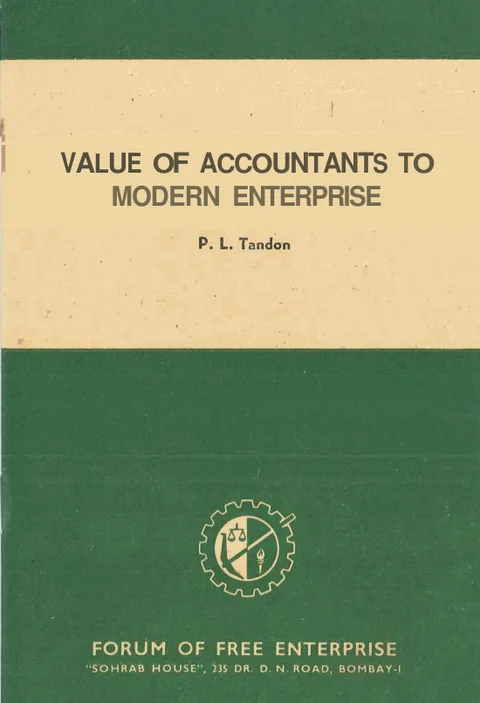
Value of Accountants to Modern Enterprise
Published by M. R. PAI, for Forum of Free Enterprise, "Sohrab House", 235 Dr. Dadabhai Naoroji Road, Bombay 1, and Printed by B. G. DHAWALE at Karnatak Printing Press, Chira Bazar, Bombay 2 · Bombay · 1963
8 pages
Value of Accountants to Modern Enterprise
By P. L. Tandon
Summary
P. L. Tandon, then Chairman of Hindustan Lever Ltd., delivered this talk under the auspices of the Forum of Free Enterprise in Bombay in June 1963 to argue that the Indian economy’s rapid diversification and specialisation have outrun the traditional, book-keeping conception of the accountant’s role. He frames an industrial enterprise as three major sectors — production, marketing and buying — whose success depends on output value exceeding input value, and he insists that accountants must move from custodial book-keeping to active stewardship of yield on resources employed.
The core of the pamphlet is a sustained brief for management accounting as distinct from historical and statutory recording. Tandon walks through its practical mechanics: an annual estimate and budget feeding forecasts for sales, production, capital expenditure, marketing and cash flow; results presented to the board within ten days on the principle of “reporting by exception”; a variable-costs concept for marketing management; and the treatment of depreciation and direct factory labour as fixed costs in the short term. He defines management accounting as “responsibility accounting” that reports information to the level of management best placed to act on it, and he describes a highly decentralised accounting organisation in which unit-level accounts departments report to operating managers while a chief accountant at head office ensures uniform principles.
Drawing on his own firm’s experience, Tandon argues that capital-scarce India cannot afford slack book-keeping, that O. & M. work and the internal audit department are partners rather than policemen of line management, and that the financial accountant must watch cash as it moves through the company’s “veins and arteries” and keep capital employed under continual quarterly review at replacement value. He closes with a vocational appeal: accountants in modern enterprise must see themselves as full members of the management team, sharing in the running and progress of the country, and seize the chance to lift India’s productivity rather than remain narrow controllers of expenditure.
Key points
-
Frames Indian industrial enterprise as three sectors — Production, Marketing and Buying — whose viability depends on output value always exceeding input value.
-
Argues the traditional book-keeping equipment of Indian accountants is ‘behind the needs of the time’ and that the Depression of the 1930s first pushed accountants beyond mere book-keeping toward advisory work.
-
Distinguishes management accounting from historical and statutory recording, describing it as a system for the day-to-day running and future planning of the business.
-
Defines management accounting as ‘responsibility accounting’ — information targeted to the level of management able to act on it, governed by speed balanced against accuracy and accuracy against cost.
-
Recommends a decentralised accounting structure: unit-level accounts departments reporting to operating managers, with a chief accountant at head office ensuring uniform principles.
-
Champions variable-cost reporting for marketing, treats depreciation and direct factory labour as short-term fixed costs, and reassesses capital employed at current replacement value to stay alert to inflation.
-
Casts the internal audit department as a friendly source of ‘unfettered powers of free and frank criticism’, complementing rather than displacing external statutory auditors.
-
Closes with a vocational appeal that accountants must become full members of the management team and active participants in raising the nation’s productivity and prosperity.
Generated by the v1.5 extraction pipeline. Awaiting editorial review.
Metadata and summary are AI-extracted from the source PDF and reviewed for editorial accuracy. The original work is available via the Read PDF tab above (where present); paragraph-level citation inside the PDF is deferred to a future engagement.