edited volume · anthology
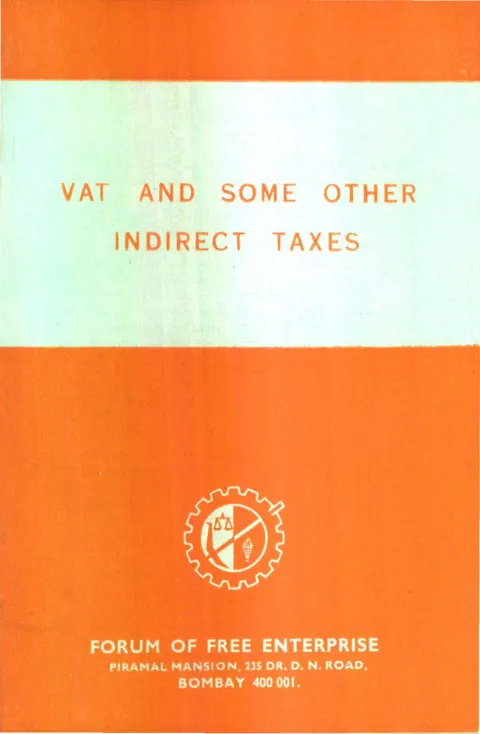
VAT and Some Other Indirect Taxes
By P. C. RANDERIA
FORUM OF FREE ENTERPRISE, PIRAMAL MANSION, 235 DR. D. N. ROAD, BOMBAY 400 001. · Bombay · 1977
23 pages
VAT and Some Other Indirect Taxes
Summary
P. C. Randeria’s booklet, published by the Forum of Free Enterprise in March 1977 as an outgrowth of a Bombay Chamber of Commerce paper, walks the general reader through three areas of indirect taxation that he believes urgently need reform: Value Added Tax (VAT), central excise, and octroi. The framing essay on VAT surveys the levy’s origin in France in 1954, its 1967 adoption across the EEC, its uneven extension to Latin American and Francophone-African developing countries, and the UK’s hesitant move to VAT in 1973 only after a decade-long Richardson Committee debate. Randeria insists that VAT in theory — a comprehensive, single-rate, neutral consumption tax — almost never survives contact with reality: exemptions, zero-rating, multiple rates and a heavy paperwork burden dilute every advantage that pure VAT is supposed to deliver, and he warns that for a federal system like India the choice between national and sub-national VAT raises hard constitutional questions about how receipts would be split between Centre and States.
The second part traces the conceptual lineage of excise from a Webster’s dictionary definition through Mauryan salt and liquor duties, Firuz Tughluq’s memoirs, Jadunath Sarkar’s reading of Aurangzeb’s regime, Romesh Dutt’s economic history and W. M. Moreland’s account of Mughal revenue extraction. Randeria’s point is continuity: the modern Central excise apparatus, now the Union’s largest single revenue source and an instrument of economic policy, sits inside a long Indian habit of taxing manufacture at the source.
The third part, on octroi, is the most polemical. Drawing on the Road Transport Taxation Enquiry Committee’s interim report and on Dr. F. P. Antia, Randeria documents that octroi has been abolished across the industrially advanced West (Belgium in the 1970s, Egypt in 1903, France in 1940) but persists in Indian municipalities as a vexatious, anachronistic toll that delays road movement, invites harassment and extortion at checkposts, and has been condemned by every committee that has examined it. The chunk closes with statistical annexures on Union excise revenues for 1976-77 (Rs. 4,165 crores gross, dominated by petroleum, tobacco and chemicals) and on State receipts, on which sales tax (Rs. 2,165.8 crores) and State excise dominate own-tax revenue.
Key points
-
VAT originated in France in 1954, was adopted across the EEC in 1967, and reached the UK only in 1973 after a decade-long Richardson Committee debate; general rates in 1976 ranged from 8% in the UK to 23% in France.
-
Randeria treats the ‘pure’ VAT system as a theorist’s fiction: in practice exemptions, zero-rating, multiple rates and high collection costs dilute its claimed neutrality and simplicity.
-
For India, the central choice he frames is whether VAT could replace both Central excises and State sales taxes — a question he calls technically demanding and constitutionally fraught for a federal set-up.
-
Excise is presented as India’s largest single source of Central tax revenue and an instrument of economic policy, with a continuous lineage back to Mauryan salt duties and Mughal levies on cloth, oil, tobacco and other goods.
-
Octroi is condemned as an anachronism abolished by every advanced Western economy yet still entrenched in Indian municipalities, where it obstructs road freight and produces harassment, extortion and overpayment at checkposts.
-
The booklet draws explicitly on official sources: the L. K. Jha Indirect Taxes Inquiry Committee, the 1963 A. K. Chanda Central Excise Reorganisation Committee report, the Road Transport Taxation Enquiry Committee, and RBI Currency and Finance statistics.
-
Statistical annexures show 1976-77 Union excise budget estimates of Rs. 4,165 crores gross with petroleum (Rs. 1,080 crores), tobacco (Rs. 319 crores) and chemicals (Rs. 319 crores) as the largest yields; in State accounts, sales tax at Rs. 2,165.8 crores dominates own-tax revenue.
-
Randeria’s broader argument is for a calm, evidence-led national debate before any wholesale indirect-tax overhaul, warning equally against blind continuance of the existing cumbersome regime and against being carried away by the surface attractions of VAT.
Generated by the v1.5 extraction pipeline. Awaiting editorial review.
Metadata and summary are AI-extracted from the source PDF and reviewed for editorial accuracy. The original work is available via the Read PDF tab above (where present); paragraph-level citation inside the PDF is deferred to a future engagement.