speech
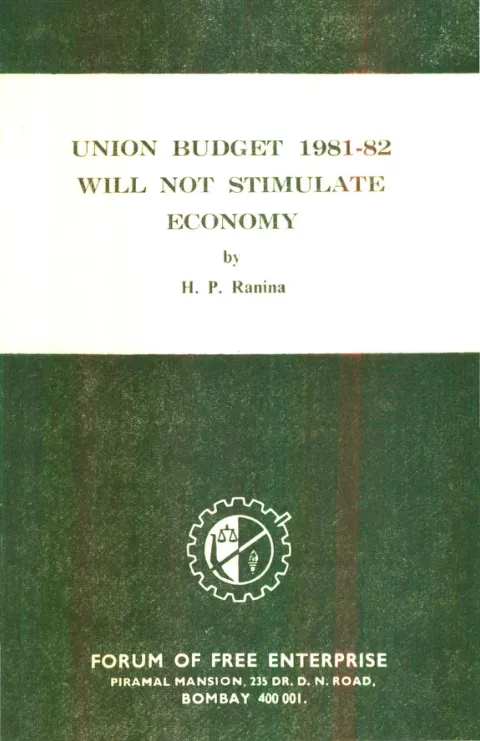
Union Budget 1981-82 Will Not Stimulate Economy
By HP Ranina
Published by M. R. PAI for the Forum of Free Enterprise, "Piramal Mansion", 235 Dr. Dadabhai Naoroji Road, Bombay-1. and printed by B. D. Nadirshaw at Bombay Chronicle Press, Sayed Abdulla Brelvi Road, Fort, Bombay-1. · Bombay · 1981
20 pages
Part of The Union Budget
Union Budget 1981-82 Will Not Stimulate Economy
By HP Ranina
Summary
H. P. Ranina, a Bombay-based tax authority, delivers a sharply critical reading of Finance Minister R. Venkataraman’s 1981-82 Union Budget at a Forum of Free Enterprise lecture on 2 March 1981. He opens by contrasting the comfortable agricultural position with stagnating industry, a widening oil import bill (imports projected at Rs. 11,300 crores against exports of Rs. 7,100 crores), and inflation he forecasts at no less than 15% in the coming year. Ranina argues that the announced budgetary deficit of Rs. 1,539 crores will in reality pierce the Rs. 2,000-crore mark once the over-stated Special Bearer Bond receipts and the ad valorem customs and railway-freight hikes are reckoned in, producing a ‘winter of discontent’ for the common man.
The bulk of the booklet is a clause-by-clause walk through the Finance Bill’s direct-tax amendments. Ranina welcomes the rise in the personal exemption limit from Rs. 12,000 to Rs. 15,000 but argues that the Finance Minister has nullified the relief by hiking marginal rates between Rs. 15,000 and Rs. 30,000 and by extending the Compulsory Deposit Scheme. He attacks the depreciation regime — still pegged to historical cost rather than the replacement-value or free-depreciation models used by ‘most progressive countries’ — citing William Miller of the US Federal Reserve on faster depreciation as the best stimulus to investment. He dissects the new tax-free holiday for free-trade-zone undertakings as illusory, the small-scale-industry threshold, the off-shore oil-collaborator provisions, the new Oral Trust and Association-of-Persons anti-avoidance sections 167-A and 86(v), the Wealth-tax Rule 1-BB on residential property valuation, and the welcome lifting of the estate-duty exemption from Rs. 50,000 to Rs. 1,50,000.
Ranina closes by accusing the Finance Minister of silence on the urgent need to cut unproductive Government expenditure — invoking H. V. R. Iengar’s claim that 40% of Government spending is wasted and President Reagan’s early curtailments — and concludes that Venkataraman’s second budget has ‘missed one more golden opportunity’ to lift India from the economic morass it has been in since 1979. The text closes with the Forum’s standard back-cover epigraph from Eugene Black on private enterprise as ‘an affirmative good’ and a colophon noting publication by M. R. Pai for the Forum of Free Enterprise.
Key points
-
Ranina projects a budgetary gap exceeding Rs. 2,000 crores once over-estimated Special Bearer Bond receipts are netted out, and inflation of at least 15% for 1981-82.
-
He argues that the increase in the personal exemption limit (Rs. 12,000 → Rs. 15,000) is largely cancelled by sharper marginal rates between Rs. 15,000 and Rs. 30,000 and the two-year extension of the Compulsory Deposit Scheme.
-
The depreciation regime, still based on historical cost, is identified as the central drag on the Sixth Plan’s 8% industrial-growth target; replacement-value or 100%-first-year free depreciation is recommended.
-
The five-year tax holiday for new free-trade-zone industrial undertakings is described as illusory because section 10-A(4) denies the parallel allowances available to ordinary units.
-
Anti-avoidance provisions — new section 167-A on Associations of Persons and amendments to section 164 on Oral Trusts — are unpacked as the substantive structural changes in the Finance Bill, alongside Wealth-tax Rule 1-BB on residential property.
-
Welcomed measures include the small-scale-industry threshold liberalisation (machinery value ceiling raised to Rs. 20 lakhs), the lift in the estate-duty exemption from Rs. 50,000 to Rs. 1,50,000, and the extension of the section 80-QQ publisher concession.
-
Ranina indicts the Finance Minister’s silence on cutting unproductive expenditure, citing H. V. R. Iengar’s claim that 40% of Government spending is wasted and Reagan’s first-day curtailment of US federal expenditure.
-
Overall verdict: Venkataraman’s second budget has ‘missed one more golden opportunity’ for triggering the ‘economic miracle which has so far eluded India’.
Generated by the v1.5 extraction pipeline. Awaiting editorial review.
Metadata and summary are AI-extracted from the source PDF and reviewed for editorial accuracy. The original work is available via the Read PDF tab above (where present); paragraph-level citation inside the PDF is deferred to a future engagement.