pamphlet · statement of principles
17th AMENDMENT
FARM, FAMILY, FREEDOM
Printed by S. R. Krishnan at Inland Printers, 55 Gamdevi Rd., Bombay 7 and published by S. V. Raju for the Swatantra Party, 143 Mahatma Gandhi Rd., Fort, Bombay 1. · Bombay · 1964
13 pages
Summary
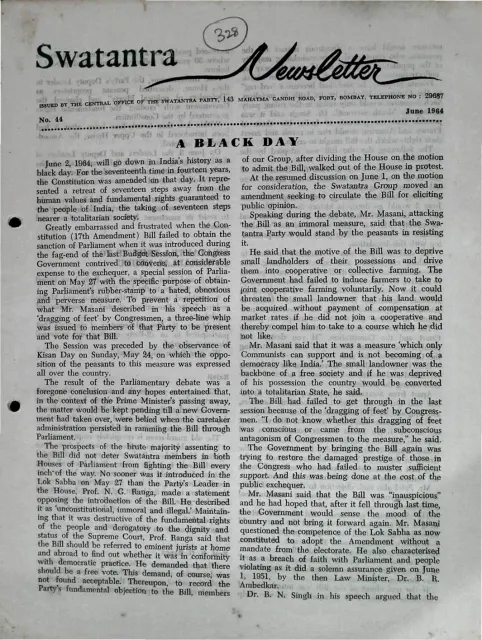
This Swatantra Party booklet presents a sustained political and constitutional case against India’s 17th Amendment. It argues that the amendment gives State legislatures sweeping control over landed property by defining “estate” broadly enough to include very small peasant holdings, including ryotwari land, and by permitting acquisition without full market-value compensation. The booklet frames this as a threat to the farmer’s livelihood, family security, and Fundamental Right to private property, warning that village and state officials would gain excessive discretion over landownership.
The argument also portrays the amendment as unconstitutional and undemocratic. It criticizes the Congress government for retrospectively validating legislation, overriding a Supreme Court judgment, disregarding a pledge associated with B. R. Ambedkar, and forcing the measure through Parliament despite opposition. The booklet reproduces objections from Rajaji, M. R. Masani, N. G. Ranga, and Dahyabhai V. Patel, and describes Swatantra’s campaign of conferences, petitions, rallies, and parliamentary resistance. It concludes that State ownership and collective farming would reduce agricultural productivity and create a path toward communism, while pledging to defend “Farm, Family and Freedom” and support peaceful peasant resistance.
Key points
- The booklet argues that the 17th Amendment places landed property under uncontrolled State legislative power.
- It criticizes the amendment’s broad definition of “estate,” which could expose even very small farms to expropriation.
- The text presents inadequate compensation and the weakening of private property rights as central constitutional objections.
- It accuses the Congress government of violating democratic norms by giving the amendment retrospective effect and rushing it through Parliament.
- B. R. Ambedkar’s earlier assurances concerning ryotwari peasants are presented as a promise breached by the amendment.
- Swatantra Party objections emphasize individual peasant proprietorship, decentralized authority, and opposition to collective farming.
- The booklet records a campaign of rural education, conferences, petitions, demonstrations, and a pledge to support peaceful peasant action.
Metadata and summary are AI-extracted from the source PDF and reviewed for editorial accuracy. The original work is available via the Read PDF tab above (where present); paragraph-level citation inside the PDF is deferred to a future engagement.