pamphlet · position paper
17th AMENDMENT
FARM, FAMILY, FREEDOM
Printed by S. R. Krishnan at Inland Printers, 55 Gamdevi Rd., Bombay 7 and published by S. V. Raju for the Swatantra Party, 143 Mahatma Gandhi Rd., Fort, Bombay 1. · Bombay
13 pages
Summary
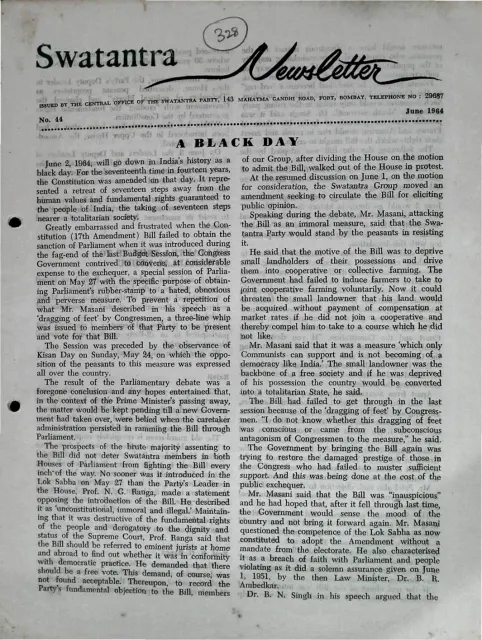
This Swatantra Party pamphlet argues that India’s 17th Amendment threatens the security, property rights, and political freedom of approximately 65 million self-employed peasants and their families. It presents the Amendment as granting State legislatures excessive power over landed property through an expansive definition of “estate,” potentially making even very small farms liable to expropriation. The pamphlet maintains that the measure denies farmers full compensation, weakens constitutional protections for private property, overrides a Supreme Court judgment, and leaves cultivators vulnerable to officials and future governments.
The pamphlet also frames the Amendment as a breach of earlier assurances, particularly those associated with B. R. Ambedkar’s defence of ryotwari tenants, and traces its origins to legislation enacted during a period of Communist rule in Kerala. It portrays the Congress government’s policy as a movement toward collective or cooperative farming and warns, by reference to Soviet Russia and Communist China, that collectivisation would damage agricultural production and produce famine. The closing sections describe the Swatantra Party’s campaign of rural education, conferences, petitions, rallies, parliamentary opposition, and commitment to peaceful peasant action under the slogan “For Farm, Family and Freedom.”
Key points
- The pamphlet identifies the 17th Amendment as a threat to small farmers’ land, livelihood, and security.
- It criticises the Amendment’s broad definition of “estate,” which could encompass holdings as small as one or two acres.
- It argues that expropriation without full compensation violates the farmer’s fundamental right to private property.
- The text presents the Amendment as unconstitutional, undemocratic, retrospectively validating earlier legislation, and dismissive of Supreme Court authority.
- It invokes B. R. Ambedkar’s earlier assurances that constitutional safeguards would not be used to dispossess ryotwari tenants.
- The pamphlet links State ownership and cooperative farming to Communist models and predicts declining agricultural output and famine.
- It records the Swatantra Party’s opposition campaign, including peasant conferences, petitions, a Delhi rally, parliamentary resistance, and a pledge of peaceful action.
Metadata and summary are AI-extracted from the source PDF and reviewed for editorial accuracy. The original work is available via the Read PDF tab above (where present); paragraph-level citation inside the PDF is deferred to a future engagement.