constitution
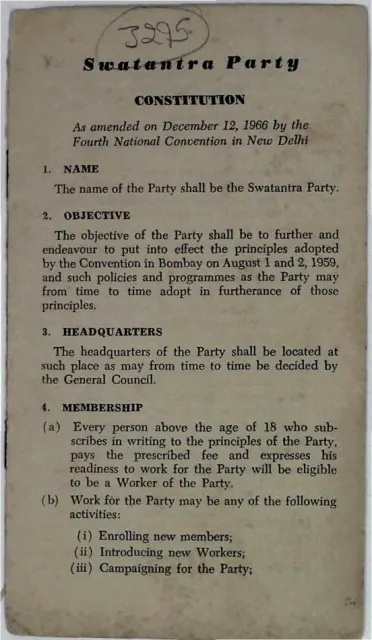
CONSTITUTION
INLAND PRINTERS, BOMBAY 7. · Bombay · 1964
8 pages
Summary
This eight-page English booklet presents the Swatantra Party’s Constitution, as amended by the General Council in Bombay on June 30, 1964. It defines the Party’s objective as implementing principles adopted at the Bombay Convention of August 1 and 2, 1959, and establishes eligibility for membership, categories of Workers, Life Workers, and Life Members, and permissible Party activities such as enrolling members, campaigning, addressing public grievances, preparing and distributing literature, and organising study circles.
The Constitution sets out a representative organisational structure from primary units and District Committees to State or Regional Councils, the General Council, the National Executive, and annual national and regional conventions. It specifies proportional representation, elected office-bearers, co-option limits, voting rights, subscription arrangements, financial auditing, terms of office, rule-making powers, amendment procedures, and transitional arrangements. The document is institutional rather than argumentative: its central concern is to codify internal party governance and electoral procedure.
Key points
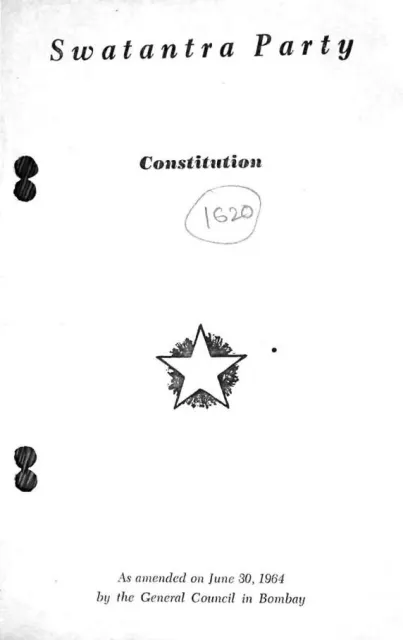
- The document identifies the organisation as the Swatantra Party and dates the visible amendment to June 30, 1964.
- Its stated objective is to implement principles adopted at the Party’s 1959 Bombay Convention and subsequent programmes.
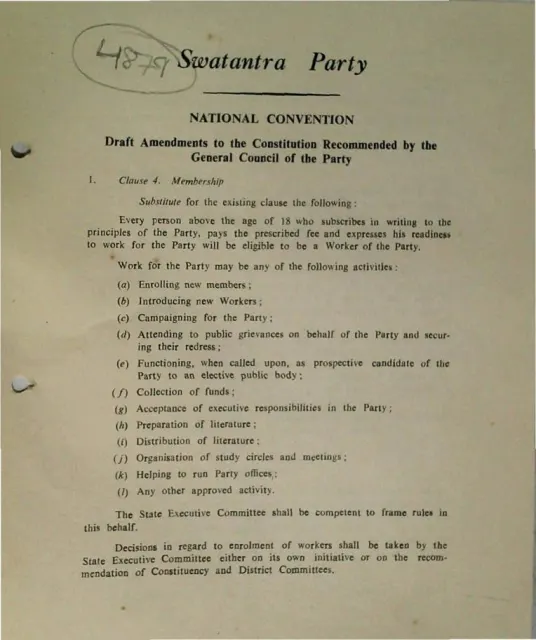
- Persons over eighteen who subscribe in writing to the Party’s principles and pay the prescribed fee may become Workers; the Constitution also recognises Life Workers and Life Members.
- Party work includes membership enrolment, campaigning, public-grievance work, prospective candidacy, literature, study circles, Party administration, fundraising, and other approved activities.
- The Constitution creates a layered structure of primary units, District Committees, State or Regional Councils, the General Council, and the National Executive.
- Elections to key bodies use direct or proportional representation, while only Workers may vote in Party elections or serve as office-bearers or members of elective committees.
- The rules govern subscriptions, allocation of membership income, audited accounts, co-option, annual conventions, amendment procedures, and transitional arrangements.
Metadata and summary are AI-extracted from the source PDF and reviewed for editorial accuracy. The original work is available via the Read PDF tab above (where present); paragraph-level citation inside the PDF is deferred to a future engagement.