constitution
Swatantra Party
CONSTITUTION
Swatantra Party · 1966
8 pages
Summary
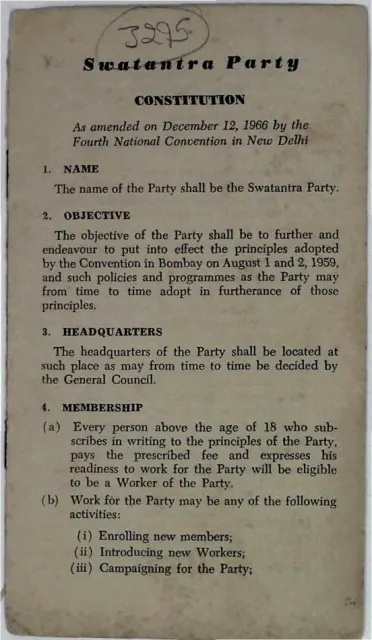
This eight-page English constitutional document sets out the Swatantra Party’s amended institutional framework, as revised on December 12, 1966 by the Fourth National Convention in New Delhi. It defines the party’s name and objective, which is to implement the principles adopted by the 1959 Bombay Convention, and establishes headquarters, membership categories, subscriptions, worker eligibility, and procedures for enrolment and expulsion. Party work includes organising members, campaigning, addressing public grievances, raising funds, producing literature, conducting study circles, and maintaining party offices.
Key points
- The constitution identifies the organisation as the Swatantra Party and ties its objective to principles adopted at the 1959 Bombay Convention.
- Persons over eighteen who subscribe in writing to the party’s principles may become members or Workers, with Workers holding voting and office-holding rights.
- The document regulates subscriptions, life membership, party cards, expulsion, financial distribution among party bodies, and annual auditing.
- The party is organised through primary units, District Committees, State or Regional Councils, a General Council, and a National Executive.
- Representation is structured through elections and proportional representation, with provisions for co-option and nominated members.
- National and State or Regional Conventions are to be held regularly, while the General Council and National Executive receive rule-making and operational powers.
- Amendments require approval through specified majorities at the Annual Convention, and transitional arrangements are assigned to the Central Organising Committee.
Metadata and summary are AI-extracted from the source PDF and reviewed for editorial accuracy. The original work is available via the Read PDF tab above (where present); paragraph-level citation inside the PDF is deferred to a future engagement.