pamphlet
Swatantra Party vs. Indian National Congress
Whether Democracy is to deliver goods or to murder National Feelings ?
The Telegraph Press · Haldwani · 1959
6 pages
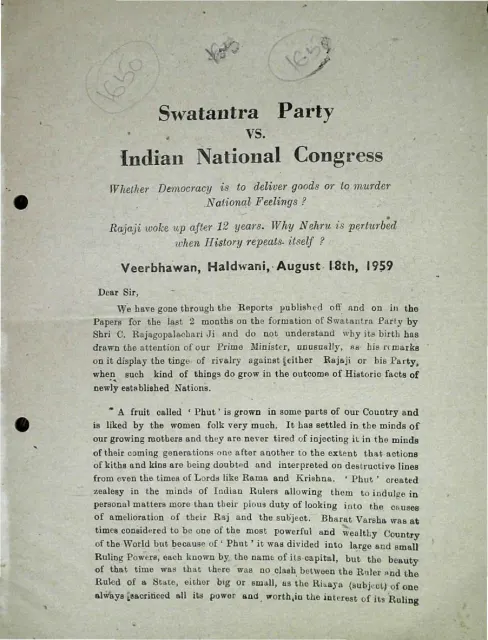
Summary
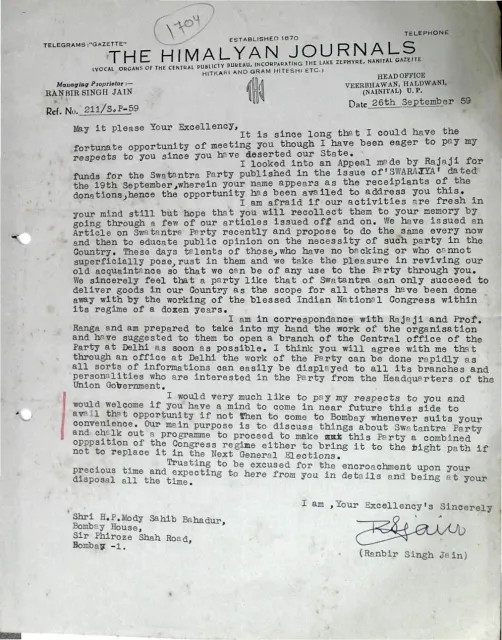
Dated Haldwani, 18 August 1959, this six-page pamphlet by Ranbir Singh Jain presents the Swatantra Party as a response to what the author sees as the Indian National Congress’s historical and post-independence failures. Jain traces India’s political fragmentation from precolonial rivalries through Mughal and British rule, arguing that British “divide and rule” policies exploited existing divisions while the Congress inherited habits of quarrelling, disorder, and centralized political control. He is particularly critical of the Congress’s earlier boycott of legislatures and its later electoral dominance.
The pamphlet frames C. Rajagopalachari’s return to politics after roughly twelve years as an attempt to replace the Congress’s alleged “fruit garden” of centralized administration with a political order based on democracy, free enterprise, productivity, and individual cooperation. Jain argues that the Congress’s record after independence produced repeated divisions, ineffective governance, heavy borrowing, and inadequate relief for farmers and labourers. He closes by defending Swatantra as a forum for free enterprise that could expose the public to alternatives to Congress rule, while acknowledging that the new party had not yet fully reached the masses.
Key points
- The pamphlet contrasts the newly formed Swatantra Party with the Indian National Congress.
- It attributes India’s historical weakness to political fragmentation and, later, British divide-and-rule policies.
- It criticizes Congress’s boycott of elections and legislatures before its eventual participation in constitutional government.
- It argues that Congress rule after independence produced administrative disorder, political factionalism, and unsatisfactory economic outcomes.
- It presents C. Rajagopalachari’s political return as an effort to establish a democratic and economically productive alternative.
- It associates Swatantra with free enterprise, cooperation, productivity, and resistance to excessive political control.
- It claims that farmers, labourers, and ordinary citizens bore the costs of Congress governance and heavy public borrowing.
Metadata and summary are AI-extracted from the source PDF and reviewed for editorial accuracy. The original work is available via the Read PDF tab above (where present); paragraph-level citation inside the PDF is deferred to a future engagement.