Summary
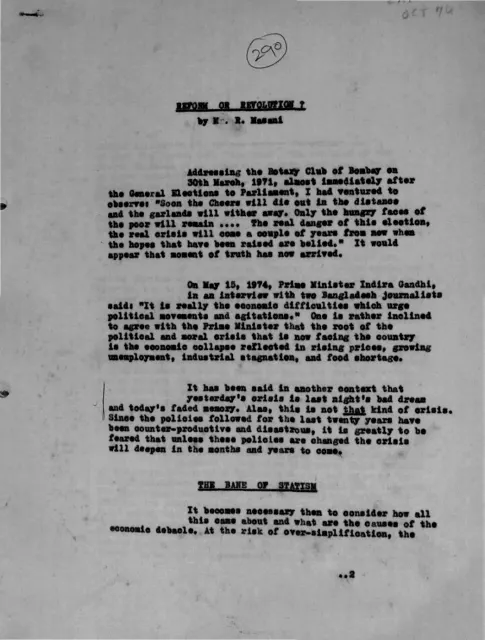
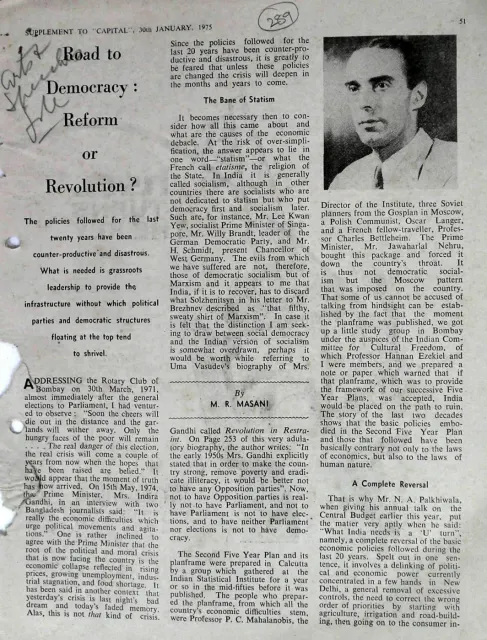
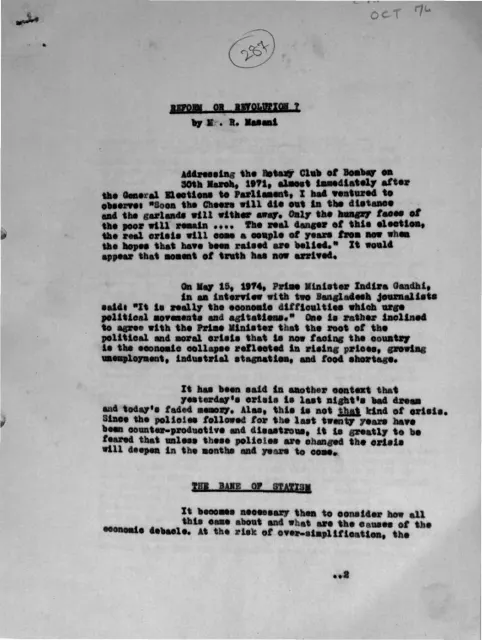
In the rendered pages, M. R. Masani argues that India’s economic crisis is inseparable from the political and economic policies pursued over the preceding two decades. He links rising prices, unemployment, industrial stagnation, and food shortages to state socialism, centralized planning, excessive controls, and misplaced investment priorities. The pamphlet distinguishes democratic socialism from the more coercive model that Masani associates with Marxism and the Soviet system, and criticizes India’s Five-Year Plans as insufficiently democratic and economically unsound.
In the rendered pages, Masani calls for a decisive “U” turn: reduced non-productive expenditure and taxation, deregulation, renewed agricultural and infrastructural investment, greater productivity, and effective population control. He presents reform rather than violent revolution as the preferable route, while warning that reform requires political organization and leadership. The later pages focus on electoral reform and democratic freedom: Masani criticizes the first-past-the-post system for producing governments with minority electoral support, advocates proportional representation or a unified democratic opposition, and insists that democracy means more than majority rule—it requires a free society, freedom of expression and dissent, and independent civic institutions. The pamphlet ends by associating India’s future with grassroots leadership and a possible non-violent democratic transformation under Jayaprakash Narayan.
Key points
- Masani attributes India’s economic difficulties to centralized planning, state socialism, excessive controls, and distorted investment priorities.
- The pamphlet contrasts democratic socialism with Marxist and Soviet-style statism.
- A proposed “U” turn would reverse economic policies through deregulation, lower non-productive expenditure and taxation, agricultural investment, higher productivity, and population control.
- Masani argues that reform is preferable to violent revolution, but that reform requires organized political action and effective leadership.
- The first-past-the-post electoral system is criticized for allowing governments to rule with support from a minority of voters.
- The pamphlet considers proportional representation and a single democratic opposition as possible routes to electoral change.
- Masani defines a free country through pluralism, freedom of expression and dissent, a free press, and a free society—not merely majority rule.
Metadata and summary are AI-extracted from the source PDF and reviewed for editorial accuracy. The original work is available via the Read PDF tab above (where present); paragraph-level citation inside the PDF is deferred to a future engagement.