essay
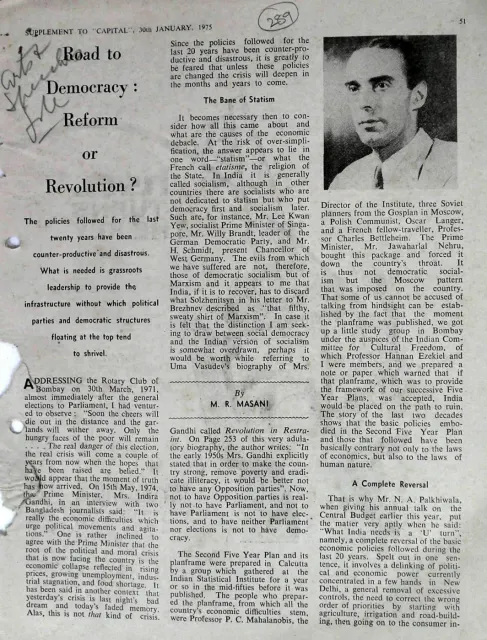
Road to Democracy : Reform or Revolution ?
By Minoo Masani
SUPPLEMENT TO “CAPITAL”, 30th JANUARY, 1975 · 1975
4 pages
Summary
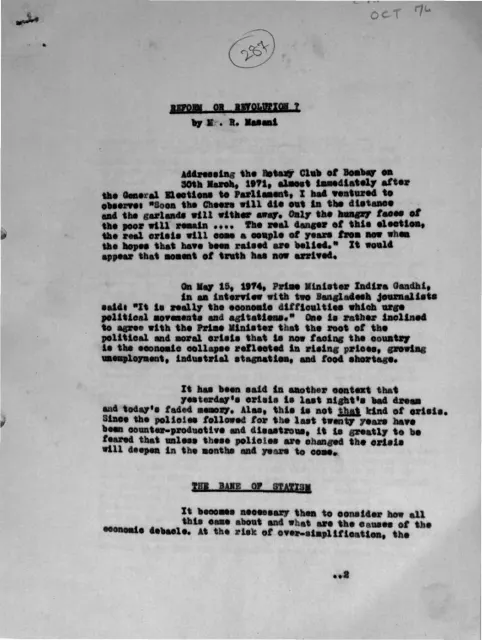
In this four-page essay, M. R. Masani argues that India’s economic and political difficulties are the result of two decades of statist policy, central planning, excessive controls, and weak democratic institutions. He identifies the “bane of statism” with an overextended state and distinguishes democratic socialism from Marxist state domination, while citing Singapore, West Germany, and Solzhenitsyn’s critique of Marxism as points of comparison. Masani contends that the Second Five Year Plan and its associated planframe established priorities contrary to both economic laws and human nature, producing inflation, stagnation, unemployment, shortages, and declining productive capacity.
Masani presents reform—not revolution—as the preferred route to recovery, but warns that reform requires a genuine “U” turn: reduced non-productive expenditure, lower taxation, an end to deficit financing, higher productivity, and population control. He also calls for electoral reform, arguing that India’s inherited first-past-the-post system has repeatedly produced governments lacking majority support. The final pages distinguish democracy from mere majority rule and emphasize a free society, grassroots leadership, moral courage, and the possibility of a non-violent democratic transformation led by Jayaprakash Narayan. The article closes by warning that if reform fails, history may make revolution unavoidable.
Key points
- Masani attributes India’s economic crisis to statist policies and excessive state control over economic life.
- He contrasts democratic socialism with Marxist statism and invokes international examples including Singapore and West Germany.
- The Second Five Year Plan and its planframe are presented as producing priorities contrary to economic laws and human nature.
- A necessary economic “U” turn would include reduced non-productive expenditure, lower taxation, less deficit financing, and greater productivity.
- Masani proposes electoral reform because the first-past-the-post system has enabled minority governments to rule with artificial majorities.
- He argues that democracy means more than majority rule: it requires a free society, free expression, a free press, and freedom of choice.
- The essay advocates grassroots leadership and moral courage as the infrastructure needed to renew India’s democratic institutions.
- Masani prefers reform but concludes that failed reform can make a non-violent democratic revolution historically necessary.
Metadata and summary are AI-extracted from the source PDF and reviewed for editorial accuracy. The original work is available via the Read PDF tab above (where present); paragraph-level citation inside the PDF is deferred to a future engagement.