
essay
IMPACT OF DEMOCRACY ON INDUSTRIAL EFFICIENCY & PROGRESS
By Minoo Masani
Swarajya Annual Number 1975 · 1975
6 pages
Summary
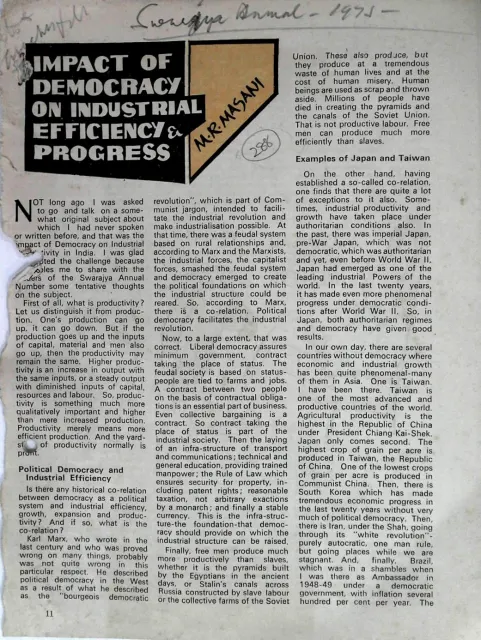
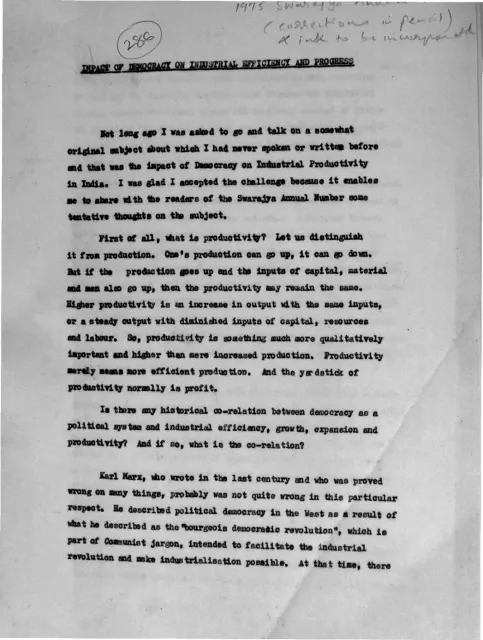
In the rendered pages, M. R. Masani examines whether political democracy is necessary for industrial efficiency, productivity, and economic progress. He distinguishes productivity from mere increases in output and argues that liberal democracy supplies the institutional foundations of productive industry: contract, property and patent rights, the rule of law, reasonable taxation, education, infrastructure, trained manpower, and a stable currency. Historical examples from Japan, Taiwan, South Korea, Iran, Brazil, and the Soviet Union are used in the rendered pages to argue that industrial growth can occur under authoritarian rule, but that democracy is not inherently hostile to productivity and may provide a more secure social and political environment for it.
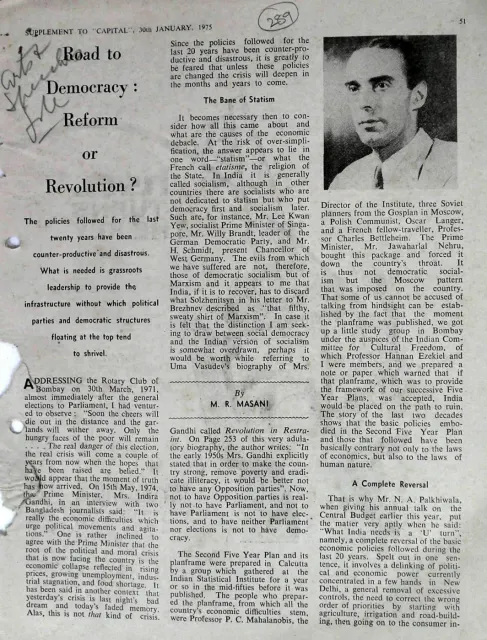
In the rendered pages, Masani directs his sharpest criticism at what he calls Statism: the politicisation of economic life, state capitalism, central planning, economic nationalism, government ownership, licensing, controls, and politically managed trade unions. He associates India’s low productivity and inflation with the priorities of its Five-Year Plans, excessive emphasis on heavy industry, protectionism, and state management. The concluding pages in the rendered set distinguish democracy from majority rule and defend limited government, minority protection, individual conscience, and a constitutional order. The pages rendered include printed pages 11, 82–84, and 87–88; printed pages 85–86 were not visible in the supplied scan.
Key points
- Productivity is defined as more efficient production, not simply a larger volume of output.
- Liberal democracy is presented as a framework for contract, property rights, education, infrastructure, rule of law, and monetary stability.
- Japan, Taiwan, South Korea, Iran, Brazil, and the Soviet Union are compared as cases of industrial growth under different political regimes.
- Masani argues that India’s Statist economic model undermines productivity through politicisation, central planning, licensing, controls, and state ownership.
- The essay criticises Five-Year Plan priorities that favour heavy industry and capital-intensive projects over agriculture, consumer goods, and labour-intensive production.
- Economic nationalism and the insistence that goods be made wholly in India are criticised as inefficient and contrary to international division of labour.
- The essay links excessive taxation, price controls, wage increases without productivity gains, and anti-automation policies to inflation, unemployment, and declining real wages.
- The conclusion defends constitutional democracy as limited government that protects minorities and individual conscience rather than simply enforcing majority rule.
Metadata and summary are AI-extracted from the source PDF and reviewed for editorial accuracy. The original work is available via the Read PDF tab above (where present); paragraph-level citation inside the PDF is deferred to a future engagement.
People in this work
Related across the archive
 Primary workIMPACT OF DEMOCRACY ON INDUSTRIAL EFFICIENCY AND PROGRESS
 Primary workGOVERNMENT ECONOMIC POLICIES : INDUCEMENTS FOR CAPITAL FORMATION AND INVESTMENT IN INDUSTRIES
 Primary workRoad to Democracy : Reform or Revolution ?
 ThePrintCapitalism isn’t responsible for mass unemployment. Look at Japan, Singapore: BS Iyer
 ExcerptStatement of the Principles of Swatantra Party