
essay
GOVERNMENT ECONOMIC POLICIES : INDUCEMENTS FOR CAPITAL FORMATION AND INVESTMENT IN INDUSTRIES
By Minoo Masani
1962
21 pages
Summary
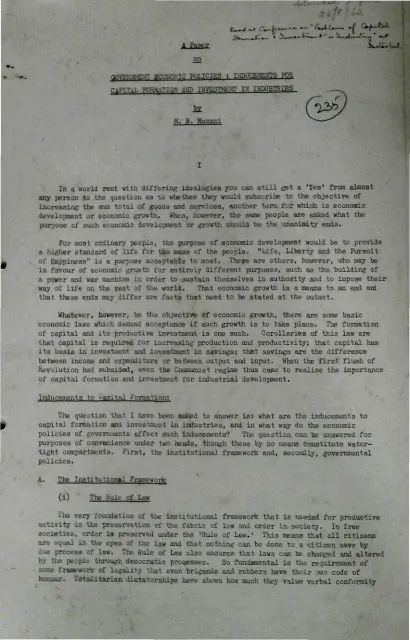
In the rendered pages, M. R. Masani argues that economic development is a means to human welfare rather than an end in itself, and that capital formation requires more than administrative direction. He identifies four institutional conditions for productive investment: the rule of law, a stable currency, security of property, and profit and reward. The discussion presents inflation, insecure property rights, nationalisation, excessive taxation, and weakened incentives as barriers to saving, enterprise, and industrial growth. Masani also argues that democratic government should act chiefly as an impartial rule-maker and provider of infrastructure, not as the day-to-day controller of production.
In the rendered pages, the paper applies this framework to India’s post-Independence experience. Masani criticises centralised planning, the dominance of the State sector, the priority given to heavy industry, neglect of agriculture and education, restrictions on transport and private enterprise, and policies of autarky. He uses figures from the Five Year Plans and contemporary economic reports to argue that public investment has produced low returns while taxation and non-developmental expenditure have impaired private saving. The paper closes in the rendered pages by advocating a change from doctrinaire socialism and self-sufficiency toward policies centred on consumption, social amenities, productivity, foreign capital, and international trade. The final page of the PDF was not rendered.
Key points
- Economic growth is presented as a means of improving mass living standards, not as an autonomous political objective.
- Masani treats the rule of law, stable currency, secure property, and profit incentives as institutional foundations of capital formation.
- He distinguishes democratic planning from totalitarian economic control and defends a mixed economy in which markets and private enterprise remain operative.
- The paper criticises Indian nationalisation, state monopolies, high taxation, and administrative interference for weakening investment and productivity.
- The rendered pages argue that Five Year Plan priorities overfavoured heavy industry while neglecting agriculture, education, transport, and consumer goods.
- Masani links autarky and import restrictions to high costs, stagnant exports, pressure on foreign exchange, and dependence on external borrowing.
- The paper’s concluding recommendation is to give first priority to basic consumption, social amenities, private saving, enterprise, and wider international economic engagement.
Metadata and summary are AI-extracted from the source PDF and reviewed for editorial accuracy. The original work is available via the Read PDF tab above (where present); paragraph-level citation inside the PDF is deferred to a future engagement.
People in this work
Related across the archive
 Primary workGOVERNMENT ECONOMIC POLICIES : INDUCEMENTS FOR CAPITAL FORMATION AND INVESTMENT IN INDUSTRIES
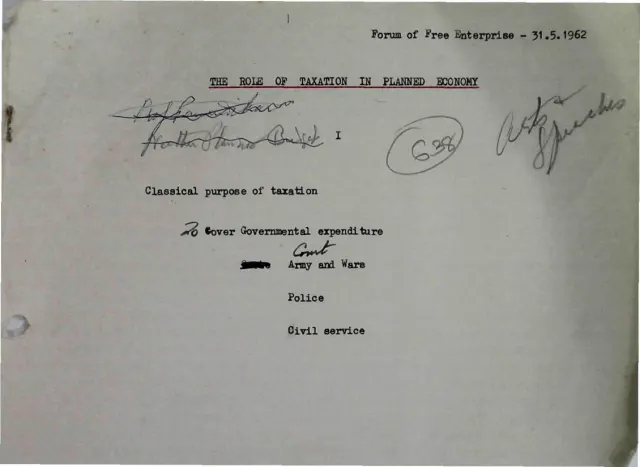 Primary workTHE ROLE OF TAXATION IN PLANNED ECONOMY
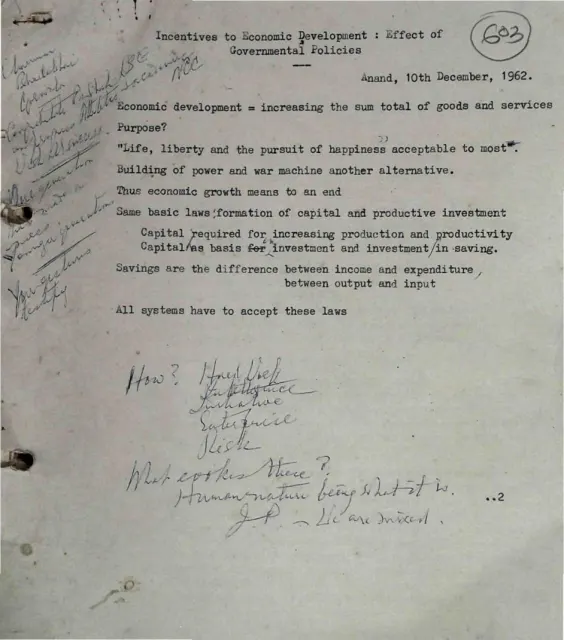 Primary workIncentives to Economic Development : Effect of Governmental Policies
 ExcerptB.R. Shenoy on Economic Growth with Social Justice
 ThePrintFree-enterprise features are reshaping Russia’s socialist institutions: AD Shroff