
office record · working paper
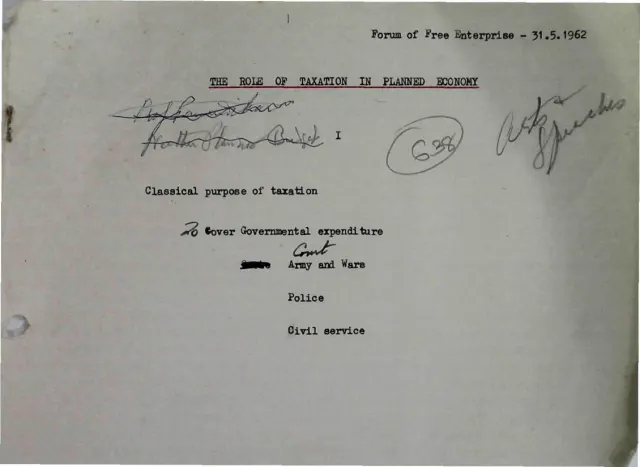
THE ROLE OF TAXATION IN PLANNED ECONOMY
1962
14 pages
Summary
This 1962 Forum of Free Enterprise working paper examines whether taxation in India supports the objectives of a planned economy. It distinguishes the classical purpose of taxation—financing government expenditure—from the additional aims of economic development and social justice. The paper argues that taxation should help expand production through infrastructure, education, saving, investment and incentives, while also supporting stable currency, employment, fair remuneration and access to basic needs. It repeatedly stresses that production, private initiative and profit remain necessary even within a planned or welfare-oriented economy.
Key points
- Taxation in a planned economy is presented as an instrument for economic development as well as revenue collection.
- The paper argues that infrastructure, education, saving, investment, profit and enterprise are essential to increasing production.
- It links social justice to stable currency, equal pay for equal work, employment, consumption needs and widely distributed purchasing power.
- The author criticises Indian budget priorities for neglecting roads, irrigation, power, fuel, education and agriculture while increasing non-developmental expenditure.
- High direct and commodity taxation is said to discourage saving, investment, employment, productivity and exports.
- The paper treats inflation as both economically damaging and socially unjust, especially because it burdens poorer households.
- Its recommendations include abolishing land revenue, reducing excise on necessities and inputs, reducing corporate and income taxation, avoiding deficit finance, and cutting civil expenditure and bureaucracy.
Metadata and summary are AI-extracted from the source PDF and reviewed for editorial accuracy. The original work is available via the Read PDF tab above (where present); paragraph-level citation inside the PDF is deferred to a future engagement.
Related across the archive
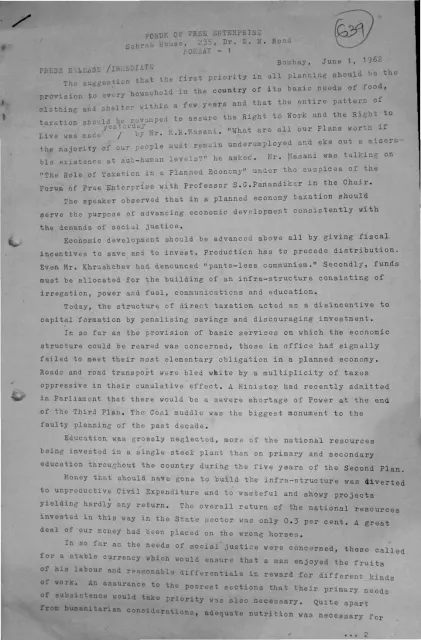 Primary workForum of Free enterprise-Press Release
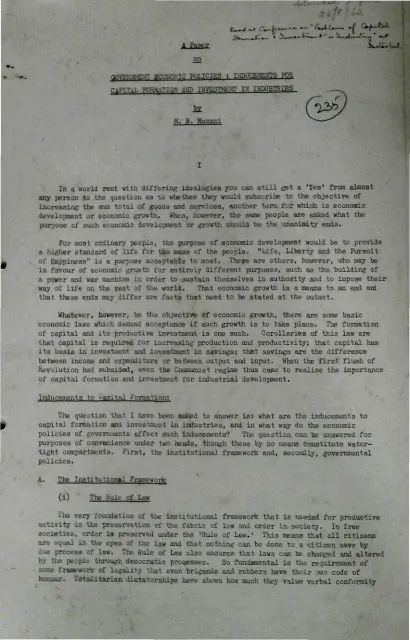 Primary workGOVERNMENT ECONOMIC POLICIES : INDUCEMENTS FOR CAPITAL FORMATION AND INVESTMENT IN INDUSTRIES
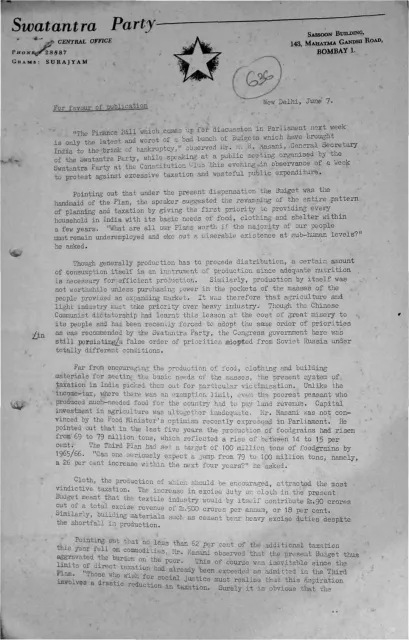 Primary workFor Favour of Publication
 ExcerptLaying The Foundations For An Economic Miracle
 ThePrintSocialist planners aggravated unemployment problem