
essay
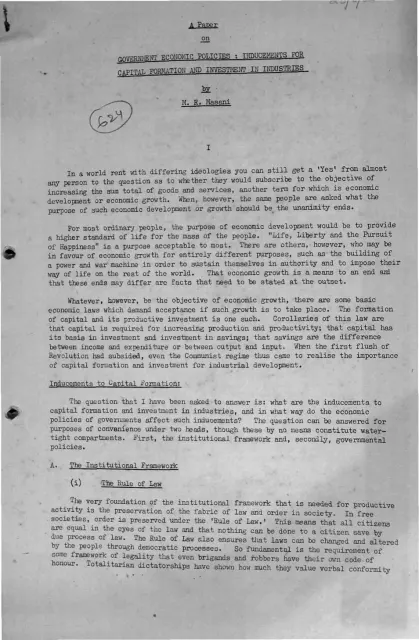
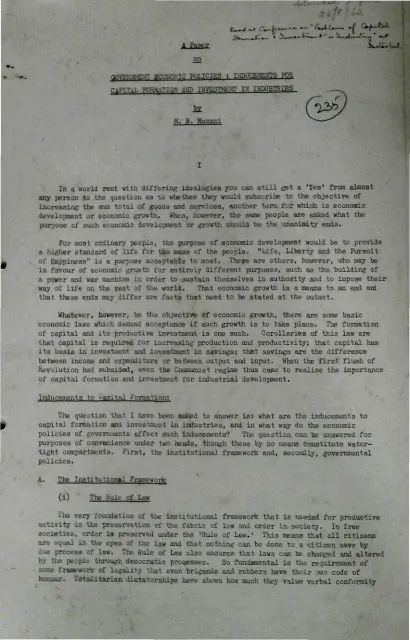
GOVERNMENT ECONOMIC POLICIES : INDUCEMENTS FOR CAPITAL FORMATION AND INVESTMENT IN INDUSTRIES
By Minoo Masani
20 pages
Summary
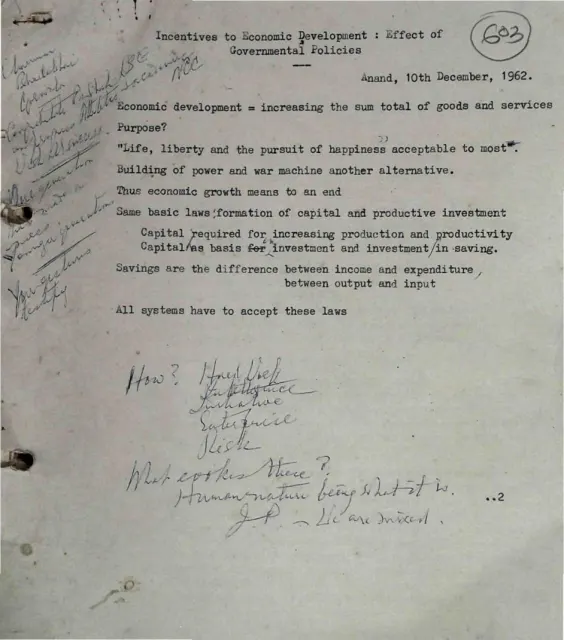
In this paper, M. R. Masani argues that capital formation and industrial investment depend not only on government incentives but also on a supportive institutional framework. The first part identifies the rule of law, stable currency, security of property, and profit-based rewards as essential conditions for productive enterprise. Masani links economic growth to individual freedom, savings, risk-taking, and investment, and warns that inflation, insecure property rights, nationalisation, and excessive taxation weaken both economic performance and democratic institutions. He draws on examples from Yugoslavia, the Soviet Union, Britain, and West Germany to argue that a mixed economy should leave production and exchange substantially to private initiative while restricting the State to an impartial, infrastructural, and regulatory role.
The paper then examines India’s economic experience since independence against these principles. Masani credits India with a broadly satisfactory record of civil order, elections, and judicial institutions, but criticises currency depreciation, nationalisation, land collectivisation proposals, high taxation, transport bottlenecks, and the concentration of planning resources on heavy industry. He contends that comprehensive planning has neglected agriculture, education, consumer goods, and private enterprise while expanding State control and producing low growth, unemployment, and weak returns on public investment. The concluding pages call for a decisive shift away from Statism and autarky toward higher private savings, foreign equity investment, international trade, and a development strategy prioritising minimum consumption and improved living conditions.
Key points
- The paper presents rule of law, stable currency, secure property, and profit incentives as prerequisites for capital formation.
- Masani connects economic liberty with democratic freedom and argues that sustained inflation can undermine both.
- He distinguishes the State’s role as an impartial rule-enforcer and provider of infrastructure from direct participation in production.
- The Indian experience is assessed through currency depreciation, nationalisation, land policy, taxation, and public-sector performance.
- Masani criticises Indian planning for prioritising heavy industry while neglecting agriculture, education, transport, and consumer goods.
- The paper argues that autarkic planning raises costs, limits exports, and makes India dependent on foreign loans despite its hostility to foreign capital.
- Its proposed alternative is a mixed economy centred on private initiative, foreign equity, international trade, and a minimum standard of consumption.
Metadata and summary are AI-extracted from the source PDF and reviewed for editorial accuracy. The original work is available via the Read PDF tab above (where present); paragraph-level citation inside the PDF is deferred to a future engagement.
People in this work
Related across the archive
 Primary workGOVERNMENT ECONOMIC POLICIES : INDUCEMENTS FOR CAPITAL FORMATION AND INVESTMENT IN INDUSTRIES
 Primary workIncentives to Economic Development : Effect of Governmental Policies
 Primary workFor Farm Family and Freedom
 ExcerptStatement of the Principles of Swatantra Party
- ExcerptB.R. Shenoy on Economic Growth with Social Justice