
speech
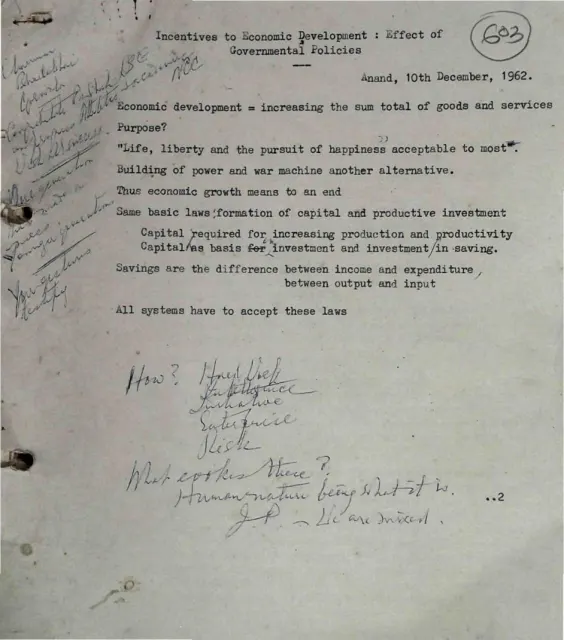
Incentives to Economic Development : Effect of Governmental Policies
Anand · 1962
9 pages
Summary
Dated Anand, 10 December 1962, this unattributed speech outline argues that economic development depends on incentives that increase saving, investment, productivity, and output while preserving individual freedom. It begins by treating economic growth as a means rather than an end, linking material progress to the broader purposes of “life, liberty and the pursuit of happiness.” Its institutional framework consists of the rule of law, stable currency, security of property, and profit and reward. Inflation is presented as especially damaging because it undermines savings, capital formation, and democratic freedom; secure property and differentiated rewards are defended as necessary to encourage work, risk-taking, saving, and investment.
The outline then turns to governmental policy. It assigns the State a limited but important role: maintaining the rules of the game and supplying infrastructure and a favourable environment in which private enterprise can operate. It distinguishes planning that works with markets from communist command planning, and argues that consumers’ choices and price signals provide an important form of economic democracy. The final visible section addresses taxation, insisting that taxes must finance government without suppressing growth, risk-taking, private investment, or employment. The pages also engage a wide range of contemporary and historical thinkers and sources, including Keynes, Graham Hutton, Khrushchev, John Kenneth Galbraith, P. T. Bauer, E. F. Schumacher, Ludwig Erhard, Walter Eucken, Thomas Wilson, Barbara Wootton, Trotsky, Canning, Parkinson, and B. R. Shenoy.
Key points
- Economic development is defined as an increase in the total production of goods and services, but growth is treated as a means to human freedom and welfare.
- Saving and capital formation are presented as prerequisites for higher production and productivity.
- The institutional foundations of development are identified as the rule of law, stable currency, security of property, and profit-based rewards.
- Inflation is criticized as destructive of savings, capital formation, democratic government, and personal freedom.
- Private property and differential returns are defended as incentives for work, risk-taking, saving, investment, and productivity.
- The State should act as an impartial rule-enforcer and provide infrastructure, rather than directly control day-to-day economic production.
- Planning is acceptable when it operates alongside markets, consumer choice, private contracts, and competition; communist command planning is rejected.
- Taxation should fund government and restrain inflation without discouraging growth, initiative, investment, or high employment.
Metadata and summary are AI-extracted from the source PDF and reviewed for editorial accuracy. The original work is available via the Read PDF tab above (where present); paragraph-level citation inside the PDF is deferred to a future engagement.
Related across the archive
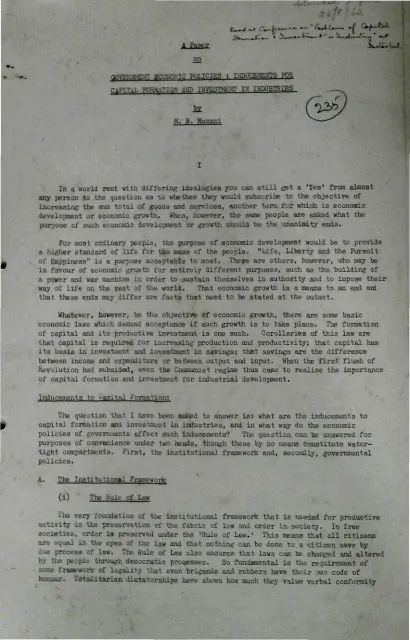 Primary workGOVERNMENT ECONOMIC POLICIES : INDUCEMENTS FOR CAPITAL FORMATION AND INVESTMENT IN INDUSTRIES
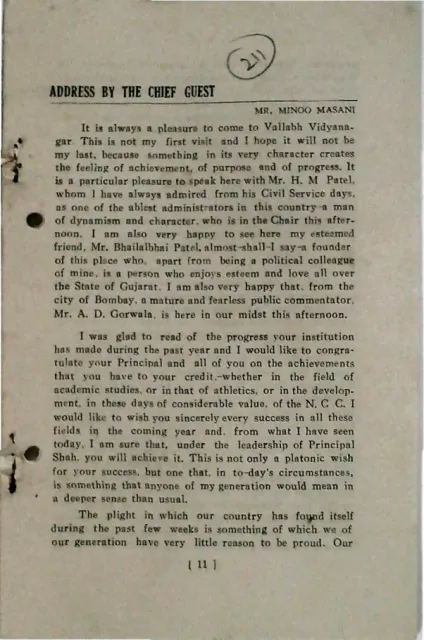 Primary workADDRESS BY THE CHIEF GUEST
 ThePrintWelfare state is socially and economically a national disaster: GN Lawande
 ThePrintCapitalism isn’t responsible for mass unemployment. Look at Japan, Singapore: BS Iyer