Summary
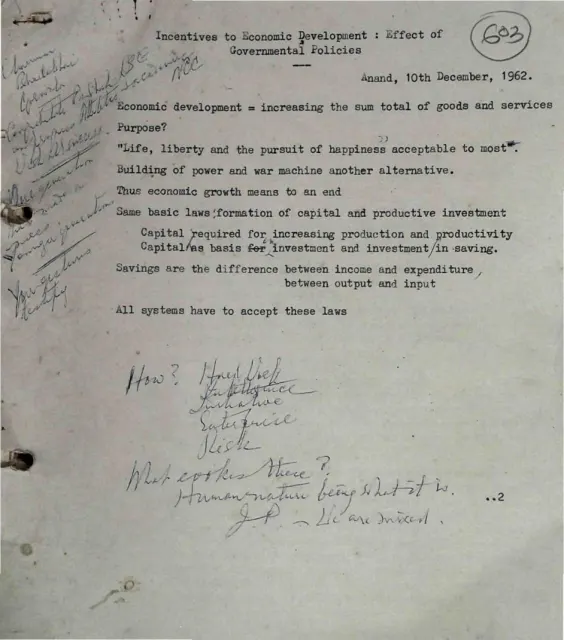
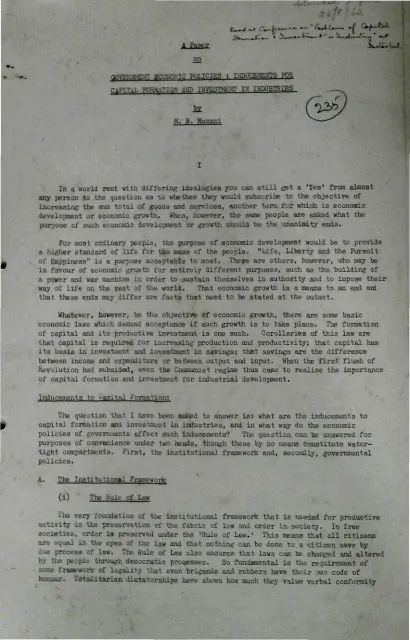
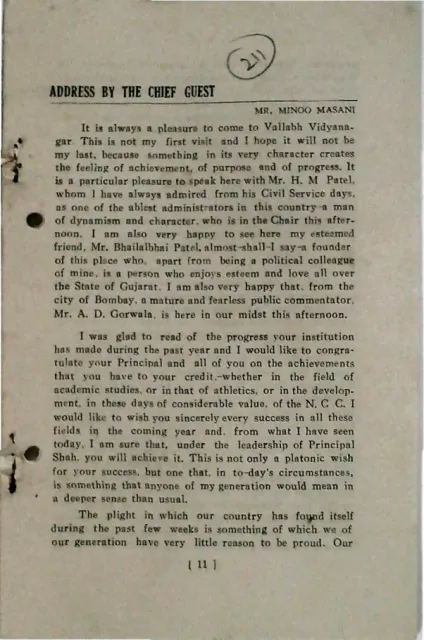
In this address at Vallabh Vidyanagar, Minoo Masani begins by reflecting on India’s post-Independence record and the responsibilities facing its younger generation. He praises the institution’s academic, athletic, and civic achievements, but warns that the country needs new policies, new measures, and new people. He then turns to economic development, arguing that growth is a means to human welfare rather than an end in itself, and contrasting India’s approximately 3 percent growth rate with Japan’s 20 percent rate. Economic progress, he maintains, must occur within conditions of liberty and security rather than serve dictatorship or war-making power.
Masani’s central economic argument is that India must encourage work, enterprise, risk-taking, saving, and investment through secure property, sound money, and competition. He attacks inflation as an anti-social and anti-socialist process that destroys savings, harms people on fixed incomes, and discourages investment. He defends profit as a measure of efficiency and rejects both private and state monopolies, while arguing that foreign capital can help correct India’s imbalance of population, land, and domestic capital. On the role of government, he advocates a referee rather than a player: the state should provide infrastructure, law and order, and essential services, but should not crowd out private enterprise.
The address also distinguishes between different kinds of planning. Masani criticizes India’s licensing and control system as a version of the Moscow model, while presenting French and British advisory approaches as more flexible alternatives. He accepts a limited role for government in a mixed economy, provided it does not establish monopolies. He closes with a critique of excessive taxation and a call for economists and students to remain curious and investigate the causes of things. The scanned pages appear to contain the complete address, ending on printed page 32.
Key points
- Masani links economic development to human happiness, welfare, liberty, and security rather than treating production as an end in itself.
- He argues that India must cultivate hard work, enterprise, initiative, and willingness to take risks.
- He presents inflation as destructive of savings and investment, with disproportionate effects on poorer and fixed-income groups.
- He defends private property, saving, and profit as incentives and as indicators of productive efficiency.
- He criticizes state and private monopolies, especially government monopolies in insurance and other enterprises.
- He argues that foreign capital can help remedy India’s shortage of capital relative to its population and land.
- He presents government as a referee responsible for law, order, infrastructure, and essential services, not as the dominant producer.
- He distinguishes flexible, advisory planning from the centralized licensing and production controls associated with the Moscow model.
Metadata and summary are AI-extracted from the source PDF and reviewed for editorial accuracy. The original work is available via the Read PDF tab above (where present); paragraph-level citation inside the PDF is deferred to a future engagement.