essay
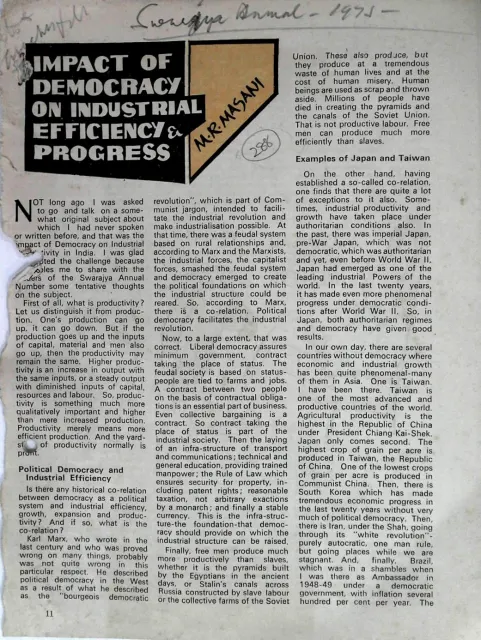
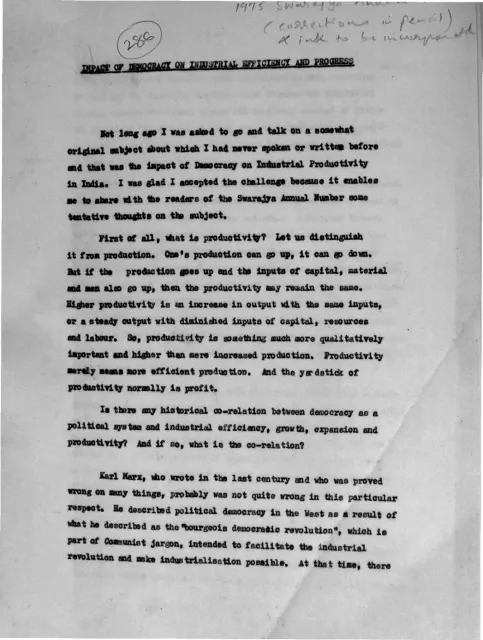
IMPACT OF DEMOCRACY ON INDUSTRIAL EFFICIENCY AND PROGRESS
17 pages
Summary
The essay examines whether democracy promotes industrial efficiency and productivity in India. It begins by distinguishing productivity from output: productivity means increased output with the same inputs, or the same output with fewer inputs, and is normally measured by profit. The author accepts Marx’s argument that political democracy historically helped create the conditions for industrialisation, emphasizing contract in place of status, infrastructure, education, the rule of law, property and patent rights, reasonable taxation, stable currency, and the greater productivity of free people compared with forced labour.
The essay then argues that democracy is neither necessary nor sufficient for industrial progress, citing Imperial and post-war Japan, Taiwan, South Korea, Iran, and Brazil as examples of authoritarian regimes that achieved substantial growth. Turning to India, it attributes low productivity to the survival of feudal attitudes within democratic institutions, the cult of personality, paternalistic government, Nehruvian economic Stalinism, political control of trade unions and education, distorted investment priorities, autarkic economic nationalism, politically determined industrial location, state employment, licensing, corruption, price controls, excessive taxation, production ceilings, and opposition to automation. The concluding argument is that democracy itself has no automatic link with productivity: a free, pluralist society with minimum government can foster it, while excessive state intervention and the politicisation of economic life undermine both productivity and constitutional democracy.
Key points
- Productivity is defined as greater output from the same inputs, or the same output from fewer inputs, rather than simply increased production.
- The author presents democracy’s historical contribution to industrialisation through contract, infrastructure, education, rule of law, property rights, stable currency, and free labour.
- Examples including Japan, Taiwan, South Korea, Iran, and Brazil are used to show that authoritarian systems can also generate industrial growth.
- India’s economic problems are attributed to feudal political attitudes, personality cults, state paternalism, and the fusion of democratic politics with statist economics.
- The essay criticises Five Year Plan priorities, especially the emphasis on capital-intensive heavy industry over agriculture and labour-intensive production.
- Autarky, politically allocated factories, employment quotas, government enterprises, licences, controls, and corruption are presented as sources of low productivity and inflation.
- The author defends modernisation, automation, computerisation, profitability, competition, and meaningful rather than merely nominal employment.
- The conclusion distinguishes democracy from statism and calls for limited government, pluralism, individual rights, and constitutional restraints on majority rule.
Metadata and summary are AI-extracted from the source PDF and reviewed for editorial accuracy. The original work is available via the Read PDF tab above (where present); paragraph-level citation inside the PDF is deferred to a future engagement.