Summary
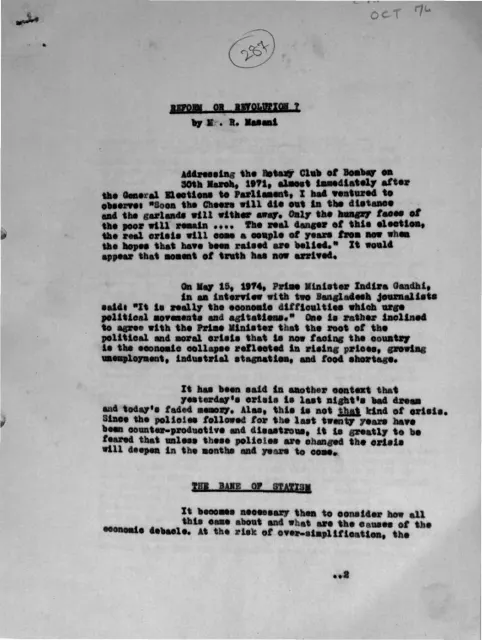
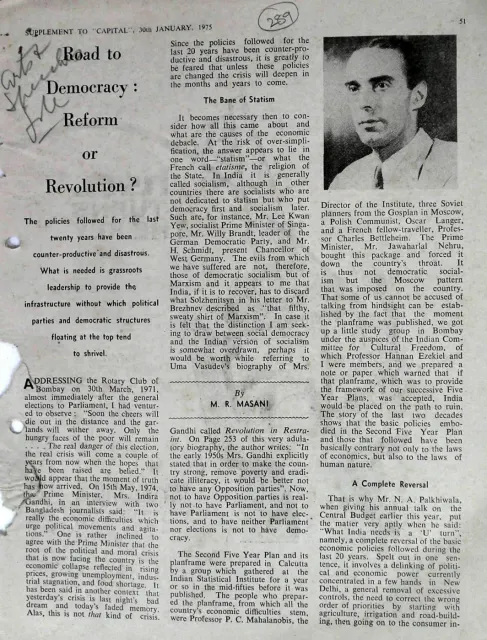
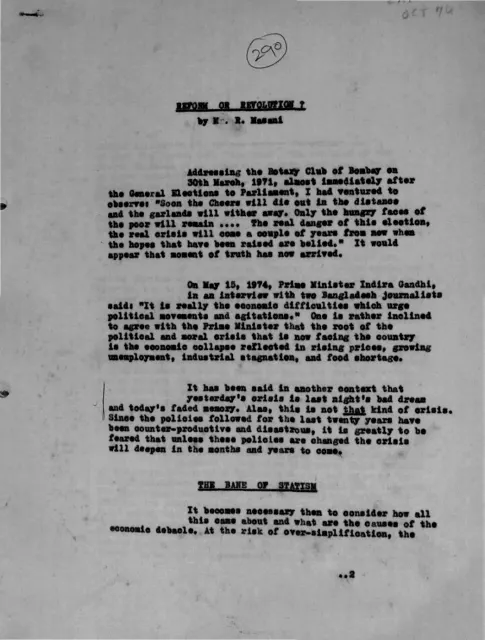
In the rendered pages, M. R. Masani argues that India’s economic crisis is the consequence of statist and Marxist policies rather than democratic socialism. He links rising prices, unemployment, industrial stagnation, and food shortages to centralized planning, the Second Five-Year Plan, excessive controls, distorted priorities, and the concentration of political and economic power. The pamphlet distinguishes democratic socialism from the Indian version of socialism, which Masani presents as a Moscow-influenced system imposed through the planning apparatus and associated with weakened parliamentary opposition.
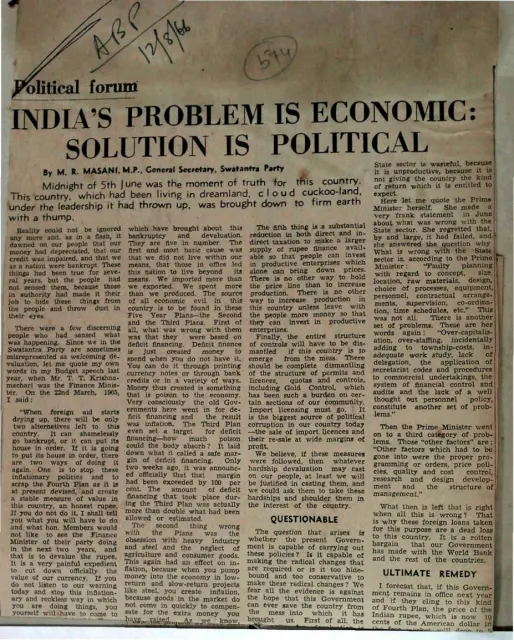
In the rendered pages, Masani calls for a “U” turn: a reversal of the economic policies pursued over the previous twenty years, including reduced non-productive expenditure and taxation, restoration of incentives, agricultural and infrastructural priorities, and effective population control. He identifies reform of the electoral system and the creation of a united democratic opposition as necessary political changes, but doubts that existing parties can accomplish them. Although he describes himself as a Liberal Democrat committed to reform rather than destruction, the pamphlet closes by warning that when reform fails, revolutionary pressures may follow; it presents Jayaprakash Narayan as a possible leader of a non-violent, Gandhian transformation and defines a free country through pluralism, dissent, economic choice, and democratic institutions.
Key points
- Masani attributes India’s economic difficulties to statist, Marxist, and centralized planning policies.
- The pamphlet distinguishes democratic socialism from the Indian form of socialism, which it associates with Moscow and Marxism.
- The Second Five-Year Plan is criticized for violating both economic principles and human incentives.
- A “U” turn would reverse economic controls, reduce unproductive expenditure and taxation, and restore agricultural and productive priorities.
- Masani advocates reform rather than violent revolution, while warning that failed reform can produce revolutionary consequences.
- Electoral reform is presented as necessary because minority governments and disproportionate parliamentary majorities have distorted representation.
- A free society requires more than majority rule: it requires freedom of choice, expression, dissent, and economic activity.
- Jayaprakash Narayan is presented as a possible leader of a non-violent, Gandhian political transformation.
Metadata and summary are AI-extracted from the source PDF and reviewed for editorial accuracy. The original work is available via the Read PDF tab above (where present); paragraph-level citation inside the PDF is deferred to a future engagement.