Summary
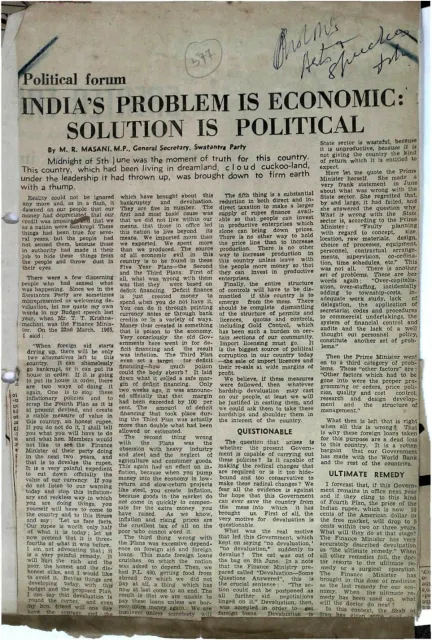
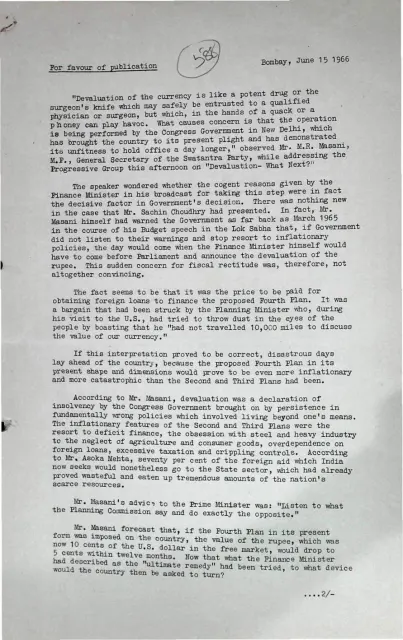
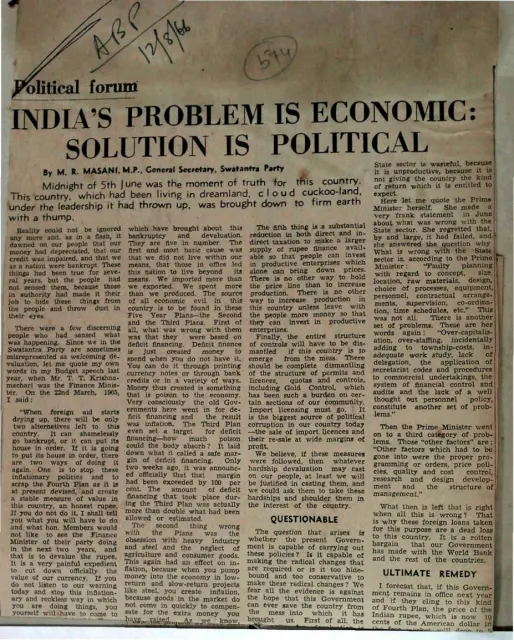
In this two-page political forum article, M. R. Masani argues that India’s immediate crisis is economic but that its remedy must be political. He attributes the crisis to prolonged fiscal irresponsibility, inflation, devaluation, excessive taxation, industrial and agricultural neglect, foreign-loan dependence, and the expansion of an inefficient state sector. The article treats the June 1966 devaluation as a moment of reckoning and criticizes the government’s Fourth Plan for pursuing unrealistic targets while diverting resources into unproductive public enterprises.
Masani’s proposed alternative is a substantial reduction in direct and indirect taxation, an end to deficit financing, restraint in public expenditure, more carefully limited foreign borrowing, dismantling of licensing and import controls, and a greater role for private investment and competition. He presents these measures as part of the Swatantra Party’s programme and concludes that economic reform depends on political change: a government willing to abandon centralized planning, reduce state monopolies, and restore public confidence in democratic institutions.
Key points
- Masani presents the June 1966 devaluation as evidence that India’s economic difficulties can no longer be concealed.
- He blames inflation, debt, deficit financing, over-taxation, and unrealistic Five-Year Plan targets for the country’s economic distress.
- The article criticizes heavy-industry priorities and the neglect of agriculture and consumer goods.
- Masani argues that foreign loans should be restricted to essential purposes and that state-sector expansion has produced waste and low returns.
- He calls for dismantling licensing, quotas, import controls, and other regulatory restrictions that obstruct productive enterprise.
- The Swatantra Party proposals include lower taxation, reduced non-development expenditure, monetary restraint, and greater reliance on private investment.
- The article links economic recovery to political change, electoral accountability, and a government prepared to reverse centralized planning.
Metadata and summary are AI-extracted from the source PDF and reviewed for editorial accuracy. The original work is available via the Read PDF tab above (where present); paragraph-level citation inside the PDF is deferred to a future engagement.